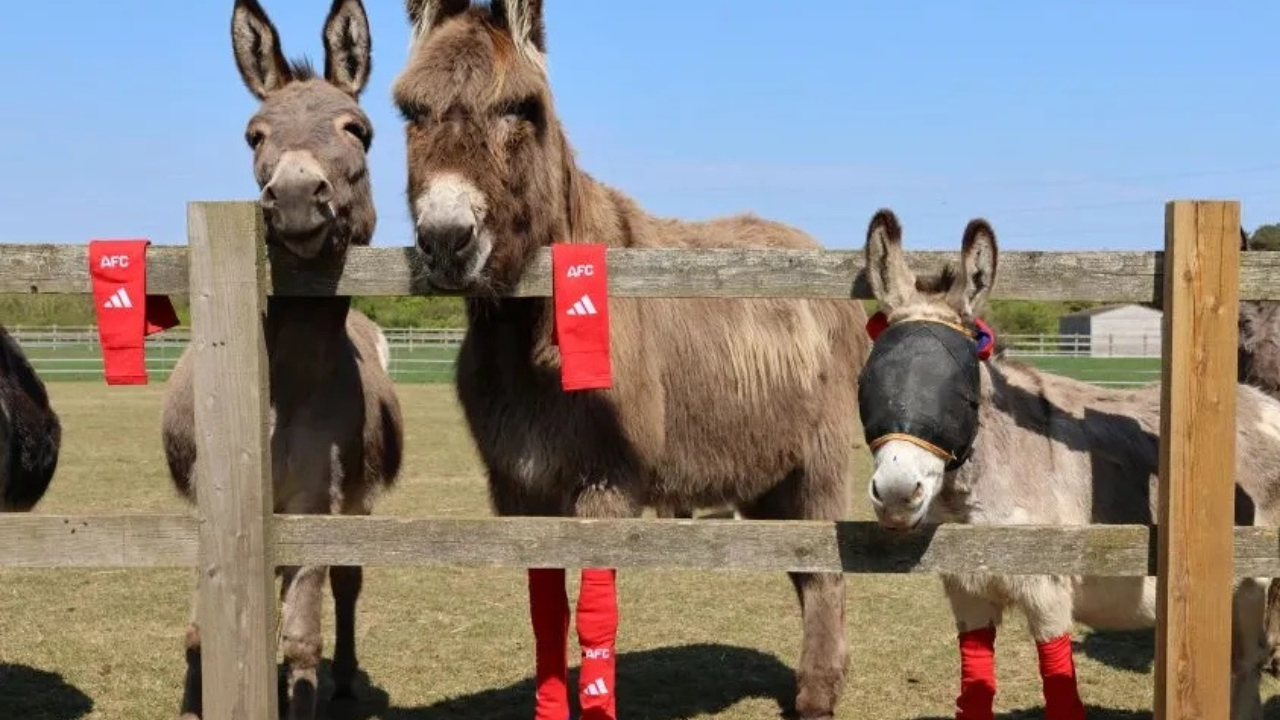
In the hyper-monetized world of Premier League football, surplus kit usually ends up in discount outlets, global charity shipments, or industrial textile shredders. However, a unique supply chain anomaly recently diverted hundreds of pairs of official Arsenal Football Club match socks away from the landfill and directly onto the legs of rescued donkeys across the United Kingdom.
While the initial social media imagery of mistreated equines wearing Arsenal's iconic red and white knitted wear struck many as a bizarre marketing stunt, the reality is rooted in veterinary necessity. Donkeys suffer severely from insect-borne skin irritation during British summer months. The club's discarded performance socks provided an immediate, highly durable barrier against aggressive midges and flies, solving a specific animal welfare challenge that traditional veterinary bandages struggled to address.
The Veterinary Crisis Behind the Viral Images
To understand why a multi-billion-pound football club's wardrobe found a second life in a sanctuary barn, one has to examine the unique physiological vulnerabilities of the domestic donkey.
Unlike horses, donkeys have a highly sensitive skin profile on their lower limbs that reacts violently to the bites of Culicoides midges, commonly known as no-see-ums. When these insects feed on the animals' legs, they trigger an intense allergic reaction called sweet itch, or insect bite hypersensitivity.
The condition creates a destructive cycle. The bites itch. The donkeys stomp their hooves and rub their legs against fences to find relief. This constant friction breaks the skin, creating open sores. The open wounds then attract larger filth flies, which lay eggs in the tissue, leading to secondary bacterial infections and severe lameness.
For sanctuary managers, managing this condition across hundreds of rescued animals is a constant battle. Traditional equine fly boots are expensive, rigid, and often slip down the leg, causing further chafing. Medical bandages require daily changing, which stresses the animals and drains staff resources.
The solution required a fabric that was breathable, tightly woven enough to block microscopic insect mouthparts, elastic enough to stay up without constricting blood flow, and tough enough to withstand mud, rocks, and constant stomping.
From the Emirates Stadium to the Muddy Paddock
Professional football clubs go through an astonishing volume of kit each season. Every player is allocated multiple fresh pairs of socks for every single match to ensure optimal compression and grip. Once a sock loses a fraction of its elasticity, or suffers a minor snag from a rogue tackle, it is retired from first-team use.
This creates a massive logistical surplus of high-performance sportswear. Arsenal’s kit management team found themselves with crates of out-of-circulation socks that were structurally sound but unfit for Premier League regulations.
When the club connected with equine welfare organizations, the utility of the modern football sock became clear.
Performance socks designed for elite athletes are engineered using advanced synthetic blends, primarily nylon, polyester, and elastane. They feature ribbed compression zones around the ankle and calf. When pulled over a donkey’s lower leg, these exact design features serve a dual purpose:
- The Ribbed Knit: Prevents the fabric from sliding down the leg as the animal walks, eliminating the need for restrictive straps or tape.
- Moisture Management: The synthetic weave wicks sweat away from the skin, preventing fungal infections that thrive under wet, dirty bandages.
- Structural Density: The tight knit creates a physical shield that midges cannot pierce, allowing existing sores to heal cleanly underneath.
Sanctuary staff simply cut the feet off the socks, transforming them into durable, washable leg sleeves.
The Logistics of Sports Waste Diversion
This unusual partnership highlights a broader issue within professional sports: the massive environmental footprint of unused or lightly used textile gear.
The modern commercial apparatus demands that clubs update their kit designs every single year. Home kits, away kits, third kits, and training wear all undergo annual redesigns to keep merchandise sales flowing. Consequently, millions of pieces of specialized athletic clothing become obsolete overnight.
While some clubs have established pathways to donate old kits to youth sports programs in developing nations, these initiatives often focus exclusively on shirts and shorts. Socks are rarely included due to hygiene perceptions and the fact that they wear out faster in the foot area than other garments.
By targeting the leg portion of the sock for animal care, the sanctuary model bypasses the hygiene issue entirely. It offers a blueprint for how professional sports franchises can rethink their waste streams.
The Financial Reality of Animal Sanctuaries
Welfare charities operate on razor-thin margins, especially during periods of economic instability when public donations fluctuate wildly. The cost of specialized veterinary supplies can cripple a sanctuary's operating budget.
A standard set of four commercial equine fly boots can cost anywhere from £40 to £80. Given that donkeys routinely destroy these items through daily wear and tear in communal fields, a large sanctuary could easily spend thousands of pounds per month just on leg protection.
The influx of donated Arsenal socks effectively eliminated this line item for the participating sanctuaries. The durability of premier-grade athletic gear means these improvised sleeves can be washed and reused dozens of times, representing a significant indirect financial injection for the charities involved.
Limitations of the Footie Sock Remedy
Despite the success of the initiative, veterinary professionals note that utilizing sportswear for animal care is an improvised workaround rather than a flawless medical cure.
Staff must monitor the donkeys constantly to ensure the elastic compression elements do not restrict circulation. If a sock gets wet from heavy rain or deep mud, it must be changed immediately to prevent skin maceration, where the tissue softens and breaks down due to prolonged exposure to moisture.
Furthermore, this solution relies entirely on the unpredictable surplus of professional sports teams. It is not a scalable manufacturing model for global animal welfare. It remains a localized, brilliant bit of lateral thinking that solves an immediate problem using the excess waste of a multi-billion-pound entertainment industry.