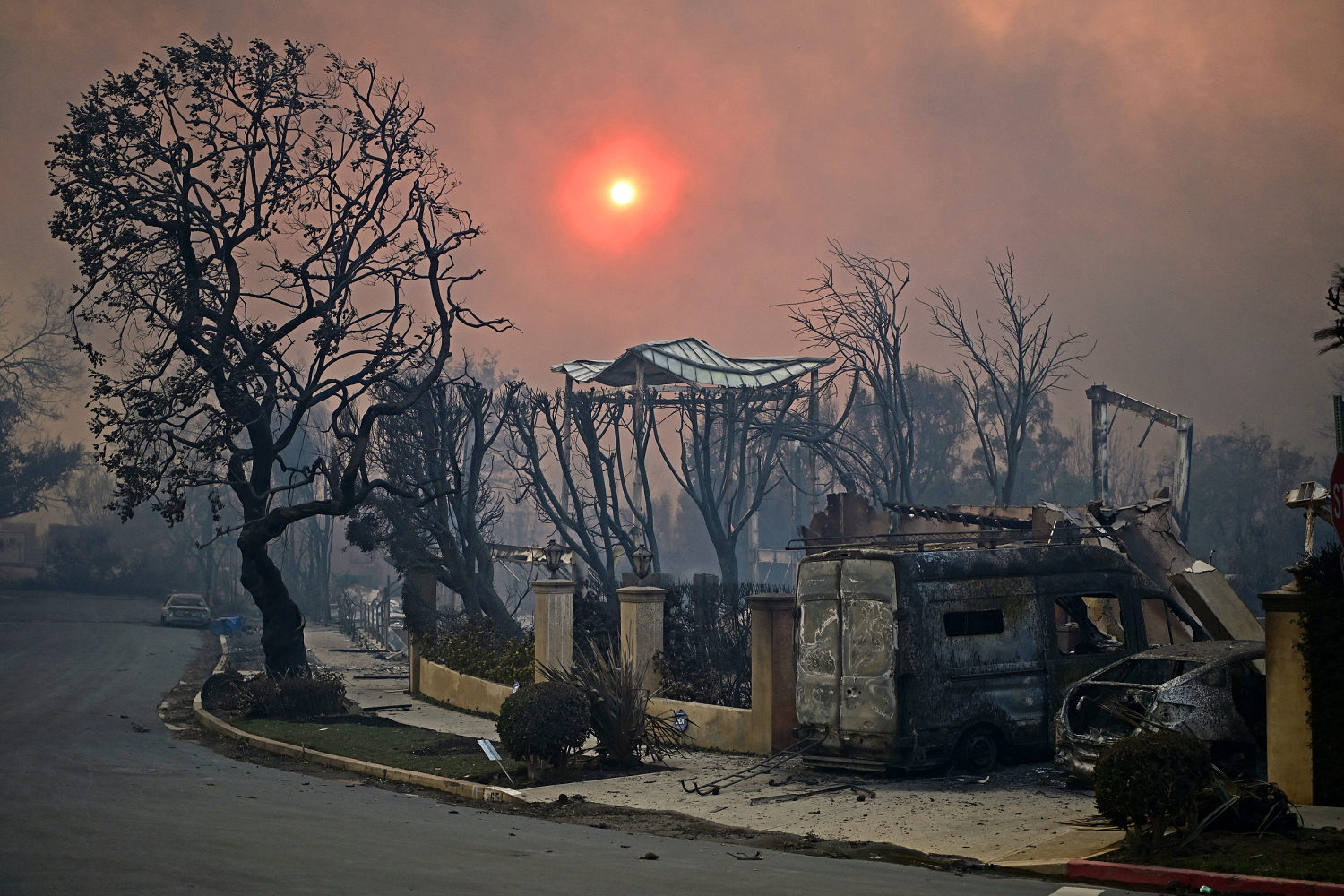
The verdict is in, the handcuffs are locked, and Los Angeles officials are already patting themselves on the back. A jury found a man guilty of starting the deadly Palisades Fire, giving city leaders, insurance executives, and media pundits the exact villain they needed to close the book on a catastrophe.
They got their scapegoat. Now they can safely ignore why the fire actually turned into an apocalypse.
Mainstream coverage treats a criminal conviction like a systemic solution. The standard narrative goes like this: a bad actor lit a match, heroic firefighters battled impossible odds, justice was served in a courtroom, and the community can now heal. That storyline is comforting, tidy, and dangerously false. When a single spark incinerates thousands of structures and claims lives in a coastal canyon, the spark is the least interesting part of the story.
Sparks are inevitable in Southern California. Dry lightning strikes. Transformers blow. Catalytic converters throw hot metal onto dry brush. Campfires escape. Arsonists strike. Treating human ignition as the primary root cause of a mega-fire is like blaming gravity when a poorly engineered bridge collapses. Gravity is a constant. So is fire in the Santa Monica Mountains.
The Ignorance of the Ignition Obsession
Every major wildfire news cycle follows a predictable script. Reporters obsess over the point of origin. Investigators spend months sifting through ash for a discarded cigarette butt, a frayed power line, or an accelerant trail. Once the culprit is identified—whether it is a negligent utility company or a lone arsonist—public outrage funnels entirely toward punishment.
I have spent years consulting on urban-wildland risk and reviewing post-fire forensic engineering reports across California. The pattern never changes. Municipalities spend millions prosecuting individual liability while approving the exact same zoning variances that turned the neighborhood into a tinderbox in the first place.
An ignition source only dictates when a fire starts. It has zero influence over how fast that fire spreads, how hot it burns, or how many homes it destroys. Those variables are determined years before anyone strikes a match. They are decided in city council chambers, planning commission hearings, and insurance underwriting offices.
To understand why the Palisades Fire turned deadly, you have to separate ignition from conflagration.
- Ignition is a localized combustion event. It requires heat, fuel, and oxygen at a microscopic scale. In Southern California's Mediterranean climate, fine fuels like dead annual grasses reach critical dryness every single summer and autumn. Ignition is statistically guaranteed over a long enough timeline.
- Conflagration is a self-sustaining firestorm capable of generating its own weather, throwing embers miles ahead of the main front, and overwhelming municipal water systems. Conflagration requires continuous fuel loads, extreme wind vectors, and vulnerable structural targets packed tightly together.
When a prosecutor proves beyond a reasonable doubt that one man started the Palisades Fire, they have only explained the first ten seconds of a multi-day disaster. They have explained nothing about the subsequent seventy-two hours.
The Physics of the Santa Ana Trap
The Santa Monica Mountains are biologically engineered to burn. Native chaparral ecosystems—dominated by greasewood, manzanita, and coastal sage scrub—do not merely tolerate high-intensity crown fires; they depend on them for regeneration. These plants produce volatile, oil-rich resins that ignite explosively when moisture levels drop below critical thresholds.
Combine that botanical reality with the meteorology of the Los Angeles basin. Between October and March, high-pressure systems over the Great Basin push dry, desert air toward the coast. As this air drops down the elevation gradient of the mountain passes, it compresses and heats up adiabatically. By the time those Santa Ana winds funnel through the steep topography of Pacific Palisades, relative humidity plunges into the single digits and gusts regularly exceed sixty miles per hour.
Under those conditions, fire behavior completely decouples from human suppression efforts.
No fire department on earth can stop a wind-driven crown fire in steep canyon terrain once it achieves momentum. Water drops from helicopters evaporate in the superheated air column before reaching the canopy. Fire hydrants lose pressure as hundreds of residents leave sprinklers running while evacuating, or as burning homes rupture domestic water pipes. Spot fires ignite a mile ahead of the containment line via ember cast.
Yet, year after year, we build luxury subdivisions directly inside these wind tunnels. We pave two-lane winding roads that act as bottlenecks during mass evacuations. We landscape multi-million-dollar estates with non-native eucalyptus, juniper, and palm trees—species that act like Roman candles when hit by wind-blown embers.
Then, when an arsonist lights a fire at the bottom of a canyon during a Red Flag Warning, we act shocked that the hillside burned down.
What People Actually Get Wrong About Wildfire Prevention
If you look at public discourse following a major conviction, the public asks predictable questions. They want to know how to catch arsonists faster, how to stiffen prison sentences, and how to clear more brush around the hills. Every single one of those instincts misses the mark.
Does harsher punishment deter wildfire arson?
No. Criminological research from the U.S. Forest Service and behavioral psychologists consistently shows that wildland arsonists fall into distinct typologies—ranging from thrill-seekers and individuals experiencing acute psychiatric crises to vagrant negligence. Almost none of them perform a rational cost-benefit analysis of California Penal Code sentencing guidelines before flicking a lighter. Locking one man away for life brings emotional closure to victims, which matters deeply, but it does zero to reduce the statistical probability of another human-caused ignition next October.
Can we just clear-cut the mountains to stop fires?
This is the favorite talking point of developers and frustrated homeowners, and it backfires catastrophically. Aggressive, wide-scale brush clearance in coastal chaparral destroys native root systems that hold steep, unstable slopes together—setting the stage for lethal mudslides during winter rains. Worse, cleared chaparral does not stay bare dirt. It rapidly converts into invasive non-native grasslands. While mature chaparral requires intense heat to ignite, flash fuels like dry invasive cheatgrass ignite effortlessly from a single spark and carry flames ten times faster than native brush.
Do firebreaks and perimeter lines save neighborhoods?
Not during wind-driven events. Bulldozed dirt lines stop slow-moving ground fires. They are completely useless against ember blizzards. Post-fire analyses conducted by the Insurance Institute for Business & Home Safety (IBHS) prove that up to ninety percent of homes lost in major wildfires are not consumed by a wall of advancing flames. They are ignited by wind-blown embers landing in roof gutters, blowing through attic vents, or catching dry mulch piled against wood siding.
The Structural Reality Nobody Wants to Fund
If we actually wanted to prevent another deadly Palisades Fire, the conversation would shift immediately from criminal justice to building codes and urban planning.
Right now, California maintains a bizarre regulatory double standard. New construction in designated Very High Fire Hazard Severity Zones must comply with Chapter 7A of the California Building Code, which mandates ignition-resistant roofing, ember-resistant vents, and tempered multi-pane glass. Those rules work. Data from recent California fires shows that homes built to modern Chapter 7A standards survive at dramatically higher rates than older structures sitting right next to them.
The problem is that the vast majority of homes in coastal Los Angeles were built decades before those codes existed.
Walking through older canyon neighborhoods is an exercise in watching thousands of unmitigated vulnerabilities waiting for a breeze. Shake-shingle roofs, unscreened soffit vents, single-pane windows, wooden decks cantilevered over brush-choked ravines, and zero-lot-line spacing where one burning house radiates enough heat to spontaneously combust the neighbor's wall twenty feet away.
Retrofitting an entire neighborhood is expensive, politically unpopular, and deeply unsexy. You cannot hold a triumphant press conference about mandating one-eighth-inch metal mesh over attic vents. You do not get viral headlines by forcing homeowners to remove combustible hedges within five feet of their exterior walls—a zone fire scientists call Zone 0, the single most critical defensive buffer on any property.
Instead, politicians offer theatrical solutions. They announce task forces. They praise prosecutors. They demand state regulators force insurance companies to keep underwriting policies at artificially suppressed rates that hide the true actuarial cost of living in a fire corridor.
The Insurance Subsidy Trap
Let's talk about the elephant in the room: homeowners insurance.
When major insurers pulled back from writing new policies in high-risk Los Angeles zip codes, residents and politicians screamed foul. They framed it as corporate greed abandoning loyal customers. The state intervened through the California FAIR Plan, the insurer of last resort, effectively socializing catastrophic wildfire risk across the broader market.
Here is the uncomfortable truth: insurance prices are data signals. When an actuary looks at a canyon home with a single access road, aging infrastructure, and extreme wind exposure, and quotes an astronomical premium, that number is not an arbitrary punishment. It is a mathematical translation of physical reality.
By artificially suppressing insurance premiums through regulation, the state removes the single strongest financial incentive for homeowners and municipalities to harden their properties. If a homeowner pays the exact same rate whether they have a Class A fire-rated roof and a cleared Zone 0 perimeter or a cedar-shake roof surrounded by dry pine needles, they will not spend forty thousand dollars on retrofits.
Why Contrarian Resilience Comes With Real Pain
Admitting that we cannot eliminate ignitions—and that our current approach to wildfire defense is broken—forces us into trade-offs that nobody in Los Angeles wants to accept. If I were handed unilateral authority over wildfire policy tomorrow, the immediate steps would trigger lawsuits, plummeting property values, and fierce neighborhood revolts.
- Enforce mandatory Zone 0 compliance with teeth. Every structure in a high-hazard zone gets twenty-four months to remove all combustible material—plants, mulch, wood fencing, patio furniture—within five feet of the foundation. Non-compliance results in daily municipal fines and immediate revocation of eligibility for state-backed insurance pools. Yes, it ruins lush garden aesthetics. It also stops houses from burning down.
- Halt residential infill in single-egress canyons. If a neighborhood only has one road in and one road out, adding density is negligent homicide waiting for a windy day. Downzone vacant lots in extreme fire corridors and use municipal bond funds to buy out the most vulnerable bottleneck properties.
- Tie insurance rates strictly to parcel-level mitigation. Allow insurers to price risk accurately while mandating transparent discounts for verified structural hardening. If you want to live in a scenic canyon surrounded by flammable brush, you pay the real actuarial freight—not your neighbor living in a concrete condo ten miles inland.
- Underground distribution lines selectively, not universally. Burying every power line in California costs billions and takes decades. Focus undergrounding budgets exclusively on high-wind canyon corridors where overhead lines historically trigger fires during peak Santa Ana events, and install fast-tripping protective relays everywhere else.
There are massive downsides to this approach. Property values in iconic coastal enclaves would drop sharply overnight. Working-class and middle-income families who inherited older canyon homes could be priced out by mandatory retrofit costs unless paired with aggressive, means-tested state grant programs. Real estate developers, local chambers of commerce, and neighborhood associations would fight every measure tooth and nail.
Even with total compliance, extreme weather will still overwhelm defenses occasionally. Mother Nature always holds the trump card in the Santa Monica Mountains.
Stop Celebrating the Verdict
A guilty verdict in the Palisades Fire trial gives grieving families a measure of accountability, and the perpetrator deserves every day of the sentence he receives. Criminal justice has a vital moral function in society.
Do not confuse moral accountability with physical safety.
The dry winds are already building in the Great Basin. The chaparral on the hillsides above Pacific Coast Highway is drying out under the California sun. Millions of residents still live behind unscreened vents, under aging roofs, at the ends of narrow, winding roads.
Putting one man in prison did not remove a single ton of fuel from those canyons. It did not widen a single evacuation route. It did not harden a single home. The match is locked in an evidence room, and the powder keg is still sitting wide open.