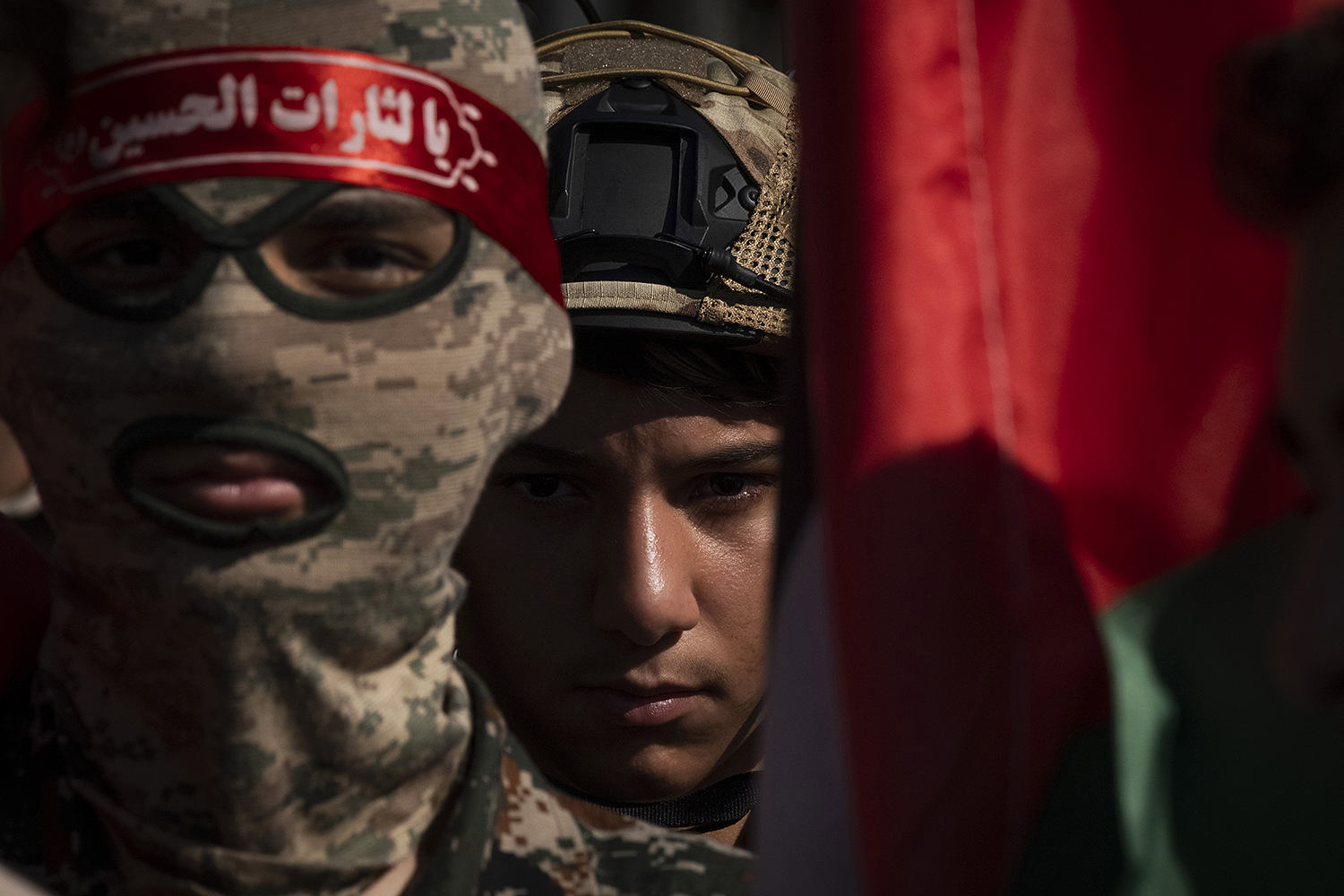
The structural mechanics of modern statecraft rely on verifiable signal transmission. When state actors issue public declarations regarding asymmetrical capabilities or diplomatic openings, analysts must isolate domestic political signaling from actual shifts in strategic calculus. The ongoing standoff between Washington and Tehran provides a case study in how deterrence pricing, nuclear threshold management, and proxy network logistics interact under conditions of high friction.
Evaluating this dynamic requires stripping away rhetorical posturing to examine the underlying structural constraints governing both administrations.
The Asymmetry of Deterrence and New Weapon Claims
Recent warnings from the Islamic Revolutionary Guard Corps regarding the introduction of novel capabilities and unattacked targets must be categorized through the lens of cost imposition. In military doctrine, an actor losing conventional parity compensates by raising the projected cost of escalation for the adversary.
- The Cost-Imposition Vector: By threatening novel vectors, Tehran attempts to widen the operational surface area that United States and allied defense planners must protect, particularly concerning maritime choke points and regional basing infrastructure.
- The Domestic Signaling Loop: Concurrently, statements broadcast by senior Iranian security officials serve an internal audience, reinforcing regime resilience following significant kinetic exchanges and degraded industrial bases.
Washington handles this through a dual-track strategy: maintaining maximum economic pressure and military readiness while intermittently testing diplomatic pathways. However, structural distrust creates a high-friction environment where preliminary diplomatic contact is routinely dismissed or labeled as fabrication by factional rivals within Iran's clerical apparatus.
The Nuclear Threshold and Institutional Inertia
The core friction point remains the status of enriched material and the integrity of the nuclear industrial complex. From an analytical perspective, a regime facing existential pressure treats its nuclear threshold as the ultimate strategic insurance policy.
The structural variables governing this posture break down into three distinct components:
- Verification Deadlocks: The International Atomic Energy Agency faces continuous access restrictions, transforming verification into an ongoing intelligence deficit.
- Pre-conditions as Negotiating Ceilings: Tehran’s insistence on a formal ceasefire and the removal of specific economic sanctions before substantive dialogue begins functions as a structural barrier. It prevents asymmetrical concessions under duress.
- The Multilateral Dimension: Wider geopolitical actors, including Moscow and Beijing, maintain distinct equities in the region, preventing any monolithic international consensus on enforcement or compliance.
When United States leadership asserts that large portions of the adversary's nuclear infrastructure have been compromised, while domestic security councils concurrently vow to retain enriched material, the bargaining space collapses. Neither side can alter its baseline red lines without signaling vulnerability to domestic constituencies.
Economic Leverage Versus Regional Posture
Sanctions and economic containment operate on the assumption that financial constriction will force a strategic re-evaluation in Tehran. Yet, historical data across multiple administrations demonstrates that highly insulated authoritarian systems absorb economic shocks by redirecting trade through secondary corridors and tightening internal security controls.
The anticipated diplomatic meetings, whether floated via intermediaries in Qatar or discussed on the margins of multilateral summits, often founder on the absence of a mutually hurting stalemate. For a meeting to produce structural agreements rather than temporary tactical pauses, both parties must calculate that the status quo is more expensive than the concessions required for a settlement. Current intelligence suggests neither side has reached that tipping point.
Strategic Outlook
The trajectory of the standoff depends on the friction coefficients of maritime security in the Persian Gulf and the unmonitored advancement of enrichment programs. If diplomatic channels remain closed due to irreconcilable pre-conditions, the baseline equilibrium will default to low-intensity maritime skirmishes, continuous cyber friction, and periodic targeted strikes. Strategic calculus indicates that sustainable de-escalation is impossible without a redefinition of security guarantees that satisfies regime survival metrics on one side and non-proliferation mandates on the other.