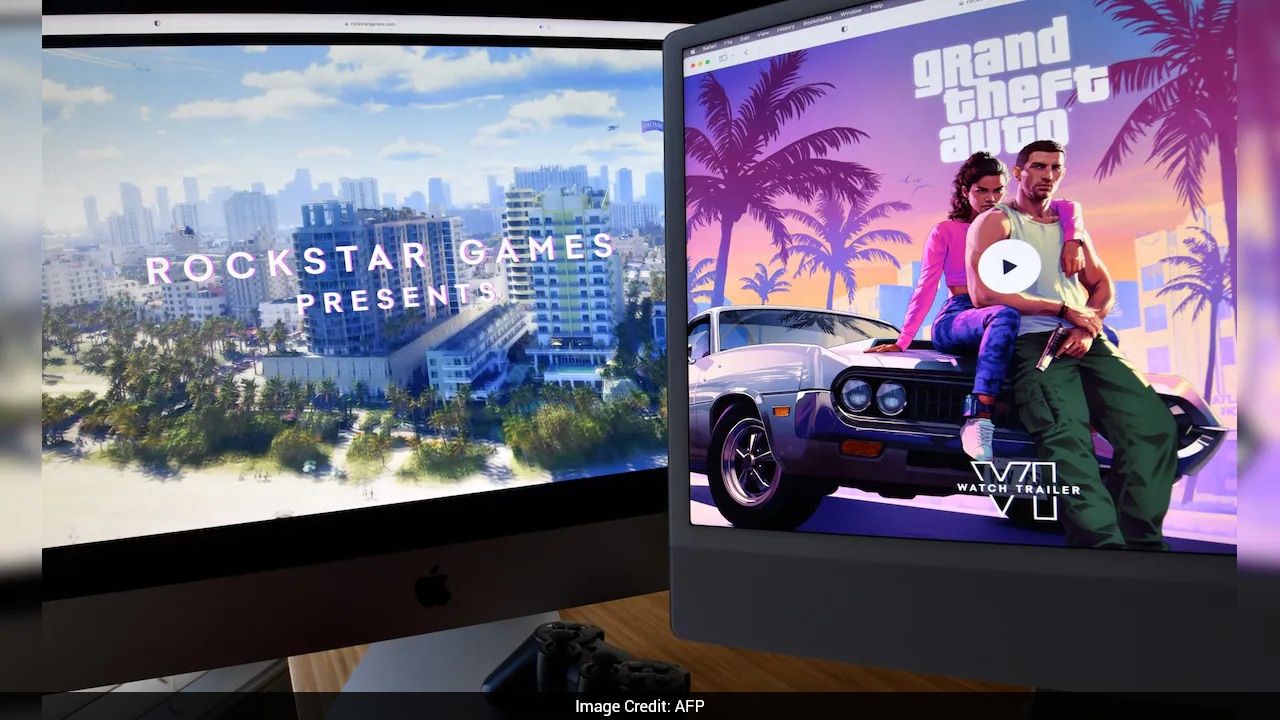
Calling the launch of Grand Theft Auto VI the "moon landing" of gaming is an insult to Apollo 11 and a hallucination born in a PR agency.
Every decade, the video game press suffers a collective bout of amnesia. They mistake a massive capital expenditure for a technological leap. They confuse a clever rolling-midnight timezone release with a historic human achievement. And when Australian players boot up their consoles a few hours before the rest of the Western world, the media treats a standard UTC+10 timezone advantage like Neil Armstrong stepping onto the Sea of Tranquility.
It is lazy. It is historically illiterate. And it completely misses what is actually happening beneath the neon-soaked surface of Vice City.
I have spent fifteen years dissecting AAA production pipelines, tracking console attach rates, and watching publishers burn nine-figure budgets on hype cycles that collapse under their own weight. When a product is hyped as a singular, civilization-altering monolith, the reality is almost always a masterclass in conservative risk management disguised as rebellion.
Grand Theft Auto VI is not a giant leap for mankind. It is the ultimate triumph of industrial-scale iteration, regulatory arbitrage, and weaponized nostalgia.
The Timezone Illusion and the Myth of the "First" Player
Let us dismantle the geographic novelty first. The narrative that Australians are "first to play" is a cute piece of consumer-facing fluff, nothing more.
Digital distribution operates on regional storefront clocks. Because New Zealand (UTC+12/13) and eastern Australia (UTC+10/11) hit midnight before London, New York, or Los Angeles, their local PlayStation and Xbox servers unlock the decryption keys first. For twenty years, hardcore players in North America and Europe have bypassed this by simply setting their console regions to Auckland or Sydney.
There is no competitive advantage here. There is no server-first world boss race. GTA VI launches as a single-player narrative experience first, with its online component staggered or gated to prevent the exact kind of infrastructure meltdown that crippled GTA Online in October 2013.
When outlets frame Australian midnight queues as a historic vanguard, they are doing free regional marketing for Take-Two Interactive. They are manufacturing scarcity and urgency around a digital file that will be infinitely replicable across tens of millions of SSDs within seventy-two hours.
Why the "Moon Landing" Metaphor Fails Every Technical Test
To understand why the moon landing comparison is nonsense, you have to understand what Grand Theft Auto actually is under the hood.
Apollo 11 required inventing guidance computers, materials science, and orbital mechanics from scratch under a ticking clock. Rockstar Games, conversely, is the undisputed king of iterative engine refinement.
The Rockstar Advanced Game Engine (RAGE) has been evolving since Rockstar Games Presents Table Tennis in 2006. Every milestone—GTA IV, Red Dead Redemption, GTA V, Red Dead Redemption 2—has been a brick laid atop the exact same architectural foundation.
- Physics and Animation: Rockstar relies heavily on NaturalMotion’s Euphoria engine for procedural animation. They did not invent a new way to render human movement for Vice City; they scaled up the blend-trees, increased bone counts, and fed more motion-capture data into an existing pipeline.
- World Density: What players are actually seeing in the Leonida state map is an optimization triumph, not a paradigm shift. Streaming high-resolution textures and dense NPC schedules off NVMe SSDs is standard practice across the ninth console generation. Rockstar simply has the budget to pay three thousand developers across global studios (Rockstar North, San Diego, India, Toronto, New England) to hand-craft more assets than any competitor can afford.
- Artificial Intelligence: Despite breathless rumors of revolutionary generative AI NPCs, AAA console hardware—specifically the AMD Zen 2 CPUs inside the PlayStation 5 and Xbox Series X—cannot run local large language models alongside a massive open-world simulation without tanking frame rates. What you are experiencing is deeply nested, state-machine scripting. It is brilliant illusionism, not artificial general intelligence.
Calling this a moon landing confuses scale with innovation. A skyscraper with two hundred floors uses the same structural steel principles as a skyscraper with fifty floors. It just requires more money, more cranes, and more time.
The Australian Ratings Paradox Nobody Wants to Talk About
There is a massive, glaring irony in celebrating Australia as the launchpad for GTA VI.
Australia possesses one of the strictest, most paternalistic media classification regimes in the Western world. For decades, the Australian Classification Board has delayed, censored, or outright banned video games—including previous Rockstar titles. Grand Theft Auto III was temporarily pulled from shelves in 2001. Grand Theft Auto: San Andreas had its rating revoked in 2005 over the "Hot Coffee" mod. Even GTA V sparked major retail boycotts by Target and Kmart across the country in 2014 over depictions of violence against women.
To ship GTA VI simultaneously on day one in Sydney and Melbourne without an "RC" (Refused Classification) bottleneck, Rockstar had to thread a very specific regulatory needle.
This is the nuance the cheerleaders ignore. When a cultural product costs upwards of a billion dollars to develop and market, it cannot afford to be genuinely subversive. It has to pass compliance checks in Canberra, Berlin, Tokyo, and Washington simultaneously.
The satire in GTA VI—mocking Florida Man headlines, influencer culture, and social media brain-rot—is sharp, funny, and utterly safe. It punches at targets everyone already agrees are ridiculous. Real transgression gets your game banned in Australia and pulled from digital storefronts. Corporate satire gets you an R18+ rating and a midnight launch party at EB Games.
Answering the Questions Players Are Actually Asking
When hype reaches a fever pitch, consumers start asking the wrong questions because the press feeds them the wrong framing. Let us strip away the PR noise and look at the real friction points.
Is GTA VI worth buying a new console for right now?
No—unless you enjoy paying an early-adopter tax for 30 frames per second.
Rockstar’s historical release pattern is unambiguous. They target maximum visual fidelity at 30fps on base console hardware, release the PC version twelve to eighteen months later, and then sell you a 60fps "enhanced" edition on the next console generation. If you buy a base console strictly for this game, you are paying full price to beta-test the lowest-performing version of the software. Wait for the PC release or the inevitable mid-gen hardware patches if frame pacing matters to you.
Will GTA VI save the struggling video game industry?
It will do the exact opposite.
Publishers and investors are praying that GTA VI acts as a rising tide that lifts all boats. In reality, massive cultural black holes suck oxygen out of the room. When tens of millions of players spend $70 to $100 on a single game and sink three hundred hours into its ecosystem, they stop buying mid-tier releases. Competing publishers have spent the last two years frantically clearing their release calendars just to avoid being crushed in Take-Two’s wake. A single monopoly-scale hit does not fix broken studio economics, bloated headcounts, or unsustainable development timelines; it just masks the rot on quarterly earnings calls.
Why did GTA VI take over a decade to make?
Because live-service monetization made making a sequel financially irrational until now.
Stop romanticizing the "artistic perfectionism" of a thirteen-year gap between GTA V and GTA VI. Between 2001 and 2013, Rockstar released GTA III, Vice City, San Andreas, GTA IV, and GTA V—five mainline entries in twelve years. The pipeline slowed to a crawl for one reason: GTA Online generated billions of dollars in high-margin recurring revenue via Shark Cards. Why spend $500 million building a new city when selling virtual flying motorcycles in Los Santos prints money at a fraction of the overhead? GTA VI only exists because the GTA V player base finally hit demographic saturation.
The Strategic Reality: What Developers and Investors Should Actually Watch
If you work in software, entertainment, or capital allocation, do not look at the midnight launch queues in Melbourne. Look at the unit economics.
1. The Death of the Fixed Price Ceiling
For years, publishers tried to break the $70 barrier without triggering a consumer revolt. GTA VI is the battering ram. Through tiered editions, early-access bundles, and immediate integration with subscription layers like GTA+, Take-Two is effectively testing the upper limits of price elasticity in mass-market entertainment. Watch the attach rate on the $100+ editions; if it crosses 35%, every major publisher will abandon the $70 standard within two fiscal years.
2. User-Generated Content as the Real Endgame
The single-player campaign in Vice City is an expensive loss-leader—a massive billboard designed to funnel players into the persistent online world. Rockstar’s acquisition of Cfx.re (the team behind the massive FiveM and RedM roleplay modding communities) was the most telling business move of the decade. They realized they do not need to build every mission themselves. By turning GTA VI into a moderated platform for creator-made servers and roleplay economies, Take-Two is pivoting from a game developer into a tax-collecting digital landlord.
3. The Consolidation Trap
I have seen studios blow tens of millions of dollars trying to build "GTA killers" (Saints Row, Watch Dogs, Cyberpunk 2077 at launch, Mafia III). Every single one failed because they tried to match Rockstar’s scope without Rockstar’s balance sheet. The lesson of GTA VI is not to build bigger open worlds. It is to abandon the open-world arms race entirely. Smaller, high-craft, mechanically distinct games with five-year development cycles beat bloated, ten-year behemoths every time on return on invested capital.
The Caveat to My Cynicism
Let us be brutally fair here. Dismissing the hype does not mean dismissing the craft.
There is a legitimate downside to viewing GTA VI purely through a cold, corporate lens: you miss the genuine magic of collective cultural experiences. Very few pieces of media still command simultaneous global attention in an era of fragmented TikTok algorithms and niche streaming bubbles.
When millions of people across Sydney, London, and New York share the exact same digital geography on the exact same weekend—discovering the same radio stations, arguing over the same plot twists, breaking the same physics engine—that shared consciousness has real cultural value. Rockstar remains one of the only studios on earth capable of executing environmental storytelling at a microscopic level while maintaining macroscopic coherence. Their attention to ambient audio, lighting transitions, and satiric detail is unmatched.
You can admire the cathedral while acknowledging the brutal economics that built it.
Stop Worshipping the Hype Cycle
If you are planning to play Grand Theft Auto VI, do it because you want a richly detailed crime sandbox to unwind in after work. Do it because Rockstar knows how to pace a heist mission better than anyone in the business.
Just stop calling it a moon landing.
Apollo 11 expanded the boundaries of human capability and took us to another world. Grand Theft Auto VI is an exceptionally expensive, brilliantly engineered video game that takes us back to a fictionalized version of Miami we already visited in 2002.
Enjoy the game. Buy the digital download. Ignore the breathless headlines. And keep your wallet closed when the microtransactions go live.