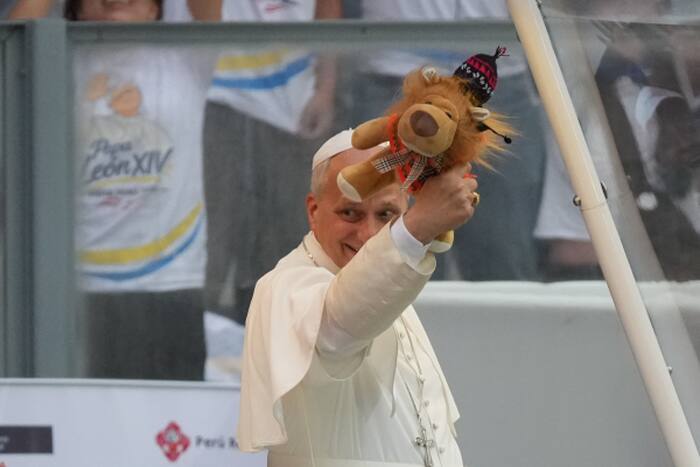
Standard reporting on the papal return to Chiclayo frames the event as a sentimental homecoming between a former bishop and a devout local population. That framing misses the institutional mechanics at play. When Pope Leo XIV—formerly Cardinal Robert Francis Prevost, Bishop of Chiclayo—returned to northern Peru, the event functioned as a calculated deployment of soft power, a validation of localized pastoral governance, and a strategic recalibration of the Catholic Church's demographic center of gravity. Emotional displays in the Plaza de Armas are not merely spontaneous expressions of piety; they are the visible output of a multi-year institutional investment in social capital, crisis management, and decentralized clerical authority.
To understand the operational significance of this visit, we must strip away the hagiographic language of local press coverage and analyze the event through three distinct lenses: institutional legitimacy transfer, regional geopolitical signaling, and the economics of religious tourism and civic infrastructure.
The Architecture of Institutional Legitimacy
Religious institutions operate on trust networks that require periodic physical reinforcement. When a former diocesan bishop ascends to the papacy and subsequently returns to his prior jurisdiction, the institutional dynamic shifts from hierarchical command to reciprocal validation.
The Three Pillars of Local Social Capital
Prevost's tenure in Chiclayo from 2015 to 2023 established the baseline conditions for the reception observed during his return. Standard narratives describe this as "love" or "affection." In organizational terms, this represents accumulated social capital built through three operational mechanisms:
- Crisis-Response Presence: During the 2017 El Niño Costero floods and the subsequent COVID-19 pandemic, the Diocese of Chiclayo functioned as an auxiliary logistical network where state capacity failed. By mobilizing Caritas networks for oxygen distribution and infrastructure relief, the diocese converted spiritual authority into tangible material survival. When the institution saves lives during state failure, loyalty becomes structural rather than merely doctrinal.
- Administrative Integration: Unlike clerical appointments characterized by top-down decrees from Lima or Rome, the Chiclayo model emphasized parish-level autonomy and lay leadership integration. This decentralized governance model reduced friction between the episcopate and rural or peri-urban communities in the Lambayeque region.
- Linguistic and Cultural Fluency: Operating in the local vernacular and adopting regional administrative norms eliminated the "foreign prelate" friction that frequently undermines Vatican appointments in Latin America.
The return visit monetizes this accumulated capital at a global scale. By validating Chiclayo, the papacy validates a specific blueprint for episcopal governance: hands-on, crisis-responsive, and deeply embedded in local socioeconomic realities.
The Mechanics of Legitimacy Transfer
In institutional theory, legitimacy flows downward through office and upward through popular acclaim. The Chiclayo reception creates a closed feedback loop:
- Upward Flow: The massive mobilization of northern Peruvians signals to the Roman Curia and global church stakeholders that the pontiff commands authentic grassroots authority, insulating him from internal bureaucratic resistance.
- Downward Flow: By elevating a secondary Peruvian coastal city to the global stage, the Vatican confers immediate prestige and political leverage onto the Peruvian Episcopal Conference and local civic authorities.
Geopolitical Signaling in the Global South
A papal itinerary is never accidental. Every destination represents a deliberate allocation of scarce diplomatic attention. Choosing Chiclayo over—or alongside—traditional Latin American power centers like Lima, Bogotá, or Buenos Aires sends three clear geopolitical signals.
1. Decentralizing the Catholic Periphery
For decades, the Vatican's pivot toward the Global South focused on major metropolitan hubs or historically symbolic sites like Cusco and Aparecida. Chiclayo is an agro-industrial and commercial hub, often overlooked in favor of Lima's political apparatus or Cusco's historical tourism profile. Elevating Chiclayo demonstrates that the institutional center of the Catholic Church is no longer anchored in European capitals or even Latin American megacities, but in mid-sized, working-class dioceses where demographic growth and religious practice remain resilient against secularization.
2. Navigating Peruvian Political Instability
Peru has experienced chronic executive turnover, congressional gridlock, and severe erosion of public trust in democratic institutions over the past decade. In environments characterized by state fragility, the Catholic Church frequently acts as a stabilizing civil-society counterweight.
A high-profile papal presence in northern Peru bypasses the polarized political theater of Lima while reinforcing social cohesion at the regional level. The Vatican avoids direct entanglement with specific political factions while reminding the Peruvian state of the Church's unmatched capacity to mobilize the populace. This creates a subtle deterrent against state policies that might infringe upon ecclesiastical autonomy or social welfare partnerships.
3. Countering Evangelical Expansion
Northern Peru, like much of coastal and Amazonian Latin America, has seen sustained demographic competition from Pentecostal and neo-Pentecostal movements. These groups succeed largely through hyper-local community building and immediate social support networks.
The papal visit to Chiclayo functions as a strategic counter-offensive. By showcasing a pope who personally walked the muddy streets of Lambayeque during flood seasons, the Catholic hierarchy directly neutralizes the evangelical critique that Rome is distant, aristocratic, and disconnected from the daily struggles of working-class families. The message is operational: the universal institution is accessible at the hyper-local level.
The Cost Function and Civic Infrastructure Impact
Beyond theology and geopolitics, a papal visit is a massive logistical shock to a mid-sized city. Chiclayo's urban infrastructure—characterized by congested transit corridors, strained municipal sanitation, and uneven hospitality capacity—was forced to absorb a sudden influx of domestic and international pilgrims, media crews, and state security personnel.
Short-Term Municipal Strain vs. Long-Term Capital Investment
Local reporting celebrates the economic windfall of full hotels and booming street commerce. A rigorous cost-benefit analysis reveals a more complex fiscal reality for the Lambayeque regional government:
- Immediate Expenditure: Security deployments, crowd-control barriers, temporary sanitation facilities, and emergency medical staging require immediate municipal outlay. In regions with low tax-collection efficiency, these costs frequently cannibalize funds earmarked for routine public works.
- Accelerated Infrastructure Maintenance: Papal visits force central governments to release stalled funds for road paving, airport terminal upgrades (such as improvements at Cap. FAP José A. Quiñones Gonzáles International Airport), and public lighting. The visit acts as an external forcing mechanism that overcomes bureaucratic inertia in Lima's transport and housing ministries.
- Informal Sector Capture: While formal hotels and airlines capture high-margin international revenue, the majority of local economic activity occurs within Chiclayo's vast informal economy—street vendors, unregulated transport, and informal lodging. This generates immediate household liquidity for low-income residents, though it yields minimal direct tax revenue for the municipality.
The Sustainability Bottleneck of Religious Tourism
Civic leaders routinely project that a papal visit will transform a city into a permanent international pilgrimage destination. Empirical evidence from previous papal stops in secondary cities suggests this outcome is far from guaranteed.
Sustaining religious tourism requires permanent institutional infrastructure: curated heritage routes, multilingual hospitality standards, reliable regional air connectivity, and continuous marketing budgets. Without post-visit capital allocation, the "papal bump" follows a steep decay curve, reverting to baseline domestic tourism within 12 to 18 months. Chiclayo possesses strong culinary and archaeological assets (such as the Royal Tombs of Sipán), yet these remain disconnected from a cohesive ecclesiastical tourism circuit.
Analytical Blind Spots in Mainstream Coverage
Competitor narratives rely heavily on emotional descriptors—referring to the crowd's "euphoria" and the pope's "paternal tenderness." Relying on sentiment analysis obscures critical operational vulnerabilities that both the diocese and local government must manage post-visit.
The Expectation Trap
When a former bishop returns as pope, local expectations for material and institutional intervention escalate dramatically. Communities facing unresolved post-flood reconstruction, agricultural water stress, or local corruption may view the pontiff as an omnipotent problem-solver.
However, the papacy operates through moral suasion and canonical governance, not direct municipal administration. If the local diocese cannot manage the gap between heightened popular expectations and the practical limits of ecclesiastical authority, initial euphoria can curdle into disillusionment.
The Dependency Risk on Charismatic Authority
The institutional strength demonstrated in Chiclayo is heavily tied to the personal biography of one leader. In organizational management, over-reliance on charismatic or biographical legitimacy creates succession risks. The current and future bishops of Chiclayo face the difficult task of institutionalizing the operational habits of the 2015–2023 era so that lay engagement and crisis responsiveness survive without the physical presence of the former shepherd.
Strategic Imperatives for Regional Stakeholders
To convert a transient media spectacle into durable institutional and economic value, stakeholders in northern Peru must execute three targeted interventions within the next six months.
- Formalize the "Ruta del Papa" Infrastructure: The regional government of Lambayeque and the Ministry of Foreign Trade and Tourism (MINCETUR) must immediately integrate key diocesan sites—such as St. Mary's Cathedral and the rural parishes impacted by the 2017 floods—into existing archaeological circuits (Sipán, Túcume). Bundling religious heritage with pre-Columbian history increases average visitor stay duration and captures higher-spending international demographics.
- Institutionalize the Caritas Logistics Model: The Diocese of Chiclayo should codify its disaster-response protocols into permanent public-private agreements with regional civil defense authorities (INDECI). Formalizing the Church's last-mile distribution network ensures that future El Niño events are met with pre-positioned supplies rather than ad-hoc fundraising.
- Deploy Targeted Municipal Reinvestment: Municipal authorities must ring-fence any windfall tax receipts from hospitality and transport surges to maintain the specific urban corridors upgraded for the visit. Allowing newly paved arteries and lighting systems to degrade due to deferred maintenance will rapidly erase the civic pride generated by the event.
The events in Chiclayo demonstrate that modern religious authority is built through operational competence during crises and sustained through strategic visibility. Sentiment fills the plaza, but institutional discipline determines whether anything remains after the motorcade departs.