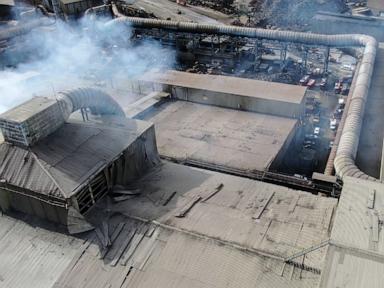
Ten workers are dead, four remain missing, and emergency crews are still digging through twisted steel in western Turkey. When an industrial disaster like the steel plant explosion in western Turkey hits the headlines, the public usually gets a 300-word wire report listing the casualties before the news cycle moves on. That's a mistake.
Behind every catastrophic foundry or steel mill blast lies a predictable chain of mechanical failures, extreme thermal physics, and regulatory blind spots. If you want to understand what actually happened in western Turkey—and why steel manufacturing remains one of the most volatile heavy industries on the planet—you have to look past the initial casualty numbers. For an alternative look, check out: this related article.
The Reality of the Western Turkey Steel Plant Blast
An explosion at a steel facility in western Turkey left 10 people dead and 4 missing, triggering a massive emergency response across the region. Local authorities, medical teams, and disaster management personnel rushed to the site immediately following the detonation, working through structural instability and extreme heat to locate trapped workers.
Western Turkey, particularly industrial corridors stretching through provinces like İzmir, Manisa, and Bursa, serves as the backbone of the country's heavy manufacturing and metallurgical output. Turkey consistently ranks among the top steel producers globally, sitting right alongside major industrial economies in Europe and Asia according to data from the World Steel Association. That massive output comes with intense operational pressure. Similar reporting regarding this has been provided by The New York Times.
Early reports around these events often get muddied by confusion over whether a blast was caused by a boiler failure, a gas leak, or a molten metal reaction. While official forensic investigators in Turkey work to pinpoint the exact trigger at the site, the scale of destruction—capable of killing ten people instantly and burying four others under debris—points directly to high-energy thermal or pressurized containment failure.
Why Steel Plants Are Uniquely Volatile Environments
Most people picture a steel mill as a loud, dirty factory. In reality, it's a controlled thermodynamic battlefield. You're dealing with materials heated to roughly 1,600°C (nearly 2,900°F), pressurized oxygen lances, volatile combustible gases, and heavy overhead cranes moving hundreds of tons of liquid metal at a time.
I've spent years analyzing industrial accident reports, and one pattern shows up constantly. Steel plants don't usually blow up because of a single catastrophic mistake. They blow up when two minor, seemingly unrelated anomalies collide at the exact wrong second.
The Physics of a Molten Metal Explosion
If you drop a cup of water into a vat of molten steel, you don't just get steam. You get a violent, supersonic detonation.
Water expands roughly 1,600 times its original volume when it flashes into steam. When liquid water gets trapped beneath molten metal—whether from a leaking cooling pipe, a damp scrap load, or a roof leak during heavy rain—it superheats instantaneously. The resulting vapor explosion can shear through reinforced concrete and send multi-ton steel ladles flying across a facility floor.
Even without water, electric arc furnaces (EAFs)—which Turkey relies on heavily for recycling scrap metal into new steel—carry massive risks. Sealed containers, unexploded ordnance hidden in imported scrap metal, or trapped moisture inside bales of crushed cars can detonate the moment they hit the furnace bath.
Gas Accumulation and Pressurized Systems
Steel production generates and consumes massive amounts of carbon monoxide, hydrogen, and natural gas. Blast furnaces and reheating systems rely on complex networks of valves, scrubbers, and pipelines to keep these gases contained.
A hairline fracture in a valve seal or a malfunctioning pressure relief system allows gas to pool in enclosed workspaces. At that point, any stray spark from an electrical panel or hot slag turns an entire building wing into a fuel-air bomb.
What Initial News Reports Almost Always Miss
Wire services focus on the immediate human toll, which is understandable. Ten dead and four missing is a devastating number for any community. Yet standard breaking news coverage skips the structural realities that govern how these disasters unfold and how they're investigated afterward.
First, search and rescue in a collapsed steel facility is exponentially harder than in a standard building collapse. You aren't just lifting concrete slabs. Rescuers have to navigate warped structural steel beams, unstable cranes, toxic fumes from burning insulation or chemical coatings, and residual heat that can linger for days. That's why finding the four missing workers takes agonizingly long, even with heavy lifting equipment on site.
Second, accountability in heavy industrial accidents rarely moves quickly. Turkish prosecutors routinely launch immediate judicial investigations following workplace fatalities, often detaining site managers or safety officers for questioning. However, determining root-cause mechanical failure requires metallurgical testing, maintenance log audits, and sensor data recovery that take months—sometimes years—to complete.
Turkey's Industrial Growth Versus Workplace Safety
Turkey's manufacturing sector has expanded aggressively over the past two decades. Exports of iron, steel, automotive parts, and heavy machinery drive a massive portion of the national economy. Western Turkey sits at the center of this boom, benefiting from proximity to Aegean and Marmara ports.
Rapid industrial scaling creates friction. Factories run around the clock to meet export quotas. Maintenance windows get squeezed. Subcontracting networks grow complex, sometimes blurring the line over who is directly responsible for inspecting a high-pressure valve or clearing a drainage channel near a furnace.
The International Labour Organization (ILO) has repeatedly highlighted the correlation between high-output heavy industries and elevated occupational fatality rates when regulatory enforcement lags behind production speed. Turkey has updated its occupational health and safety laws over the last decade to align closer with European standards, mandating certified safety specialists on industrial sites. On paper, the rules look strict. On the factory floor, enforcement varies wildly between massive tier-one conglomerates and smaller regional operators.
Common Misconceptions About Heavy Industrial Disasters
When news breaks of a deadly plant explosion, public debate quickly settles into familiar, flawed narratives. Clearing those up matters if we actually care about preventing the next tragedy.
Misconception 1: It was caused by a single careless worker.
Blaming "human error" is the easiest way for corporate leadership to close an incident file. It's also lazy. In high-hazard environments like steel mills, engineering controls are supposed to make fatal human errors impossible. If one worker pressing the wrong button or loading damp scrap can kill fourteen people, the facility's safety architecture was broken long before that shift started.
Misconception 2: Modern plants don't experience catastrophic blasts.
Automation reduces the number of workers standing directly next to open furnaces, which saves lives. It doesn't eliminate the energy stored inside the equipment. Automated continuous casting lines and high-pressure oxygen systems still pack enough kinetic and thermal energy to level a facility when containment fails.
Misconception 3: Official casualty counts tell the full story.
Beyond the ten workers killed and four missing, industrial explosions leave dozens of survivors dealing with severe thermal burns, blast-induced traumatic brain injuries, and permanent respiratory damage from inhaling toxic particulates. Those long-term casualties rarely make the follow-up headlines.
How Industrial Operators Prevent Furnace and Plant Explosions
Preventing catastrophic explosions in metallurgical plants isn't mysterious. The engineering protocols exist, and top-tier facilities treat them like religion.
- Strict Scrap Inspection Protocols: Every load of scrap metal entering an electric arc furnace yard must be screened for closed cylinders, moisture pockets, and hazardous materials before it ever touches a charging bucket.
- Automated Leak Detection and Interlocks: Cooling water circuits around furnaces require real-time flow and pressure sensors tied directly to automated shutdown systems. If water pressure drops unexpectedly, the furnace cuts power immediately before water can pool under molten steel.
- Explosion-Relief Venting: Facilities handling combustible gases or fine metallic dust need properly engineered blow-out panels that direct blast pressure upward and away from occupied control rooms.
- Independent Maintenance Authority: Safety engineers and maintenance leads must hold absolute authority to halt a production line without fear of retaliation from production managers chasing weekly tonnage targets.
Following This Story Responsibly
If you're tracking updates on the western Turkey steel plant explosion—whether for industry research, supply chain monitoring, or staying informed on the rescue operation—stick to verified official channels. Follow statements from Turkey's Disaster and Emergency Management Presidency (AFAD), the Ministry of Labor and Social Security, and provincial governorates for confirmed updates on the four missing workers.
Watch closely for what happens once the rescue phase ends. The real test of accountability won't be the initial condolences issued by officials, but whether the subsequent prosecutor's report names specific equipment failures, uncovers skipped maintenance cycles, and leads to enforceable safety overhauls across the region's steel mills.