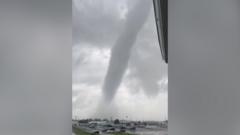
People think tornadoes only happen in flat midwestern fields. They forget that severe weather does not care about regional stereotypes. When violent storms tore through the Interstate 95 corridor, packing suspected tornadoes that slammed New York and Delaware, residents were left scrambling.
You do not expect to see a beach club ripped apart on Long Island or a state of emergency declared in Dover. Yet, that is exactly what happened when rapid-fire convective storms collided with the Northeast. Understanding why these events happen and how to stay safe matters now more than ever.
The Reality of Eastern Seaboard Tornadoes
Let us clear up a persistent myth right now. Tornadoes happen in every single U.S. state, including New York and Delaware. They might not match the sheer frequency or width of twisters in Oklahoma or Kansas, but they pack enough punch to destroy homes and uproot massive trees.
The recent outbreak proved just how volatile coastal and suburban weather can become. In Atlantic Beach on Long Island, witnesses watched in disbelief as a rotating column of air tore through a popular beach club, shredding cabanas and launching debris into the air. Down in Delaware, Dover took a direct hit, leaving behind significant structural damage, flooded streets, and urgent warnings from local police to stay off the roads.
Why do these storms turn so nasty so fast? It comes down to a brutal mix of high humidity, intense daytime heating, and sharp shifts in wind shear. When an aggressive cold front plows into warm, moisture-laden air sitting over the Northeast, the atmosphere gets unstable in a hurry.
Why Urban and Suburban Twisters Are Uniquely Dangerous
If you live in a rural part of Tornado Alley, you usually have a clear view of the horizon. You can spot the wall cloud forming miles away.
In places like New York and Delaware, you have dense populations, heavy tree cover, and buildings blocking your line of sight. You cannot see a funnel cloud coming until it is right on top of you.
Consider what happened during the recent storms:
- Flash flooding paralyzed major commuter routes, trapping drivers in rising water on the Long Island Expressway.
- Subway stations in New York City took on heavy runoff, turning transit hubs into indoor waterfalls.
- Power grids failed across multiple counties, cutting off electricity to thousands of homes and businesses.
When a tornado warning pops up on your phone in the Northeast, people often shrug it off as a heavy thunderstorm. That complacency is dangerous. A brief spin-up can form in minutes, driven by squall lines moving at highway speeds.
What You Should Do When Severe Weather Strikes
You cannot stop a severe storm, but you can control how you react to it. Most injuries during unexpected eastern tornadoes happen because people wait too long to seek shelter or try to outrun rising floodwaters in their cars.
First, take warning alerts seriously. If the National Weather Service issues a tornado warning for your specific zip code, move immediately to a basement or an interior room on the lowest floor of a sturdy building. Stay away from windows.
Second, never drive through flooded roadways. Turn around. Most flood-related casualties happen when drivers underestimate the depth and current of moving water over a paved road.
Keep a battery-powered radio or a charged smartphone nearby so you can track real-time radar updates. Weather patterns are shifting, and severe storms are pushing into unexpected corners of the country. Drop the assumption that your zip code is immune, and always have a basic emergency plan ready before the sirens start wailing.