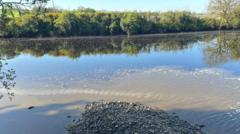
The immediate mortality of several hundred juvenile fish following a localized pollution event represents more than an isolated environmental failure; it is a catastrophic disruption of the biological compound interest required for riverine ecosystem stability. When a pollutant—typically a high-concentration surfactant, agricultural runoff, or industrial effluent—enters a waterway, the damage is not merely a count of carcasses. It is a systematic liquidation of future breeding stock, creating a multi-year demographic gap that destabilizes the food web and degrades the "ecosystem services" provided by the waterway.
The Mechanics of Acute Aquatic Toxicity
To understand the impact of a spill, one must analyze the chemical interaction between the contaminant and the aquatic physiology. Most pollution incidents involving mass fish die-offs operate through three primary physiological failure modes:
- Gill Cauterization and Surfactant Interference: Many industrial pollutants contain surfactants that reduce the surface tension of water. This prevents the diffusion of oxygen across the gill lamellae. Even if the water remains oxygenated, the fish suffocate because their biological interface with the environment has been chemically compromised.
- Dissolved Oxygen (DO) Sag: Organic pollutants, such as raw sewage or silage wrap runoff, trigger a spike in Biochemical Oxygen Demand (BOD). Aerobic bacteria consume the pollutant, and in doing so, strip the water of oxygen. This creates an "anoxic plug" that moves downstream, killing everything in its path that cannot outswim the plume.
- Neurotoxicity and Metabolic Inhibition: Pesticides or heavy metals act as direct toxins, disrupting the nervous system or cellular respiration. For juvenile fish (fry and parr), the surface-area-to-volume ratio is high, meaning they absorb lethal doses significantly faster than adult specimens.
The Demographic Gap and Recruitment Failure
The loss of "hundreds" of young fish is a specific type of ecological damage known as recruitment failure. In fisheries biology, "recruitment" refers to the number of fish that survive to a specific life stage or size.
A river is a conveyor belt of age classes. If the 2026 cohort of Atlantic salmon or brown trout is wiped out in a specific reach, that reach will see zero spawning activity from that generation three to five years down the line. This creates a "missing year class." The impact cascades:
- Predatory Imbalance: Predation pressure from herons, kingfishers, and larger fish does not disappear. With the 2026 cohort gone, predators over-consume the 2025 and 2027 cohorts to compensate, thinning the entire population density.
- Genetic Bottlenecking: If the pollution is localized to a specific spawning tributary, it may eliminate unique genetic markers adapted to that specific micro-environment, reducing the long-term resilience of the species to climate shifts or disease.
Quantifying the Recovery Timeline
Recovery is not a linear process of "wait and see." It is governed by the hydraulic residence time of the river and the proximity of "seed populations."
The first bottleneck is the Macroinvertebrate Recovery Phase. Fish do not return to a stretch of water if their food source—mayflies, caddisflies, and freshwater shrimp—has been eradicated. These species often have shorter life cycles but are more sensitive to chemical shifts than the fish themselves. A "clean" river that looks healthy to the naked eye may be a biological desert if the benthos (the riverbed) remains contaminated or sterilized.
The second bottleneck is Repopulation Logistics. If the pollution event affected a significant stretch, the river relies on "drift" from upstream or migration from downstream. If the spill occurred near the headwaters, the recovery is significantly slower as the system must rely on the slow upstream migration of adults to spawn and "re-seed" the area.
Failure of Detection and the "Lag Time" Problem
Current monitoring frameworks often fail because they are reactive rather than predictive. By the time dead fish are spotted by the public, the "slug" of pollution has often already passed through the system and diluted. This creates an evidentiary vacuum.
The technical limitation here is the sampling frequency. Most regulatory bodies rely on spot sampling—taking a jar of water once a month. This is statistically useless for catching a three-hour discharge event. To modernize this, the industry requires a shift toward Continuous Water Quality Monitoring (CWQM).
CWQM systems utilize sensors for:
- Electrical Conductivity: To detect inorganic pollutants or salt-based chemicals.
- Turbidity: To measure suspended solids that can smother spawning gravels.
- Dissolved Oxygen and pH: To track real-time biological stress.
The data must be coupled with automated sampling triggers. When a sensor detects a deviation from the baseline, it automatically draws a physical sample for lab analysis. Without this "automated smoking gun," polluters avoid the "polluter pays" principle because the evidence literally flows away.
Institutional Inertia in Enforcement
The primary reason these incidents recur is the low "Cost of Non-Compliance." If the fine for a spill is £20,000 but the cost of upgrading a failing slurry tank or industrial filtration system is £200,000, the spill becomes an unbudgeted but acceptable business risk.
For the ecosystem to be protected, the legal framework must shift from "Fine per Incident" to "Natural Capital Valuation." Under this model, the polluter is billed for the total loss of ecosystem services, including the projected value of the lost fish generations over a ten-year horizon and the cost of active restoration (re-stocking and habitat improvement).
Engineering the Riparian Buffer
To mitigate the risk of these "points source" pollution events, the structural design of the riverbank must be treated as a piece of protective infrastructure.
A "naked" riverbank adjacent to a farm or industrial site offers zero buffer. The implementation of Riparian Buffer Zones—strips of native vegetation and trees—serves as a physical and biological filter. These zones slow down overland flow, allowing pollutants to settle and be broken down by soil microbes before they reach the water column. Furthermore, the root systems stabilize the banks, preventing sediment (itself a pollutant) from clogging the gravel beds where fish eggs incubate.
Strategic Operational Protocol
To address the immediate fallout and prevent the recurrence of such events, stakeholders must move beyond sentiment and toward a rigorous operational response:
- Immediate Benthic Assessment: Dissect the riverbed within 48 hours of the event. If the invertebrate population is intact, the fish loss is a "pulse" event and recovery will be rapid. If the invertebrates are dead, the system requires active intervention.
- Hydraulic Modeling for Source Tracking: Use flow rate data and the timing of the first sighting to triangulate the exact entry point of the contaminant. This removes the "unknown origin" defense often used in legal proceedings.
- Mandatory Telemetry for High-Risk Sites: Any facility (farm, factory, or sewage works) within 500 meters of a sensitive watercourse must be mandated to install real-time telemetry that feeds directly to a public or regulatory dashboard. Transparency is the only effective deterrent.
- Cohort Replacement Strategy: If the loss of young fish is total, the fishery must be closed to all angling for a minimum of two years to protect the remaining survivors and allow for the introduction of farm-reared fry of local provenance.
The survival of a river system depends on the recognition that a few hundred dead fish are not just a tragedy; they are a leading indicator of a systemic infrastructure failure that requires a hard-coded engineering and regulatory solution.