In a quiet suburb outside Yekaterinburg, a woman named Elena stares at a chalkboard in an empty classroom. She is a teacher, but her students are disappearing. Not through tragedy or migration, but through a slow, mathematical evaporation that has been decades in the making. Every year, the intake for the first grade gets smaller. The desks stay stacked in the corner. The hallway echoes just a little more than it did the year before.
This is the silent crisis of the Russian heartland. It isn't a war of tanks, though the current conflict in Ukraine has certainly accelerated the bleeding. It is a war of biology and belief.
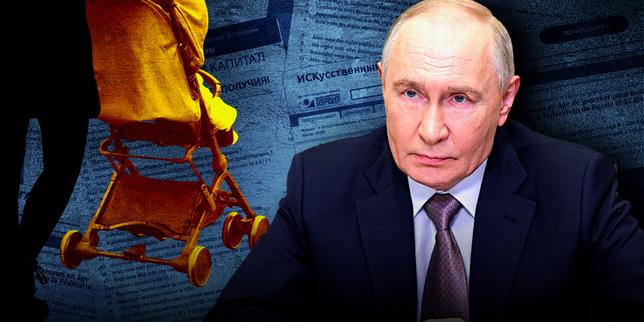
Vladimir Putin is obsessed with Elena’s classroom. To the master of the Kremlin, those empty desks are not just a local demographic quirk; they are a direct threat to the survival of the Russian state. He views the womb as a front line, perhaps the most critical one he has ever commanded. If Russian women do not have children, the map of the world as he envisions it simply ceases to exist.
The Cold Math of Survival
To understand why the Russian President spent a significant portion of his recent national addresses pleading with families to have three or more children, you have to look at the numbers. They are brutal. Russia is a vast, sprawling landmass—the largest on earth—protected by a population that is shrinking toward a precarious tipping point.
The statistics tell a story of a "demographic abyss." Russia’s fertility rate hovers around 1.4 to 1.5 children per woman. To keep a population stable without immigration, that number needs to be 2.1. When it stays low for decades, the society begins to look like an inverted pyramid. A small, overworked youth population struggles to support a massive, aging generation of retirees.
But Putin’s concern isn’t just about pension funds or healthcare costs. It is about power. You cannot project imperial strength if you do not have the boots to fill the boots. An army needs young men. A sprawling border needs guards. A domestic industry needs fresh hands. Without them, Russia becomes a hollow giant—enormous in geography, but brittle in soul.
Consider a hypothetical young couple in St. Petersburg, let's call them Viktor and Anya. They are educated, urban, and deeply anxious. They look at the cost of an apartment, the volatility of the ruble, and the uncertain shadow of the draft. When they hear the state offering "maternity capital"—a lump sum of money for having a second or third child—they don’t see a gift. They see a down payment on a life they aren't sure they can afford.
The state is trying to buy what only hope can produce.
A Century of Scars
Russia’s demographic struggles are not new. They are the echoes of a century of trauma. The "Great Patriotic War" (World War II) didn't just kill 27 million Soviet citizens; it carved a hole in the family tree that reappears every twenty-five years like a recurring ghost.
Every time the generation that wasn't born in the 1940s reaches childbearing age, there are fewer parents to have children. This creates a "hollow" in the population graph. Then came the 1990s. After the Soviet Union collapsed, the economic shock was so profound, and the future so bleak, that birth rates plummeted to historic lows.
Now, the children of the 90s—the smallest generation in modern Russian history—are the ones who are supposed to be having babies. There simply aren't enough of them to go around.
Putin views this as an existential emergency. He has framed the "Special Military Operation" as a defense of Russian values, but the irony is biting. By sending hundreds of thousands of young men to the front and causing hundreds of thousands more to flee the country to avoid the draft, he has effectively lobotomized the very demographic he needs to save.
He is burning the furniture to heat the house.
The Cult of the Family
To fight this, the Kremlin has moved beyond mere financial incentives. The strategy has shifted into the realm of the spiritual and the cultural. The government has aggressively pushed a "traditional values" agenda, painting the West as a decadent, childless wasteland and Russia as the last bastion of the traditional family.
The rhetoric is no longer just about economics; it is about identity.
In this narrative, having a child is a patriotic act. Propaganda posters and state media broadcasts emphasize the beauty of large families. Laws against "LGBTQ+ propaganda" and the crackdown on feminist movements are part of this broader design. The goal is to funnel social energy back into the domestic sphere. The state wants women to see motherhood not just as a choice, but as a duty to the Motherland.
But for women like our hypothetical Elena in Yekaterinburg, these decrees feel disconnected from the kitchen table. Mothers are being asked to bring children into a world where the social safety net is fraying. Healthcare in the provinces is struggling. Inflation eats away at the "maternity capital" before the child is even out of diapers.
There is a profound disconnect between the "Great Power" rhetoric of the Kremlin and the daily struggle of a mother trying to find a reliable pediatrician in a town five hundred miles from Moscow.
The Ghost of the Future
What happens when a nation’s leaders become more obsessed with the number of citizens than the quality of their lives?
The stakes are invisible until they aren't. They manifest in the closed schools. They show up in the labor shortages that stall factories. They appear in the lonely apartments of the elderly who have no children to check on them.
Russia is not alone in its demographic decline—Japan, Italy, and South Korea are all facing similar cliffs—but Russia’s situation is uniquely volatile because of its geopolitical ambitions. You cannot maintain an empire on a skeleton crew.
Putin’s obsession with birth rates is a recognition that time is his greatest enemy. He is trying to legislate a biological renaissance, attempting to use the power of the state to force a spring that won't come.
The tragedy is that children are the ultimate expression of confidence in the future. They are a vote of thanks to the present and a bet on the years to come. When a population stops growing, it is often because that confidence has evaporated. No amount of state funding can replace the simple, quiet belief that the world tomorrow will be a better place for a child than the world today.
Back in that quiet classroom near Yekaterinburg, Elena turns off the lights. The sun sets early in the Russian winter, casting long, thin shadows across the empty desks. She knows the names of the children who should be there, the ones who were never conceived because their potential parents were too afraid, too poor, or too tired.
The silence in the hallway is heavy. It is the sound of a country holding its breath, waiting for a future that might never arrive.
Would you like me to analyze the specific economic impact of Russia's maternity capital program on its rural provinces?