Every major news outlet just regurgitated the exact same press release without a single ounce of critical thought. The Federal Aviation Administration says the air travel schedule will "recover by Sunday," and journalists are printing it like gospel.
They are wrong. You are being lied to. And if you have a boarding pass for Sunday evening, you are walking straight into an operational buzzsaw.
The mainstream consensus operates on a childishly simple premise: once the storm clears, the outage resolves, or the ground stop lifts, airplanes simply take off again. They treat the national airspace system like a highway where traffic magically flows the second a fender-bender gets towed to the shoulder.
Anyone who has ever sat inside an airline Network Operations Center (NOC) knows that is pure fantasy. Aviation is not a highway. It is a tightly wound, brittle watch running at 99% capacity with zero margin for error. When you break a gear on Thursday, you do not fix the watch by Sunday. You spend the next five days hunting for missing pieces across four time zones while the remaining gears grind themselves into dust.
The Lie of the "Recovered" Schedule
When the FAA announces a "schedule recovery," they are measuring the wrong metric entirely. They are looking at Air Traffic Control (ATC) flow rates—the raw capacity of the sky and the concrete runways to accept metal tubes.
Yes, by Sunday, the radar screens at Atlanta, O'Hare, and Newark will look clean. The ground delay programs will expire. On paper, the National Airspace System will be green.
That means absolutely nothing to you, the passenger, because the FAA does not fly airplanes. Airlines fly airplanes. And an airline's internal recovery curve lags behind ATC clearance by anywhere from 48 to 96 hours.
I have spent years watching legacy carriers burn tens of millions of dollars trying to dig out of mid-week meltdowns. The public sees blue skies out their bedroom window on Sunday morning and assumes their 4:00 PM flight is safe. Meanwhile, inside the NOC, schedulers are staring at a digital bloodbath. The sky is open, sure, but the aircraft assigned to your route is sitting on a remote pad in Tulsa with a blown tire, and the First Officer who was supposed to fly it timed out in a Marriott outside Charlotte three hours ago.
The Crew Legality Time Bomb
If you want to understand why your Sunday flight will cancel under clear blue skies, stop looking at the weather app and start reading 14 CFR Part 117.
Part 117 is the FAA's strict regulation governing flight crew duty limits and mandatory rest periods. It is non-negotiable. A pilot cannot "push through" a delay the way a truck driver drinks another cup of coffee. The second a crew hits their maximum Flight Duty Period (FDP), they are legally prohibited from touching the controls. Even if the cabin door is closed. Even if the tug is hooked up to the nose gear.
Here is how a Friday disruption destroys a Sunday schedule:
- The Cascade: Friday's delays push crews past their duty limits. Instead of landing at their scheduled hub, dozens of pilots and flight attendants divert to secondary cities.
- The Rest Reset: Under Part 117, those crews must now receive a minimum of 10 consecutive hours of uninterrupted rest, which must include an 8-hour sleep opportunity. Factor in waiting for a hotel shuttle, checking in, and getting back through security, and a crew is easily out of commission for 14 to 16 hours.
- The Positional Mismatch: By Saturday afternoon, the airline has hundreds of rested crews—in the completely wrong cities. Meanwhile, the airplanes are stranded somewhere else entirely.
- The Sunday Execution: To fix this, crew scheduling has to deadhead pilots (fly them as passengers) across the country to reunite them with orphaned aircraft. Every seat taken by a deadheading pilot is a seat taken away from a paying customer. Worse, if the deadhead flight gets delayed by 45 minutes, the pilot arrives at their destination already timed out for the flight they were supposed to operate.
When the FAA says the schedule will recover by Sunday, they are ignoring the human bottleneck. You cannot manufacture rested pilots out of thin air.
The Hub-and-Spoke Death Spiral
Modern commercial aviation relies on the hub-and-spoke model, a logistical masterpiece designed to maximize load factors and profitability during normal operations. Under normal conditions, it allows airlines to connect small markets like Des Moines to international destinations like Frankfurt through a single fortress hub like Chicago or Atlanta.
During a system-wide disruption, that masterpiece turns into a suicide pact.
Point-to-point carriers like Southwest or Ryanair can occasionally isolate a regional meltdown, though Southwest's infamous December 2022 collapse proved even they are vulnerable when their crew-tracking software chokes. Legacy hub-and-spoke carriers—Delta, United, American—have no firebreaks. Everything touches everything else.
Imagine a scenario where a three-hour ground stop hits Dallas/Fort Worth on Friday afternoon. That single bottleneck immediately traps 150 outbound aircraft. Those 150 aircraft were scheduled to fly to 80 different spoke cities, turn around in 45 minutes, and return to Dallas that night to feed the late-evening bank of flights.
Because they never left Dallas, those 80 spoke cities now have zero airplanes sitting at their gates on Saturday morning. The morning departures from those spoke cities cancel. Now the passengers in those cities rebook onto Saturday afternoon flights—flights that were already 92% full because airlines now run historically high load factors year-round.
By Sunday, the airline isn't just trying to fly Sunday's schedule. They are trying to absorb 48 hours of displaced human cargo into a system that only had 8% spare seat capacity to begin with.
Why Load Factors Kill Resilience
Twenty years ago, the average domestic flight flew at roughly 70% to 75% capacity. If a flight canceled, the gate agent could easily re-accommodate 120 stranded passengers onto the next two flights out. The system had natural shock absorbers.
Today, thanks to ruthless algorithmic revenue management, domestic load factors routinely hover between 85% and 95%. Airlines have optimized away every ounce of slack in the name of quarterly yield.
When you run a network at 94% capacity, there are no empty seats to absorb a shock. A single canceled Boeing 737-800 strands roughly 170 people. On a Sunday—historically the single busiest travel day of the week—finding 170 empty seats on alternative flights is mathematically impossible.
The FAA's "recovery" timeline only accounts for scheduled departures leaving the gate. It completely ignores the tens of thousands of stranded passengers sleeping on terminal floors who won't actually get a seat until Tuesday or Wednesday.
Dismantling the Passenger Playbook
Most travel advice you read online is written by lifestyle bloggers who have never worked an operational shift in their lives. They tell you to "arrive early," "pack snacks," and "be nice to the gate agent."
Being polite is basic human decency, not a logistical strategy. When the network is melting down, gate agents are overwhelmed, under-tooled, and often working with software interfaces built in the 1980s (looking at you, native Sabre and Shares terminals).
If you want to survive a fake FAA recovery, you have to stop asking "Is my flight on time?" and start asking "Where is my airplane right now?"
1. Track the Inbound Metal, Not Your Flight Status
Airline apps are notorious for rolling delays. They will push your departure back in 20-minute increments for four hours because admitting a cancellation early triggers passenger refunds and rebooking chaos.
Ignore your flight's status. Open FlightAware or Flightradar24, look up your flight number, and click "Where is my plane now?"
Trace that specific tail number backward through its day. If your 6:00 PM flight from New York to Miami relies on an aircraft that is currently sitting on a tarmac in Denver at 3:30 PM, your 6:00 PM flight is dead. The app just hasn't admitted it yet. Use that three-hour head start to grab the last seat on a competing airline before the rest of your gate area realizes what is happening.
2. Weaponize the Rebooking Queue
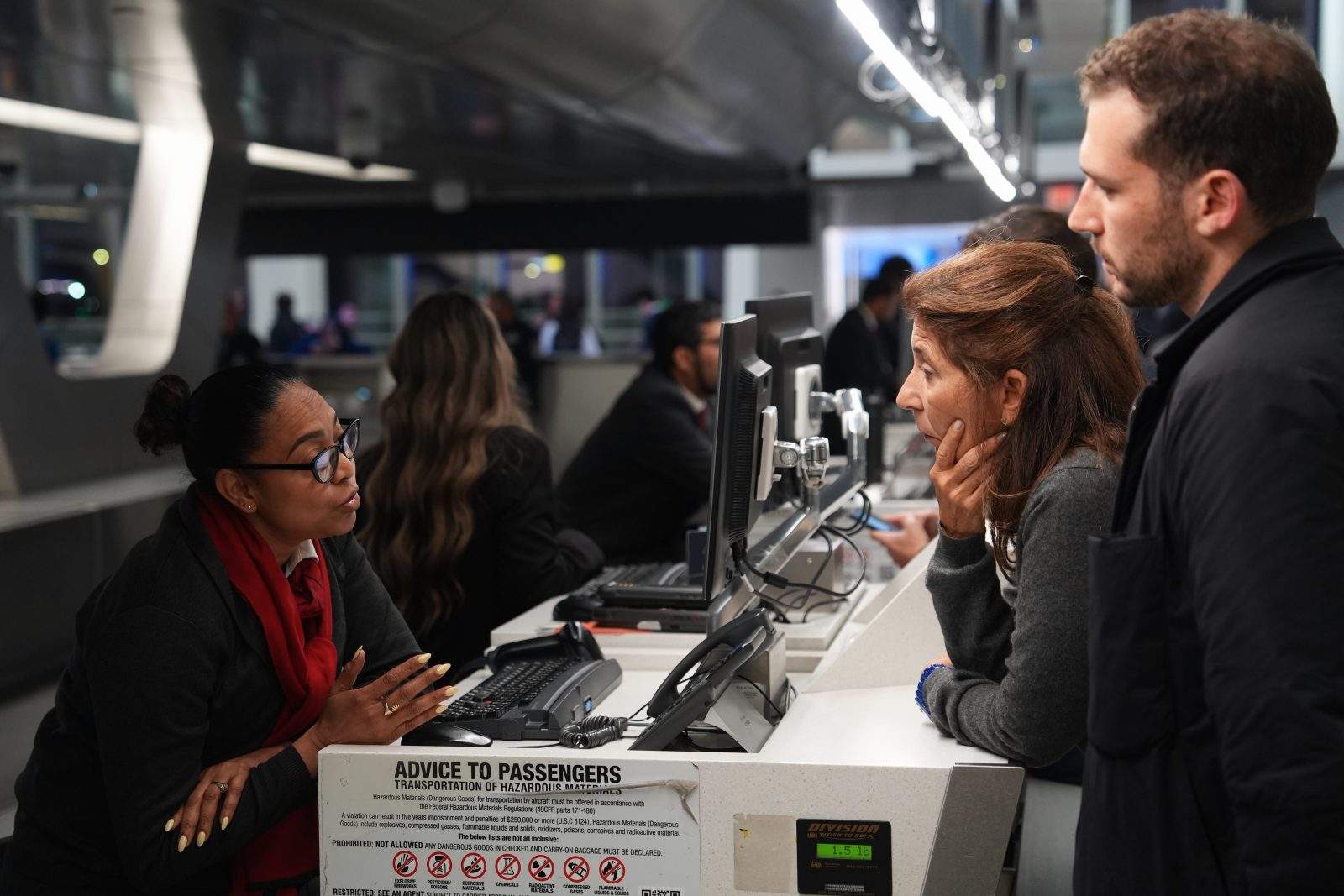
Never stand in the physical customer service line at the airport. Watching 200 people queue up at a single desk while two exhausted agents type furiously is watching collective helplessness in real time.
Do three things simultaneously the second you suspect a cancellation:
- Get on the airline's mobile app and look at self-service rebooking options.
- Call the airline's international support line (e.g., their UK, Australian, or Singaporean toll-free numbers via Skype or Wi-Fi calling). They route to global call centers with drastically shorter wait times than the main US queue.
- Walk to an empty gate—or better yet, pay $59 for a day pass into the airline's airport lounge. Lounge agents have the exact same terminal access as gate agents, zero line, and the bandwidth to manually force-build complex multi-leg itineraries that the consumer app won't show you.
3. The "Book a Backup" Arbitrage
Yes, doing this costs cash up front, and yes, airlines hate it. If you must be somewhere on Sunday, book a fully refundable backup ticket on a competing carrier the moment the initial disruption hits on Friday or Saturday.
Do not book on a partner airline or codeshare (e.g., don't back up an American flight with British Airways or Alaska, as they share disruption patterns and alliance inventory). Cross-pollinate. Back up a Delta flight with United. Back up a hub-and-spoke carrier with a point-to-point carrier. If your primary flight actually operates on time, cancel the refundable backup ticket prior to departure for a full cash refund.
The Honest Downside of Cynicism
Taking this aggressive, operational view of air travel comes with a distinct cost: paranoia and financial friction.
If you start tracking tail numbers and booking backup fares, you will occasionally burn money on lounge passes you didn't need or tie up $800 on a credit card for a refundable backup ticket that ends up unused. You will also become acutely aware of just how fragile the entire system is, which strips away whatever lingering romance remains in commercial flight.
Furthermore, if you proactively change your flight before the airline officially cancels or severely delays it, you forfeit your leverage. Under Department of Transportation (DOT) rules, if an airline cancels your flight or significantly changes it, they owe you a full cash refund—even on a non-refundable basic economy ticket—if you choose not to travel. If you panic and modify your own ticket early while the flight still shows "On Time," you may eat change fees or fare differences that the airline would have waived two hours later.
Timing is everything. You have to read the operational telemetry and jump right before the herd moves, without jumping so early that you subsidize the airline's failure out of your own pocket.
Stop Trusting Press Releases
The FAA's job is to manage public perception and maintain confidence in the national airspace. When an administrator goes on television and says things will be back to normal by Sunday, they are speaking in macro-averages designed to calm the market and get cable news anchors to move on to the next segment.
They are not looking at your specific Boeing 737. They are not looking at the crew legality clock ticking down in a crew lounge in Newark. And they certainly aren't looking at the 94% load factors that guarantee you will be fighting 150 other people for three middle seats when your "recovered" flight inevitably goes mechanical or times out at the gate.
Check the inbound tail number, secure your backup seat, and ignore the talking heads. The sky might be open on Sunday, but your plane isn't coming.


