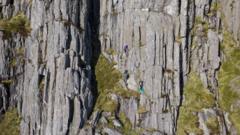
The air at high altitudes doesn't just feel thin; it feels sharp. It carries the scent of ancient stone and the metallic tang of adrenaline. When you are suspended on a vertical face of granite, the world shrinks to a singular focus: the three inches of rock directly in front of your eyes. Everything else—your mortgage, your morning coffee, the argument you had last week—evaporates. There is only the rock, your breath, and the person on the other end of the rope.
Climbing is often described as a solo pursuit of peak performance, but that is a lie. It is a radical exercise in communal trust. You are literally holding someone’s life in your hands, and they are holding yours. Usually, that trust is a quiet, background hum.
Then the rope goes taut.
The Physics of a Heartbeat
Gravity is a constant, patient predator. It doesn't get tired. It doesn't get distracted. When a climber falls, they aren't just dropping; they are accelerating at 9.8 meters per second squared. Within a heartbeat, a human body becomes a projectile.
Imagine Fay Manners. She is an elite alpinist, someone who treats the most unforgiving peaks in the world like a second home. She was climbing in the Chamonix valley, a place where the mountains are as beautiful as they are lethal. Her partner was moving above her, leading the pitch. In climbing terms, the "leader" is the one taking the risk, trailing the rope behind them and clipping it into metal anchors fixed in the rock.
The fall wasn't a slip. It was an eruption.
Thirty-three feet.
To a person standing on the ground, ten meters sounds like a diving board. To a climber, a thirty-three-foot fall is a violent arc of energy that threatens to rip gear out of the stone and snap bones upon impact. As her partner tumbled through the thin mountain air, the physics of the situation shifted from abstract math to a brutal, physical demand.
Fay was the belayer. Her job was to catch that energy.
When the Machine Fails
Standard climbing safety involves a belay device—a small piece of machined aluminum designed to create friction and lock the rope during a fall. It is a brilliant piece of engineering. But mountains are messy. Ropes get tangled. Angles get awkward. Sometimes, the mechanical advantage isn't enough, or the sheer force of a long fall threatens to override the system.
When her partner fell, the rope began to scream through the system.
If Fay had let go, if she had prioritized her own safety, her partner would have hit a ledge or plummeted further, likely with fatal consequences. She didn't let go. Instead, she became the friction.
She gripped the moving rope with her bare hands.
Think about the texture of a climbing rope. It is a kernmantle construction, a nylon sheath woven tightly over a core. It is designed to be durable and abrasive. Now imagine that nylon zipping through your palms at high speed, carrying the weight of a falling human body amplified by the force of the drop.
The heat is instantaneous. Friction at that intensity doesn't just burn; it deconstructs. It shears away the epidermis, the dermis, and bites into the raw meat of the hand. It is a choice made in a microsecond: your skin or their life.
The Biology of Sacrifice
Pain is supposed to be a signal to stop. Our nervous systems are wired to retract from heat and sharp pressure. It is a primal reflex, one that has kept our species alive for millennia. To override that reflex requires a specific kind of mental grit that few people ever have to access.
Fay Manners held on.
She watched the skin peel away from her palms like wet paper. She felt the searing heat as the rope charred her flesh. Yet, her grip tightened. This wasn't about technique anymore. It wasn't about being a "master" of the sport. It was a raw, visceral display of human Will.
She managed to arrest the fall. She stopped the acceleration.
In the aftermath, the silence of the mountains returns, but it feels different. It’s a heavy silence. The adrenaline that masked the initial agony begins to recede, replaced by the throb of exposed nerve endings. Her hands were ruined, a roadmap of red, raw trauma. But her partner was alive.
The Invisible Stakes
We live in a world obsessed with "safety" and "optimization." We buy cars with collision-avoidance systems and insurance policies for our insurance policies. We have largely scrubbed the necessity of physical sacrifice from our daily existence. We talk about "teamwork" in air-conditioned boardrooms, using words like synergy to describe people who barely know each other's last names.
But the mountain strips away the jargon.
On a granite face, "teamwork" is the willingness to let a rope burn through your muscles to keep your friend from hitting the ground. It is the ultimate accountability.
There is a psychological phenomenon known as the "Bystander Effect," where individuals are less likely to offer help to a victim when other people are present. The responsibility feels diluted. In a climbing duo, there is no dilution. The responsibility is 100 percent yours. You are the only thing standing between your partner and the abyss.
Fay’s injuries were severe, the kind that require months of healing and leave permanent scarring. In the climbing community, hands are a primary tool, a source of livelihood and identity. To sacrifice them is to sacrifice a part of your future.
Beyond the Scars
People often ask why anyone would do this. Why risk the skin on your hands, or your life, for a summit that offers nothing but a view and a cold wind?
The answer isn't in the summit. It’s in the rope.
Most of us will go through our entire lives without ever knowing if we are the kind of person who would hold on. We hope we would. We like to think we are brave, that we are loyal, that we are capable of selfless acts. But until the rope goes taut, it's all just theory.
Fay Manners doesn't have to wonder.
Her hands will heal, eventually. The skin will grow back, though it will be tougher, thicker, and mapped with the memory of that day. Every time she reaches for a hold, every time she ties a knot, she will feel the ghost of that friction.
It is a high price to pay for a Tuesday afternoon in the Alps. But for her partner, standing on solid ground and breathing the crisp mountain air, that price was the greatest gift one human can give another.
The mountains don't care about our stories. They are indifferent to our pain and our triumphs. They sit there, massive and silent, waiting for the next person to test themselves against the gravity. But in the small, frantic space between the rock and the sky, we find out what we are actually made of.
Sometimes, it turns out we are made of something much stronger than the gear we carry. We are made of a stubborn, bleeding refusal to let go.
The rope stays tight. The partner lives. The scars remain.