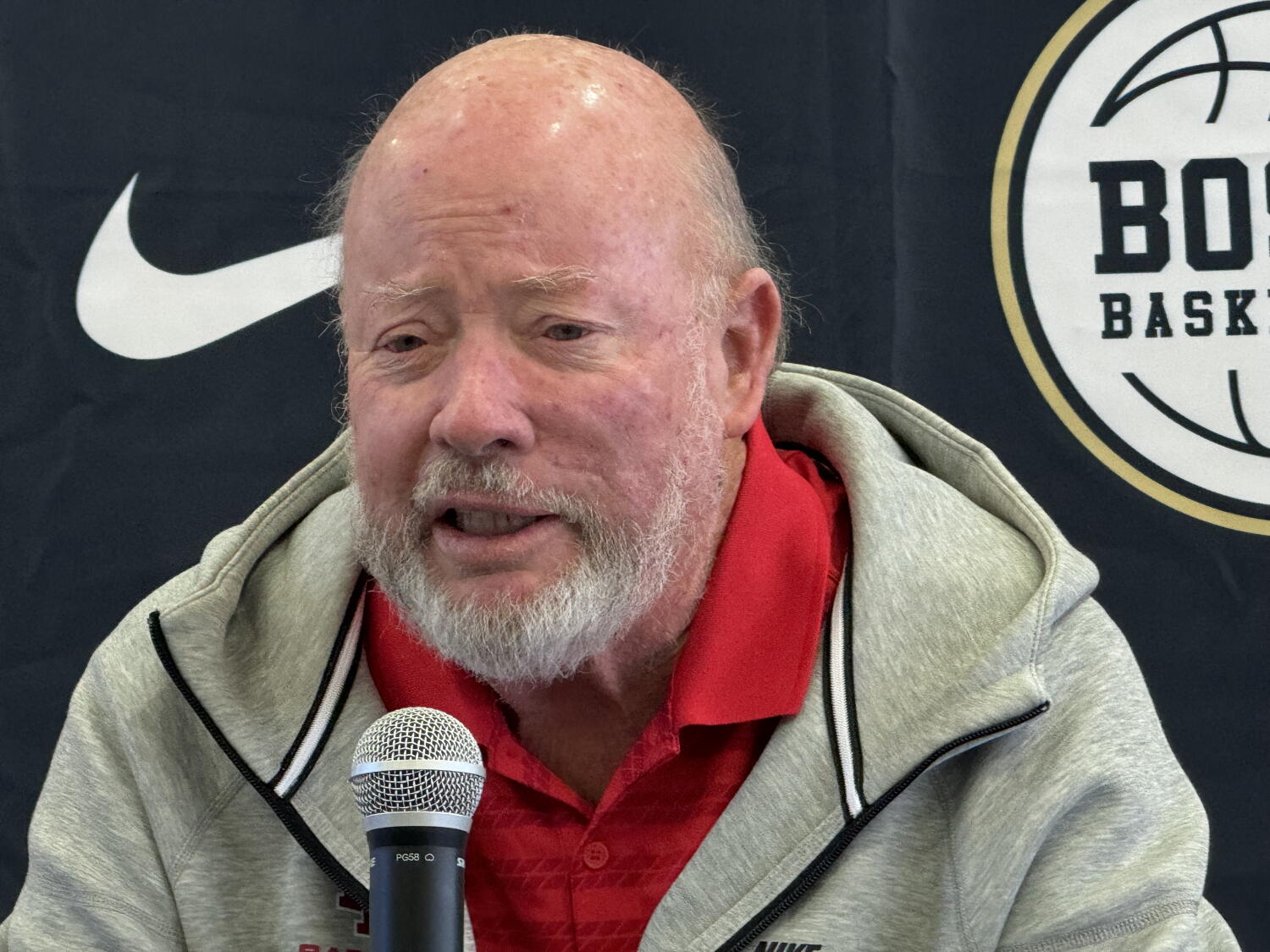
Gary McKnight stands 18 victories away from the all-time national high school boys basketball coaching record. The Mater Dei High School head coach sits at 1,318 career wins, trailing only the late, legendary Morgan Wootten of DeMatha Catholic, who retired in 2002 with 1,274—or 1,336 depending on how various national record books tally his early career and forfeit adjustments, though the widely accepted National Federation of State High School Associations benchmark places Wootten at 1,274 and Robert Hughes of Fort Worth Dunbar at 1,333. Wait—let us get the exact ledger straight before another banner goes up in Santa Ana.
Robert Hughes holds the official NFHS national record at 1,333 career wins. When the local Southern California press notes that Gary McKnight is 18 wins away from the national record, they are tracking his climb past Hughes's 1,333 mark to 1,334. At 1,316 wins entering the stretch, 18 victories puts McKnight alone at the summit of American high school basketball.
Most coverage of this milestone reads like a press release written by a booster club. You get the bullet points of state championships, the roll call of NBA alumni, and a warm-and-fuzzy portrait of a tireless lifer who never left Orange County. That version of the story misses the real tectonic shift underneath McKnight’s four-decade run. Reaching 1,334 wins in the modern era is not merely a testament to longevity or Xs and Os. It is an indictment—or a validation, depending on which side of the Trinity League bleachers you sit on—of how prep sports evolved from neighborhood pastimes into semi-professional talent monopolies.
The Math Behind 1,300 Wins
To understand what 1,316 victories actually requires, look at the calendar rather than the trophy case. An average high school basketball team plays roughly 25 to 30 games per season. A very good coach who wins 20 games a year—a benchmark that gets your name engraved on a municipal gym wall in most states—would need 66 consecutive seasons without a down year to catch Robert Hughes.
McKnight took over at Mater Dei in 1982. Over more than four decades on Bristol Street, his teams have averaged roughly 30 wins per season. You do not hit a 30-win annual average by winning league games and bowing out in the regional semifinals. You hit that number by playing 35-game schedules, flying to national showcase tournaments in Hawaii, Florida, and Massachusetts, and routinely playing deep into March for CIF Southern Section and California State Open Division crowns.
Longevity alone does not explain it. Plenty of coaches stay at one school for forty years and retire with 650 wins and a gold watch. Sustained elite volume is the actual mechanism. McKnight built a program where a 25-win season feels like a rebuild and an early exit in the state playoffs triggers post-mortem autopsies across Orange County sports talk.
Why the Old Record Books Are Messy
Anyone who has spent twenty years covering prep sports knows that national coaching records are held together by duct tape and local newspaper clippings. State athletic associations did not standardize reporting until the late twentieth century.
- Forfeit discrepancies often swing a coach's total by five to ten games decades after the fact.
- Preseason and exhibition tournaments in the 1960s and 1970s were counted differently in Texas, Maryland, and California.
- Dual-role seasons, where coaches led both varsity and junior varsity squads in small schools during the 1950s, muddied early totals for pioneers like Morgan Wootten.
None of those historical gray areas will apply to McKnight. Every single game of his tenure since 1982 has been documented by the Orange County Register, the Los Angeles Times, and the CIF Southern Section office. When he hits win number 1,334, there will be zero ambiguity about the ledger.
The Architecture of the Mater Dei Machine
If you walk into the Meruelo Athletic Center on the Mater Dei campus, you are not looking at a typical Catholic high school gymnasium. You are looking at a mid-major Division I facility. That physical reality is inseparable from McKnight’s win total.
When McKnight arrived in 1982, Mater Dei was already a respected parochial school, yet its basketball program had never won a CIF championship. Within a decade, McKnight had turned the Monarchs into the gravitational center of West Coast prep basketball. How did he do it while public schools three miles away struggled to keep their best eighth-graders from transferring?
The Self-Perpetuating Talent Loop
Success in private high school athletics operates on a compounding flywheel. Once you win your first two or three state titles, you stop recruiting players—the players' families and club coaches start recruiting you.
- Visibility guarantees exposure. College coaches from the Big Ten, SEC, and ACC do not have time to visit twelve different suburban gyms during the fall evaluation period. They fly into John Wayne Airport, drive ten minutes to Mater Dei, and watch four future Division I prospects practice in one gym.
- Iron sharpens iron daily. A five-star sophomore at a standard public high school might go months without facing an equal defender in practice. At Mater Dei, the second unit could win most public school leagues in Southern California.
- The system protects the star. McKnight rarely asks a teenage phenom to carry an unmanageable offensive load. Because the roster is stocked with complementary shooters, rim protectors, and disciplined ball-handlers, individual flaws get masked while strengths get amplified for college scouts.
Critics call it stacking the deck. Defenders call it excellence attracting excellence. Both things are true at the exact same time.
What Critics Get Wrong About Private School Superpowers
Every time McKnight approaches another milestone, the same predictable debate erupts on message boards and in rival coaching offices. Public school coaches argue—often with bitter accuracy—that they are playing an entirely different sport under entirely different rules.
Public schools draw from strict geographic attendance boundaries. If a neighborhood experiences a demographic shift or a downturn in youth sports participation, the local high school coach has to ride out a four-year talent drought. Private schools have no attendance boundaries. A student can commute from Los Angeles County, Riverside County, or south Orange County if the family can afford the tuition or qualify for standard need-based financial aid.
Yet reducing Gary McKnight’s 1,300-plus wins to "he gets all the best players" is lazy analysis. History is littered with wealthy private academies and prep factories that assembled McDonald's All-American rosters and imploded by January.
Talent without hierarchy is poison in a high school locker room. Seventeen-year-old stars arrive with personal trainers, shoe-company handlers, and parents who have already mapped out their son's NBA draft slot. Getting five alpha scorers to accept defined roles, dive on loose balls, and sit on the bench when they blow a defensive rotation requires an iron grip that most modern coaches simply do not possess.
McKnight’s real superpower has never been his playbook. It has been ruthless cultural enforcement. Players at Mater Dei tuck their jerseys in. They look the coach in the eye during timeouts. If a future lottery pick loafs back on defense, he sits next to the water cooler regardless of which college head coach is sitting in the front row. Over forty-plus years, dozens of highly touted transfers have arrived at Mater Dei expecting a red carpet, only to transfer back out a year later when they realized the culture would not bend to accommodate their highlight tape.
The Structural Shift That Threatens the Record
Ironically, the very ecosystem McKnight helped pioneer has mutated into something that makes his record almost untouchable for future generations. Even if a young coach starts at age 25 today and wins 30 games a year for four decades, the ground beneath high school basketball has shifted permanently.
The Rise of the Prep Academy Circuit
In the 1980s, 1990s, and 2000s, a top prospect in Southern California had two choices: play for his local public school or go to a traditional Catholic powerhouse like Mater Dei, Bishop Gorman, or DeMatha. Those schools still operated inside state athletic associations. They had to abide by CIF transfer rules, academic eligibility standards, and limits on total games played.
Over the last decade, a parallel universe emerged. Independent prep academies—institutions like Montverde Academy in Florida, IMG Academy, and Prolific Prep—broke away from traditional state association governance. They operate as basketball boarding schools that play national schedules against one another, unrestricted by state semester limits or local league obligations.
This fragmentation pulls elite talent away from traditional high schools. When a top-ten national prospect leaves California at age 16 to attend an independent prep academy, he takes wins away from traditional programs like Mater Dei. McKnight has had to navigate that talent drain while still competing inside the rigid framework of the CIF Southern Section—a balancing act that makes his recent Open Division titles even more impressive than his dominance in the 1990s.
Coaching Burnout in the Transfer Portal Era
Beyond the prep academy threat, the psychology of the job has deteriorated. High school coaches today deal with constant roster turnover driven by a youth-sports culture that treats adversity as a reason to change uniforms.
- Parental interference is instantaneous and relentless, fueled by social media rankings and grassroots circuit politics.
- Transfer volatility means a coach can spend two years developing a promising freshman only to watch him leave for a rival school the moment another prospect transfers in at his position.
- Administrative pressure has shifted from supporting long-term educators to appeasing vocal booster groups who demand immediate results.
Most coaches tap out after fifteen or twenty years. They take athletic director jobs, move into college assistant roles, or simply walk away to preserve their sanity. Staying in the same seat for 44 years while maintaining a winning percentage north of 85 percent requires an almost unnatural tolerance for friction.
The Uncomfortable Truth About The Trinity League Arms Race
To celebrate McKnight’s march toward 1,334 wins without examining the Trinity League is like praising a heavyweight champion without mentioning the promoter who booked the fights.
Mater Dei competes in the Trinity League alongside St. John Bosco, Santa Margarita, JSerra, Servite, and Orange Lutheran. On any given Friday night in January, a regular-season Trinity League basketball game draws bigger crowds and higher-level Division I talent than many mid-major college matchups.
That concentration of wealth and athletic talent has created a localized arms race across Orange County. Every school in the league invests millions into facilities, strength coaches, and coaching staffs just to avoid finishing fifth. While the level of basketball is extraordinary, the collateral damage is visible across the rest of Southern California.
Neighborhood public schools that once produced Cinderella playoff runs now find themselves locked out of the highest competitive tiers. The CIF eventually had to create the Open Division specifically to separate juggernauts like Mater Dei from traditional schools, effectively admitting that standard enrollment-based divisions could no longer contain the private-school powerhouses.
McKnight did not break the system, nor did he violate the rules written by the state federation. He simply understood the rules earlier and executed them more relentlessly than anyone else. When a coach builds a dynasty that forces the governing body to invent a new playoff division just to restore competitive balance, you are no longer talking about a normal career. You are talking about a structural monopoly.
What Happens After Win Number 1,334
Every countdown creates an artificial finish line. Once Gary McKnight passes Robert Hughes and claims the national record, the local media will run their commemorative editions, the school will unveil a permanent tribute on the gym wall, and the broader sports world will move on within 48 hours.
Inside the Mater Dei gym, nothing will change. The next afternoon at 3:15 PM, the whistle will blow, the baseline drills will start, and another group of 15-year-olds will learn that 1,334 past victories do not buy them a single point on Friday night.