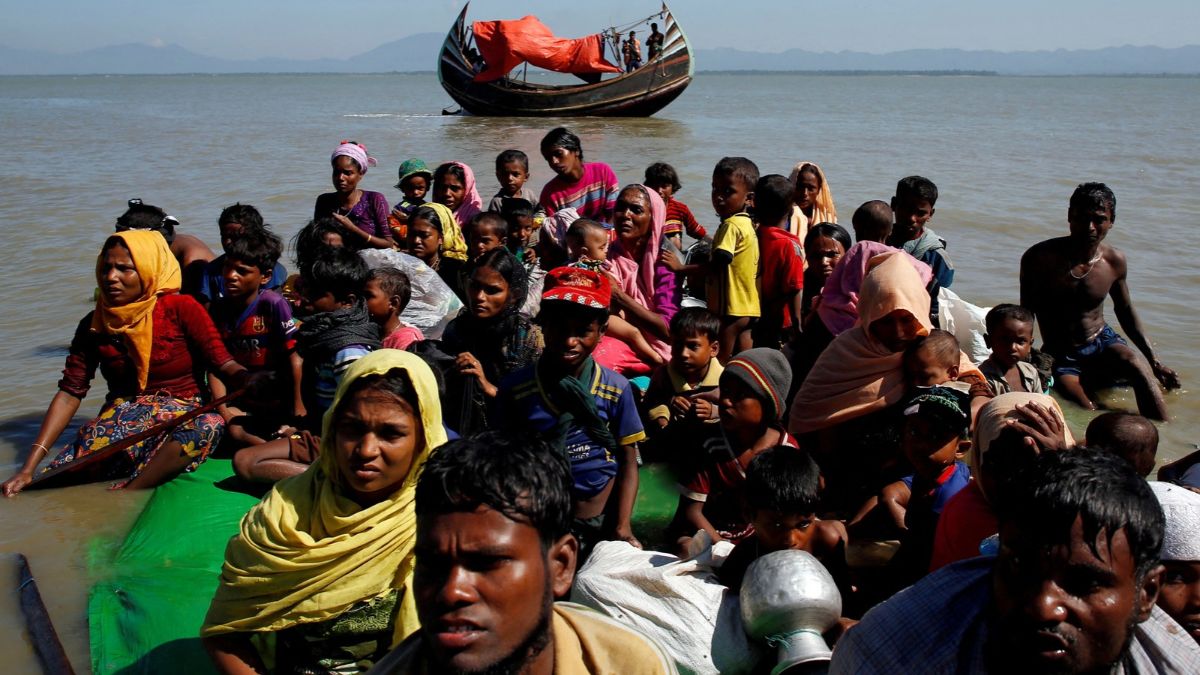
Political arguments over where a people belong usually ignore the hardest evidence we have. For decades, official narratives in Myanmar framed the Rohingya as recent colonial-era arrivals from Bengal, stripping away their citizenship and rewriting regional history to justify exclusion. Then the lab results came in.
Modern population genetics doesn't care about nationalist talking points. When researchers sequenced whole genomes from Rohingya individuals and compared them against neighboring groups across South and Southeast Asia, the biological record told a clear, nuanced story. Yes, the Rohingya carry substantial South Asian ancestry closely tied to populations in Bengal and eastern India. They also carry distinct genetic markers linking them to Southeast Asian and Tibeto-Burman populations in Myanmar, showing centuries of local mixing rather than a sudden, modern migration. In other updates, we also covered: Ontario’s Red Tape Debate Misses the Real Economic and Environmental Math.
That distinction matters more than most headlines let on. A population with deep, multi-generational admixture isn't a group of recent newcomers. It's a community forged right on the borderlands of the Bay of Bengal over hundreds of years.
Why the Rohingya DNA Study Changes the Debate
For years, anyone studying the history of Rakhine State—historically known as Arakan—had to rely on fragmented chronicles, colonial census records, and competing oral histories. Those sources are easy to cherry-pick. Politicians on one side pointed to British-era labor migration in the 19th and early 20th centuries to claim the entire population was foreign. Historians on the other side pointed to the Mrauk U Kingdom, Muslim court poets, and Arabic inscriptions dating back centuries. NBC News has also covered this important issue in extensive detail.
Genetics cuts straight through that fog.
In landmark genomic studies examining Rohingya DNA alongside populations from Bangladesh, India, Myanmar, and broader Southeast Asia, researchers looked at both autosomal DNA—which captures ancestry from all your ancestors—and uniparental markers like Y-chromosomes and mitochondrial DNA. The findings confirmed two critical realities at once. First, the primary genetic component of the Rohingya aligns closely with Indo-Aryan speaking groups of the Bengal region. Second, there is a measurable, non-trivial layer of East and Southeast Asian ancestry embedded directly within the Rohingya gene pool.
You don't get uniform genetic blending across a community overnight. Geneticists use patterns of DNA segment lengths—essentially measuring how broken up ancestral chunks of chromosomes have become over time—to estimate when populations mixed. Those recombination clocks point to contact and intermarriage stretching back centuries, long before the British Raj drew borders across the subcontinent.
Breaking Down the Genetic Blueprint
To understand what the data actually shows, you have to look at how human populations move around the Bay of Bengal. Geography dictates everything here. Rakhine State sits wedged between the Arakan Mountains and the sea, physically separated from the central Irrawaddy valley of Myanmar while opening directly onto the coastal waters connecting Chittagong and the Ganges delta.
For a sailor or merchant in the 15th century, traveling from Bengal to Arakan was vastly easier than crossing the mountain range from central Burma. People moved along that coast constantly.
When geneticists analyze Rohingya genomes using tools like ADMIXTURE and Principal Component Analysis, the data clusters in a very specific spot. Here is what stands out when you look closely at the numbers and genetic components:
- Dominant South Asian Ancestry: Roughly two-thirds to three-quarters of Rohingya genetic ancestry matches populations from Bengal and northeastern India. This reflects deep roots in the eastern Indian subcontinent, sharing ancestral ties with groups living across the modern border in Bangladesh.
- Southeast Asian and Tibeto-Burman Admixture: The remaining portion—often hovering around 20 to 30 percent depending on the specific reference panels used—comes from East and Southeast Asian lineages. These markers link directly to indigenous populations of Myanmar, including Rakhine and Bamar-related groups.
- Asymmetric Paternal and Maternal Lines: Like many historical contact zones, the Y-chromosome data (passed father to son) shows heavy South Asian influence, reflecting male merchants, soldiers, and settlers arriving along coastal trade routes. Meanwhile, mitochondrial DNA (passed mother to child) shows a noticeably higher share of Southeast Asian lineages, a classic genetic footprint of local women marrying into incoming communities over generations.
Think about what that maternal-paternal split proves. It's the exact opposite of an isolated enclave that arrived recently and refused to integrate. Incoming men from the west married local women in Arakan, creating families that bridged both worlds. Over generations, those descendants married within the growing community, locking that dual heritage into their DNA.
What Most People Get Wrong About Genetic Ancestry
Whenever a genetics paper hits the news cycle, people tend to flatten complex biology into simplistic slogans. I've seen commentators on both sides misread what this research actually proves.
One common mistake is treating "South Asian roots" as proof that the Rohingya are simply displaced Bangladeshis. That logic falls apart the second you look at how South Asian populations actually formed. Every group across India, Bangladesh, and Pakistan is itself a mixture of ancient ancestral populations—Ancestral North Indians, Ancestral South Indians, and Austroasiatic or Tibeto-Burman groups in the east. Bengalis themselves carry significant East and Southeast Asian genetic components compared to populations in western India.
The Rohingya aren't just an offshoot of modern Bangladesh. Their genetic profile reflects a distinct coastal trajectory. While they share a foundational base with Chittagonian and Bengali groups, their specific proportion of Tibeto-Burman admixture and shared haplotypes with Myanmar populations set them apart as a localized Arakanese group.
Another misconception is assuming genetics can assign a precise calendar date to a single family's arrival. Admixture dating models estimate pulses of mixing across a population. When researchers detect admixture dating back 300 to 500 years—or even earlier—that doesn't mean zero migration happened in the 1800s. It means the core biological identity of the group was already well established during the era of the Arakanese kingdoms, with later arrivals blending into an already existing population.
Centuries of Links With Myanmar
The genetic timeline lines up almost beat for beat with what serious historians of Southeast Asia have documented for years.
During the Mrauk U Kingdom, which ruled Arakan from 1430 to 1785, the region was a cosmopolitan maritime power. Arakanese Buddhist kings regularly employed Bengali Muslims as administrators, soldiers, court poets, and artisans. They even adopted Muslim royal titles alongside their Buddhist ones and minted coins bearing Persian inscriptions.
When the kingdom expanded into Chittagong, thousands of people moved back and forth across the Naf River. Some came voluntarily for trade and land. Others were brought to Arakan as captives following naval raids—a standard practice across pre-colonial Southeast Asia. Over time, these communities settled in the river valleys of northern Arakan, farming rice and speaking an Indo-Aryan language that evolved into the modern Rohingya tongue, distinct from standard Bengali and heavily inflected with local vocabulary.
Then came 1784, when the Konbaung Dynasty of central Burma conquered Arakan, followed by the First Anglo-Burmese War in 1824, which brought the region under British colonial rule. British administrators encouraged agricultural expansion, and seasonal laborers moved south from Chittagong into sparsely populated tracts of Arakan.
Here is where the political distortion happened. Twentieth-century nationalists took that 19th-century colonial labor movement and pretended it was the entire story. By erasing the pre-1824 population, authorities in Yangon and Naypyidaw could label every Rohingya person a "Bengali illegal immigrant." The 1982 Citizenship Law codified that erasure, restricting full citizenship to ethnic groups deemed to have settled in Myanmar prior to 1823.
The DNA evidence destroys the premise of that law. You don't generate centuries-deep Southeast Asian genetic admixture solely from 19th-century seasonal farmhands. The biological record proves that the ancestors of today's Rohingya were living, marrying, and building communities in Myanmar long before 1823.
Why Genetic Data Alone Won't Fix a Political Crisis
It's tempting to think hard science settles human rights disputes. It rarely works that way.
In Myanmar, ethnic identity is legally tied to the concept of taingyintha—"national races." The state recognizes 135 official ethnic groups, a list compiled arbitrarily during the military dictatorship of Ne Win and finalized without rigorous anthropological or genetic input. Ironically, several recognized groups in Myanmar share cross-border linguistic and genetic ties with populations in China, India, and Thailand. The Kachin, Chin, and Shan all have close relatives living outside Myanmar's modern borders, yet their belonging isn't questioned the way Rohingya belonging is.
That double standard exposes the real issue. The exclusion of the Rohingya was never an honest disagreement over anthropology or population genetics. It was a deliberate political project fueled by colonial divide-and-rule legacies, World War II communal violence, and decades of military authoritarianism that used scapegoating to consolidate power.
Still, scientific clarity has real value. International courts, historians, and journalists rely on peer-reviewed evidence to counter state propaganda. When officials claim a group has zero historical connection to the land, genomic studies provide an objective, falsifiable rebuttal that cannot be dismissed as partisan bias.
How to Read Population Genetics Studies Critically
If you follow news about human ancestry, archaeology, or regional conflicts, you're going to see more genomic studies used in political debates. Knowing how to read them keeps you from getting misled by sensationalized headlines.
First, always check sample sizes and geographic sampling. A study sampling 20 individuals from a single refugee camp in Cox's Bazar captures a real snapshot, but it might miss subtle regional variations across northern versus central Rakhine State. Look for whether researchers included diverse reference panels from both South Asia and mainland Southeast Asia.
Second, separate ancestry from identity. Genetics traces biological ancestors—where your DNA segments came from over millennia. Cultural, linguistic, and national identity are social realities built through shared history, language, and lived experience. Two neighboring groups can have nearly identical DNA and fiercely distinct identities, while a single cohesive ethnic group can carry diverse genetic roots.
Third, watch out for chronological compression. Geneticists often report a single estimated date for an admixture event, like "12 generations ago." In reality, human mixing is rarely a one-time event. It's usually a continuous process spanning centuries, and mathematical models simply average those waves into a midpoint.
Where This Leaves the Historical Record
The science on Rohingya origins is remarkably consistent across independent research teams. Their genomes carry the unmistakable signature of the Bay of Bengal's eastern littoral—a deep foundation in Bengal woven together over centuries with the indigenous peoples of Myanmar.
Anyone claiming the Rohingya have no historical roots in Myanmar is arguing against biology, linguistics, and pre-colonial history all at once. If you want to verify the primary evidence yourself, look up peer-reviewed population genetics papers on Bay of Bengal admixture in journals like Molecular Biology and Evolution or American Journal of Human Genetics, alongside historian Michael Charney's archival work on early modern Arakan. Cross-referencing the genomic data with pre-1824 colonial and Arakanese records gives you the full picture—one that no political decree can rewrite.