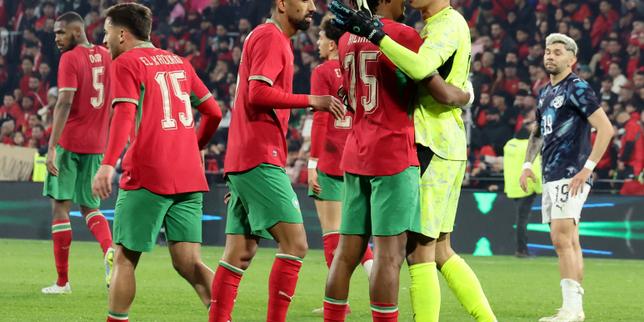
The roar of a hundred thousand voices in a stadium is a physical thing. It hits your chest like a tidal wave, vibrating through the bone and muscle until you can’t tell where your own breathing ends and the crowd begins. For a footballer, that noise is the ultimate validation. But for a woman standing in the shadows of a Tehran alleyway, or a protester dodging a baton in Isfahan, that same roar can sound like a betrayal.
Gianni Infantino sits at the head of the most powerful table in sports, and his logic is as smooth as a polished marble floor. He argues that football is a bridge. He insists that excluding a nation—specifically Iran—from the World Cup would only further isolate a population already suffocating under the weight of geopolitical tension. It is a pragmatic stance. It is a diplomatic stance. It is also a stance that ignores the blood on the cleats.
Consider a young man we will call Saman. He isn’t real, but his story is stitched together from the lived realities of thousands. Saman grew up with a poster of Ali Daei on his wall. He spent his childhood kicking a deflated ball against a brick wall, dreaming of the day the "Team Melli" would lift a trophy on the world stage. To Saman, the national team is his heart. But lately, his heart is breaking.
When he watches the news, he doesn't see goals. He sees the faces of athletes who have been arrested, or worse, for speaking out against the morality police. He sees a regime using the spectacle of the World Cup as a giant, glittering curtain to hide the gallows.
The Great Neutrality Trap
The FIFA President’s defense of Iran’s participation rests on a singular, stubborn idea: football is not political.
It is a beautiful sentiment. It is also a lie.
Nothing that commands the attention of five billion people is ever truly neutral. When a team steps onto that pitch in Qatar or North America or Europe, they are carrying more than just a playbook. They carry a flag. In the case of Iran, that flag has become a Rorschach test. To the ruling clerics, it is a symbol of defiance against Western "decadence." To the protesters, it is a hijacked shroud.
Infantino points to the millions of "ordinary" fans who deserve a moment of joy. He isn't wrong about the joy. Life in Iran is hard. Inflation has turned grocery shopping into a math problem that no one can solve. The air in the cities is thick with smog and sorrow. A ninety-minute escape into a game where the rules are clear and the referee (theoretically) cannot be bribed is a mercy.
But at what price?
There is a specific kind of cognitive dissonance required to celebrate a goal while knowing that, back home, the very act of a woman entering a stadium to watch that same goal remains a revolutionary act. For years, Iranian women have disguised themselves as men, taping down their chests and donning fake beards, just to sit in the nosebleed seats. They risk imprisonment for the "crime" of loving the game. When FIFA allows the status quo to continue without teeth, it isn't just staying neutral. It is validating the gatekeepers.
The Invisible Stakes of the Pitch
The argument for inclusion usually relies on the "engagement" theory. The idea is that by keeping Iran in the fold, FIFA retains leverage. They can "encourage" change. They can send letters. They can hold meetings in five-star hotels where everyone nods and nothing moves.
History suggests otherwise.
Sports washing isn't a new invention, but it has been perfected in the twenty-first century. It works like a charm. You take a regime with a PR problem, host a global event, and suddenly the headlines are about "dark horses" and "group stage upsets" instead of human rights abuses. The soft power of a winning goal is more effective than any propaganda film.
Imagine the stadium lights. They are so bright they erase the stars. Under those lights, the Iranian players stand for the anthem. Some stay silent, their faces stony, a quiet rebellion that risks their careers and their safety. Others sing, whether out of loyalty or fear. In that moment, the "Team Melli" is no longer just a group of athletes. They are a battlefield.
By insisting on their participation, Infantino is forcing these players to be symbols of a state they might despise. He is putting them in the crosshairs. If they play well, the regime claims the glory. If they protest, they disappear into the bowels of Evin Prison.
The Weight of the Ball
Football is a game of simple physics. A sphere, a force, a trajectory. But the ball used in the World Cup weighs much more than 450 grams. It carries the weight of a nation’s identity.
There is a logical deduction often missed in the debate over boycotts. Critics say sports shouldn't punish the players for the sins of the government. This sounds fair. It sounds like justice. But it ignores the fact that the government is the one managing the team. The Iranian Football Federation is not an independent body; it is an arm of the state. When the team travels, the minders travel with them. When they speak, the words are vetted.
The real problem lies in the definition of "the people."
When Infantino says he is doing this for the fans, which fans does he mean? Does he mean the ones who can afford the tickets and the flights? Or does he mean the families of the protesters who were killed in the streets, who now see the national team as an extension of the boots that crushed them?
The divide is not between "East" and "West" or "Politics" and "Sport." It is between those who view the world as a series of balance sheets and those who view it as a series of heartbeats.
A Bridge to Nowhere
A bridge is only useful if it leads somewhere better. If the bridge lands in a minefield, it isn't a connection; it’s a trap.
Infantino’s "bridge" has been standing for decades. During that time, has the situation for female fans in Iran fundamentally shifted? Not without the threat of massive, existential sanctions from FIFA. Even then, the concessions have been breadcrumbs—a few hundred "vetted" women allowed into a corner of the stadium for a single match, a photo op for the international press, and then a return to the shadows.
True authority isn't found in a title or a boardroom. It is found in the courage to say that some things are more important than a tournament.
Imagine if FIFA said no.
Imagine the shockwave. It wouldn't just be a sports story; it would be a global reckoning. It would tell every fan in Iran that the world sees them. Not the officials in their suits, but the people in the stands. It would tell the regime that the prestige they crave is not for sale at the price of their citizens' dignity.
Of course, that won't happen. The machinery of global sport is greased with the oil of compromise. The tournament will go on. The whistles will blow. The goals will be scored.
But we should not pretend that this is a victory for "unity."
Every time a ball is kicked in a stadium while a girl in Tehran is forbidden from watching it, the game loses a little bit of its soul. We are watching a high-stakes heist where the prize is the very idea of fair play.
The stadium lights will eventually dim. The fans will go home. The headlines will move on to the next season, the next transfer, the next scandal. But for the people living in the reality that FIFA chooses to ignore, the game never ends. They are still playing on a pitch where the boundaries are made of iron and the referee has already walked away.
The tragedy isn't that the world chooses to play. The tragedy is that we have convinced ourselves that the grass is the only thing that matters, even when it’s growing over a grave.