The coffee in the porcelain cup didn't ripple at first. It gave a microscopic shiver, a tiny hesitation on the ceramic rim, and then the world split open.
Magnitude 7.7.
To a seismologist sitting in a sterile office miles away, those numbers represent a clean calculation of energy release, a jagged line dancing across a drum of thermal paper, a Richter-scale monument to tectonic friction. But to the baker in Panama who had just pulled his morning batch of sourdough from the hearth, those numbers meant the brick oven cracking like an eggshell, the flour rising in a blinding white cloud to choke the air, and the floor turning into the deck of a ship caught in a rogue wave.
Physics is cold. Geography is abstract. Panic is intensely personal.
Imagine, for a fleeting moment, the exact second the Cocos Plate and the Caribbean Plate decided to stop their slow, agonizing creep and violently shove past each other. This isn't just about fault lines or subterranean geometry. This is about millions of tons of ancient rock grinding together with the force of a thousand tactical warheads, releasing a shockwave that travels through the bedrock beneath our feet as if it were nothing more than water in a pond.
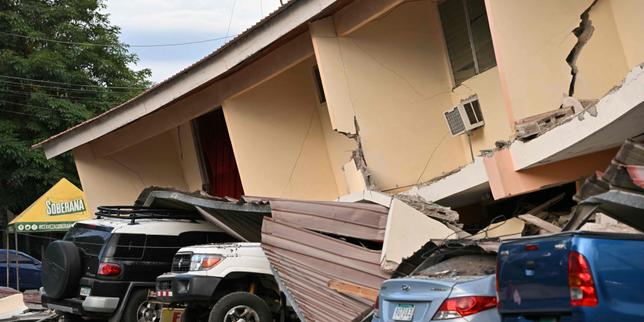
Buildings do not simply fall; they surrender. Steel beams groan in a register too low for human ears, whispering warnings that come a fraction of a second too late. Concrete turns to dust. And human beings—who spend their entire lives trusting the absolute permanence of the earth—discover with gut-wrenching suddenness that the ground is just a thin crust floating over an abyss.
Reports begin to trickle in through fractured networks. Power lines whip like angry snakes in the wind. Glass shatters in a symphonic cascade across city streets. Yet, the true measure of a disaster is never found in the initial violence. It is found in the silence that follows. That breathless, dust-choked vacuum where people look at one another with eyes wide with adrenaline, waiting to see who survived.
In the coastal zones, the immediate terror wasn't just the shaking. It was the water. When the ocean floor heaves upward, it pulls the sea with it, whispering a dark promise of what is to come. Sirens began to wail, a mechanical howling that cut through the dust-heavy air. Families grabbed children, pets, a single framed photograph, and ran toward the higher ground, driven by an ancestral instinct older than any government warning system.
Mother Earth does not negotiate. She does not pause to check if our infrastructure is up to code, or if our emergency funds are allocated, or if we are busy with our daily routines. She simply moves. And in her wake, she leaves behind a landscape of raw vulnerability.
Hours later, the dust settles into a thick, gray patina over everything. The true architecture of humanity reveals itself not in our skyscrapers, but in our hands. Neighbors who had never exchanged more than a nod across a shared fence are suddenly pulling rubble away with bleeding fingers. A stranger shares a bottle of warm water with a trembling child. First responders plunge into unstable ruins, driven by a stubborn, beautiful refusal to let the earth have the final word.
The statistics will eventually be tallied. Property damage will be quantified in millions. Engineers will analyze the rubble to see which foundations held and which failed, writing reports that will inform the next wave of building codes.
But numbers cannot capture the weight of a mother’s silence as she searches for her son’s schoolbag in the debris. Numbers cannot measure the terror of a shaking night spent under an open sky, watching the stars wheel overhead as if nothing had happened, wondering when the earth might take another breath.
This is the hidden cost of living on a living planet. We build our civilizations in the cracks of geological giants, pretending that concrete and steel make us masters of our domain. A magnitude 7.7 earthquake is a sharp, brutal reminder of the lease we sign with nature every single day.
The tremors stop eventually. The dust clears. The rebuilding begins, slow and arduous, driven by the stubborn resilience of people who have nowhere else to go and refuse to be erased.
The earth stops shaking. But the people never quite forget the day the ground forgot to stay still.