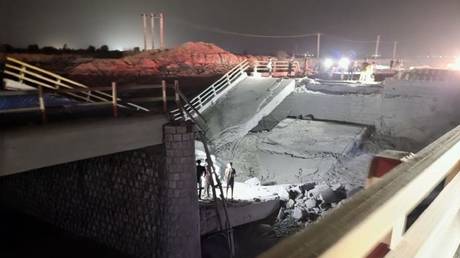
The dust never truly settles.
You breathe it. You wear it. You taste it in the back of your throat, a chalky, alkaline reminder of what used to be a living room. In Jobar, a Damascus suburb that once hummed with the noise of workshops, vegetable markets, and shouting children, the silence is heavy. It is broken only by the scrapers. For an alternative look, check out: this related article.
Abu Tariq is one of the few who returned. He stands in what remains of his second-floor apartment, holding a rusty iron crowbar. Around him, the walls are gone, replaced by a jagged view of a skeletal neighborhood. To his left, a reinforced concrete beam hangs by a single tendon of rusted rebar, swaying gently in the hot afternoon wind.
He strikes the concrete. A dull thud. A small cloud of grey powder. Further coverage on the subject has been provided by Associated Press.
This is what reconstruction looks like when the cameras leave and the official declarations of victory fade into the reality of peace. It is not a grand, state-funded effort with yellow bulldozers and high-vis vests. It is one man, fifty-eight years old, trying to pry a usable brick from the ruins of his own life.
The Geography of Ruin
To understand Jobar, you have to understand its position. It sits on the eastern edge of Damascus. For years, it was a frontline, a heavily fortified gateway to the capital. Below its streets, fighters dug a massive, labyrinthine network of tunnels. Above ground, artillery and airstrikes flattened entire blocks. When the fighting stopped in 2018, what remained was not a neighborhood, but a monument to destruction.
Most people did not come back. They couldn't.
But Abu Tariq did. He spent five years in a cramped, rented room in the outer suburbs of Damascus, watching his savings evaporate as inflation tore through the Syrian economy. Rent ate his meager earnings as a carpenter. Eventually, the math of displacement stopped making sense. It was cheaper to live in a ruin you owned than to pay for a roof you didn't.
So, he walked back into the dust.
But returning is not as simple as reclaiming your keys. Often, there are no doors left to lock, let alone keys to turn. The physical destruction is only the first obstacle. The second, and perhaps more formidable, is the invisible wall of paper, permits, and politics.
The Paperwork of the Displaced
Consider what happens when a municipality is declared a reconstruction zone.
Under various local laws, property owners must prove ownership to claim their land or participate in redevelopment schemes. But how do you prove you own a house when the local registry office was burned to the ground during the fighting? How do you produce a deed when you fled your home in 2013 with nothing but a plastic bag of clothes and your children’s birth certificates?
For those who do have their papers, the bureaucratic maze is dizzying. Permits to clear rubble require clearances from security branches. Permits to rebuild require structural assessments that cost more than a family’s annual income.
There are no public services here. The water mains are shattered, leaking into the dry earth deep underground. The electrical grid is a web of melted copper and fallen poles. If you want light, you buy a battery or a generator. If you want water, you pay a private tanker truck to fill a plastic blue drum on your roof—hoping the water is clean enough to drink, knowing it usually isn't.
The state is broke. International aid is restricted by sanctions and political stalemates. The result is a strange, privatized recovery where the poorest are left to rebuild a broken city with their bare hands.
The Math of a Single Brick
The economy of survival in Syria today is a lesson in impossible arithmetic.
A schoolteacher or a civil servant earns roughly fifteen to twenty-five dollars a month. A bag of cement costs more than a week’s wage. A single steel reinforcing bar can cost a month’s salary. To rebuild even a single room to safe, habitable standards requires thousands of dollars.
"We are rebuilding in slow motion," Abu Tariq says, wiping sweat from his forehead with a sleeve stiff with cement dust. "This month, I bought three bags of plaster. Next month, if my son can send fifty dollars from Lebanon, I will buy some electrical wire. If not, we keep using the candles."
He points to a corner of the room where a sheet of blue tarp serves as a temporary wall, keeping out the dust and the prying eyes of the street. Behind it sits a gas camping stove, a thin foam mattress, and a stack of plastic chairs. This is home now. It looks less like a residence and more like an indoor campsite.
His wife, Um Tariq, boils tea on the small gas burner. The aroma of sage struggles against the smell of damp concrete and stagnant water from the street below.
"In the winter, the cold comes through the floorboards like knives," she says, handing over a small glass of sweet, dark tea. "We burn cardboard, old shoes, anything we can find to stay warm. People think that because the war is quiet, the suffering has stopped. But this is a different kind of war. It is a slow wearing down of the spirit."
The Ghost Streets
Walking through Jobar today is an eerie experience.
A few blocks away, a main road has been cleared of major rubble to allow military vehicles and transit buses to pass. But turn down any side street, and the pavement disappears under mountains of pulverized concrete. Wild grass grows through the cracks of abandoned balconies.
Occasionally, you see signs of life. A single satellite dish bolted to a half-destroyed wall. A line of colorful laundry drying between two bullet-piddled pillars. A child playing with a rusted car part in the middle of a deserted alley.
These scattered families are pioneers in a wasteland. They rely on each other because there is no one else. If a neighbor needs to lift a heavy steel beam, three others appear from the surrounding ruins to help. They share generator time. They split the cost of water deliveries.
Yet, this solidarity is born of desperation, not choice.
The danger is also physical. Unexploded ordnance remains a constant, silent threat. Every year, children playing in the ruins of Damascus's suburbs are injured or killed by ordnance left behind in the rubble. Rebuilding is not just expensive; it is physically dangerous. Every hammer blow against a collapsed ceiling carries a sliver of risk.
The Pull of the Soil
Why stay? Why fight so hard for a pile of broken concrete in a neighborhood without water, light, or safety?
For Abu Tariq, the answer is simple, stripped of any romanticism or political grandstanding.
"If I leave, who keeps this land?" he asks, his voice dropping. "If the government decides to rezone this area because it is abandoned, my family loses everything we worked fifty years for. My father built this building. My brothers and I grew up here. If we let it go, we disappear from the map."
The struggle for Jobar is not just about shelter. It is about permanence. It is about refusing to be erased from the geography of your own country.
As the sun begins to set, casting long, orange shadows through the hollow frames of Jobar’s buildings, Abu Tariq puts his tools away in a plastic bucket. He walks to the edge of his balcony-less living room and looks out over the silent neighborhood.
In the distance, the lights of central Damascus are beginning to flicker on—a world of cafes, restaurants, and functioning water pipes just three miles away, yet completely out of reach. Here, the darkness comes quickly, swallowing the ruins block by block, until only the silhouettes of broken homes remain against the darkening sky.
Abu Tariq lights a single candle, its flame dancing in the draft, casting his long shadow against the raw concrete wall. He sits down on the foam mattress and waits for tomorrow’s dust.