The air in the Persian Gulf doesn't just sit; it weighs. It is a thick, salty humidity that clings to the skin of sailors and oil rig workers, a physical reminder that this narrow strip of blue water carries the lifeblood of the global economy. But lately, the weight isn't just the weather. It is the silence of a looming withdrawal and the digital hum of a new kind of front line.
When a superpower decides to pack its bags, the vibration is felt first in the small places. In a family-run trucking business in outback Australia, a father looks at a spreadsheet and sees a rare moment of breathing room because a government fuel excise cut finally kicked in. Thousands of miles away, a software engineer in Silicon Valley stares at a server log, watching for the first "ping" of a retaliatory strike that has nothing to do with bullets and everything to do with code.
The geopolitics of the moment have shifted from the grand movements of carrier strike groups to the blunt, transactional language of a breakup. The United States has signaled a departure. The message is as clear as it is jarring: go get your own oil.
The End of the Long Watch
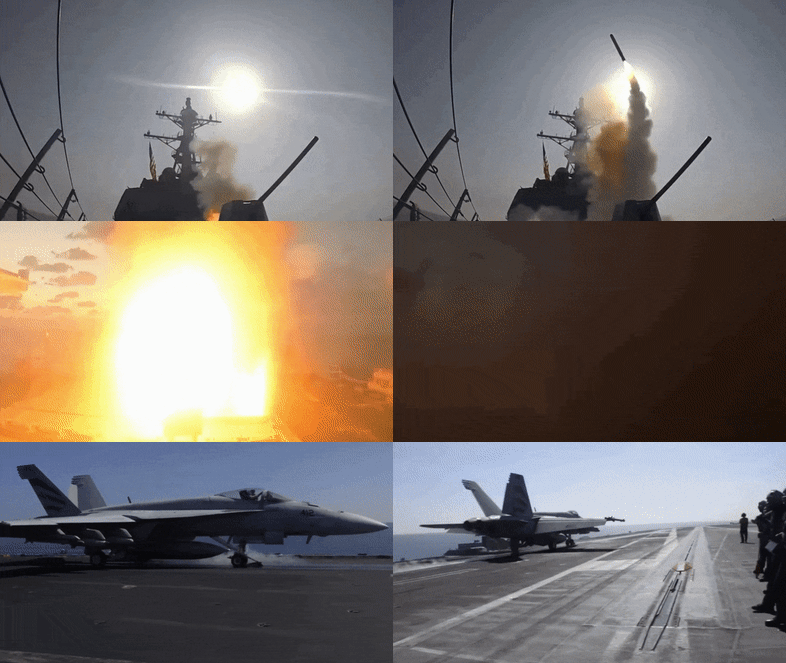
For decades, the unspoken deal was the bedrock of global stability. The U.S. Navy patrolled the Strait of Hormuz, ensuring that the black gold fueling the factories of Europe and the cars of Asia kept flowing. It was a costly, exhausting vigil. Now, the rhetoric from Washington suggests the era of the "global sheriff" is ending.
The logic is rooted in a hard-edged independence. If America is energy independent, the argument goes, why should it bleed money and men to protect a resource it no longer desperately needs?
But geography is a stubborn thing. You cannot simply walk away from a volatile neighborhood without leaving a vacuum. Imagine a crowded room where the biggest person suddenly stands up and walks out the door. The people left behind don't just relax; they scramble for the best seats, and sometimes, they start swinging.
The Digital Hostage
Iran’s response to this shifting reality hasn't stayed confined to the water. They know they cannot win a conventional war against a retreating giant, so they have turned their gaze toward the things the West prizes most: the digital nervous system.
The threat to target "Big Tech" is not just posturing. It is a recognition of where the modern world is most vulnerable. We live in an age where a well-placed line of malicious code can do more damage to a nation’s psyche than a localized missile strike. If the banking apps stop working, if the power grid flickers, if the social media platforms that hold our collective attention go dark, the chaos is immediate.
Consider a hypothetical—yet entirely plausible—scenario. A mid-sized logistics firm in the Midwest finds its servers encrypted. It isn't a random hacker looking for a payday. It is a state-sponsored actor sending a message. The message is that the "exit" from the physical Gulf will be met with an "entry" into the digital one. The stakes are no longer just about tankers in the water; they are about the data in our pockets.
The Australian Relief Valve
While the giants beat their chests, the rest of the world is busy trying to keep the lights on. In Australia, the implementation of a fuel excise cut is a perfect example of how global tension translates into kitchen-table reality.
For the person driving a delivery van in Sydney, the high-level talk of Iranian threats and U.S. withdrawals feels a world away. What matters is the price at the pump. The excise cut is a temporary shield, a way for a government to protect its citizens from the friction of a world in flux.
It is a fascinating contrast. On one hand, you have the high-drama of potential cyber-warfare and shifting alliances. On the other, you have a line item in a national budget designed to make sure a gallon of petrol doesn't cost a day's wages. One is the storm; the other is the umbrella.
The Illusion of Distance
We often fall into the trap of thinking these events are disconnected. We see a headline about Iran and turn the page. We see a headline about tech stocks and check our 401ks. We see a headline about gas prices and sigh.
In reality, they are different chapters of the same story. The "Go get your own oil" era is a pivot toward a more fractured, every-nation-for-itself world. When the U.S. tells other countries to secure their own energy interests, it is effectively dismantling the globalized security net that has existed since the end of the Cold War.
This creates a ripple effect. If Japan or South Korea or India feel they can no longer rely on the U.S. to keep the lanes open, they must build bigger navies. They must make their own deals. They must navigate the shadow of Iran’s influence without a bodyguard.
This isn't just about politics. It’s about the cost of everything. Every piece of plastic, every shipment of grain, every smartphone component that travels through a chokepoint becomes more expensive when the security of that chokepoint is in question.
The New Front Line
The shift toward targeting technology companies marks a sophisticated evolution in conflict. Silicon Valley is the new high ground. By threatening the infrastructure of Google, Amazon, or Microsoft, a regional power can exert pressure directly on the American public and the global economy without ever firing a shot in the desert.
It is a ghost war. It is fought in the cooling fans of data centers and the silent transmissions of undersea cables. For the average person, the "front" is the login screen that won't load or the credit card transaction that gets declined.
The danger of this rhetoric is that it moves us closer to a world where there are no "non-combatants." In a digital strike, the target isn't a military base; it's the platform you use to talk to your grandmother or the cloud where you store your wedding photos.
The Price of Moving On
There is a certain irony in the U.S. telling the world to "get its own oil" just as the world is trying to figure out how to stop using oil altogether. But the transition to green energy is decades away, and the hunger for crude remains the primary driver of current tensions.
We are living through a messy, dangerous middle ground. We are between the old world of American hegemony and a new, multipolar world that no one has quite figured out how to manage.
The Australian fuel cut is a reminder that the cost of this transition is being paid by individuals. It is paid in the anxiety of the commuter, the thin margins of the small business owner, and the uncertainty of the investor.
The silence of the Gulf is deceptive. It isn't the silence of peace; it is the silence of a long-standing arrangement being torn up. As the U.S. looks inward and Iran looks toward the digital horizon, the rest of the world is left to wonder who will hold the line when the next storm breaks.
The sun sets over the water, turning the oil slicks and the whitecaps into a bruised purple. The tankers continue their slow, heavy crawl toward the horizon, carries of energy and targets of opportunity, while the world waits to see what happens when the shadow of the protector finally vanishes.