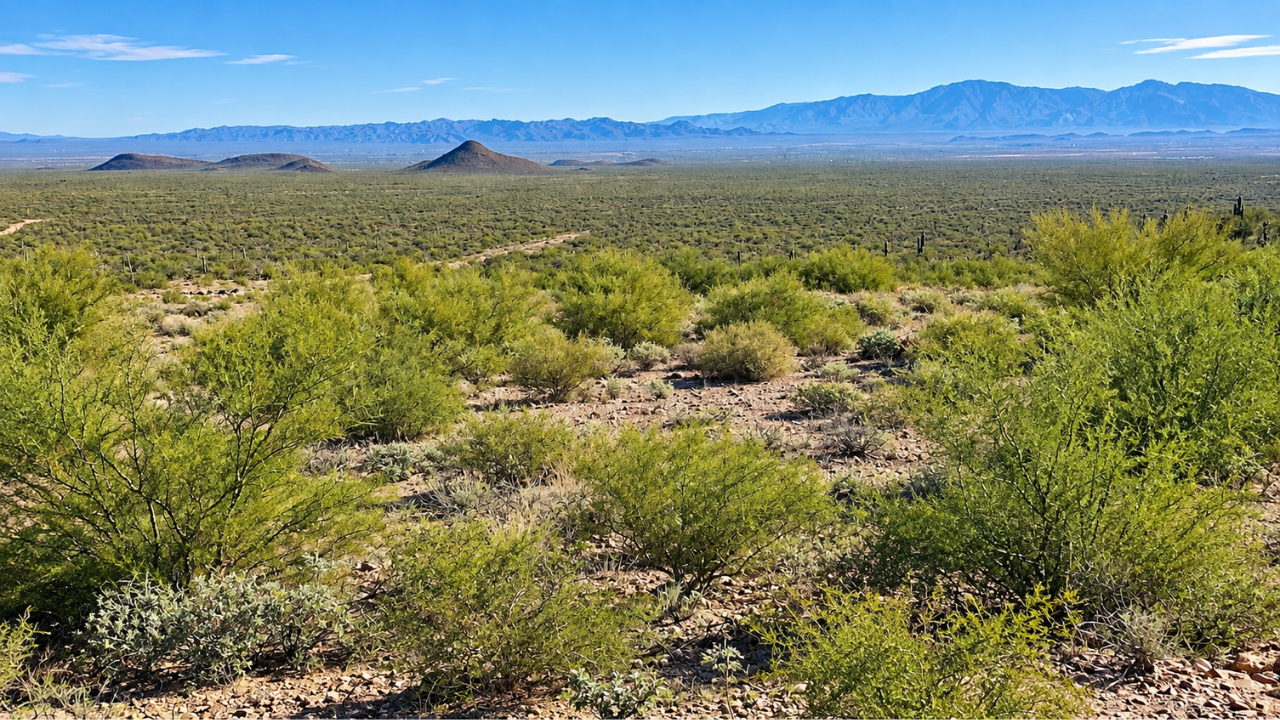
An eighteen-acre parcel of the Sonoran Desert within the Ironwood Forest National Monument spent years choking under an aggressive blanket of invasive buffelgrass. Today, that same plot houses one hundred thirty-three native plant species and more than two thousand established trees, achieved through sixteen years of relentless, manual intervention by conservationists and local volunteers. Conventional ecological restoration is often criticized as an expensive, short-sighted exercise in corporate greenwashing or bureaucratic box-checking. Yet this long-running effort demonstrates how meticulous soil manipulation, passive water harvesting, and targeted eradication can rebuild a collapsed ecosystem from the bare ground up.
Most modern environmental initiatives lean heavily on automated irrigation lines, imported topsoil, and expensive nursery stock. The Waterman Restoration Project threw out that playbook. Beginning in 2010 on Bureau of Land Management territory near Marana, Arizona, project leaders recognized that forcing foreign solutions onto an arid environment almost always backfires. Instead, they focused on correcting the underlying mechanical failures of the landscape. Heavy machinery reshaped compacted gravel flats, carving small water-retention dimples and low terraces designed to force scarce rainfall to sink rather than sheet across the surface.
Water in the desert is currency. When stormwater moves too fast, it strips organic matter, scours seed banks, and deepens erosion gullies. By slowing the flow, the project turned every monsoon downpour into a localized recharge event.
The Chemistry of Eradication
Buffelgrass is an ecological tyrant. Introduced from Africa, it thrives in disturbed soils, crowds out native flora, and creates a dense dry thatch that carries catastrophic wildfires through plant communities that evolved without adaptation to fire.
In the early stages of the Waterman site recovery, chemical intervention was unavoidable. Volunteers and contractors relied on targeted spot-spraying to beat back the invader. The numbers tell a stark story of attrition. In 2010, the operation consumed roughly two hundred thirty-four gallons of herbicide. By 2011, that dropped to seventy-four gallons. Through disciplined persistence, annual usage plummeted to single digits by the mid-2010s. Fewer than one hundred fifty individual buffelgrass plants have managed to surface in a single season at the location in recent years.
Chemical controls, however, are a blunt instrument. Spraying too much destroys the soil microbiome and leaves behind dead biomass that attracts further invasion. The core strategy relied on scaling down herbicide use the exact moment native species began reclaiming their territory, allowing biological competition to finish the job.
Letting the Seed Bank Speak
Nature possesses a memory written in dust and dormant seed coats. Rather than broadcasting commercial seed mixes, the project relied almost entirely on what was already buried beneath the crushed stone or carried on the wind from adjacent tracts.
Human hands only seeded foundational desert trees like foothill palo verde, whitethorn acacia, and ironwood. The rest of the inventory—one hundred thirty-three distinct species, including twenty-one native grasses—emerged from the earth on its own schedule.
Pioneer species performed the heavy lifting. Tiny fluffgrass, barely six inches tall, emerged first on raw earth, dying back after two seasons to form thin mats that trapped windblown seeds. Trailing four-o'clock spread across the dirt in explosive pink carpets following light winter or summer moisture, offering critical shade and organic litter for insects, rodents, and emerging shrubs.
Triangleleaf bursage eventually moved in to anchor the ecosystem. This native sub-shrub drops its leaves or branches during deep drought, steadily building a layer of soft subsurface soil that invites burrowing rodents. Those burrows open pathways for water to penetrate deeper during subsequent rains, completing a positive feedback loop of biological repair.
Engineering With Discarded Christmas Trees
Ecological engineering often demands improvisation when nature throws an unexpected punch. In September 2022, a violent storm dumped three and a half inches of rain across the terrain in under three hours. The resulting torrent carved a trench five hundred feet long, three feet wide, and three feet deep straight through the upper restoration zone.
Standard remediation would involve importing heavy riprap or pouring concrete structures, both of which conflict with the aesthetic and functional realities of a wild desert. Instead, project participants collected discarded holiday trees, stripped them of synthetic ornaments, and packed them end-to-end into the gash.
This unconventional wood matrix trapped sediment, slowed rushing water to a crawl, and forced suspended soil particles to drop back into the channel. Monitoring data proved the effectiveness of the intervention. Subsequent rainfall events exceeding a quarter-inch produced zero runoff through the packed corridor. The dead pines acted as artificial nurse logs, mimicking natural fallen timber and stabilizing the watershed without a single bag of ready-mix concrete.
The Cost of Real Labor
Scale is the primary limitation of volunteer-driven conservation. Over seven thousand hours of physical labor went into the Waterman site across sixteen years. People hauled three hundred truckloads of tree branch mulch, planted seedlings by hand, and laboriously transplanted dozens of salvaged saguaros.
This model does not easily scale to millions of acres. It demands local dedication, institutional backing from entities like the Bureau of Land Management, and scientific oversight from groups such as the Arizona Native Plant Society. When funding dries up or community interest wanes, projects of this nature routinely collapse back into neglect.
Yet the results challenge the fatalism often accompanying discussions of climate change and habitat loss. Ecosystems possess profound resilience if given basic structural protection and relief from chronic stressors.
Restoration remains an active verb here, lacking a definitive endpoint or a ribbon-cutting ceremony. Volunteers still walk the boundary lines, watching for stray green shoots of buffelgrass and checking the retention basins. The desert is healing, but it asks for constant vigilance in return.


