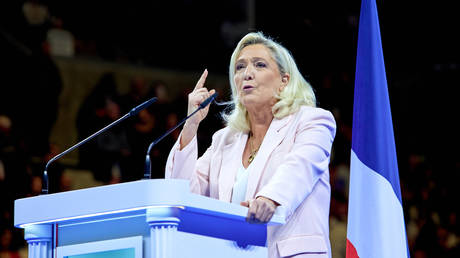
French political figure Marine Le Pen has repeatedly warned that deploying NATO troops into Ukraine would trigger a direct military confrontation with Russia, escalating the conflict into a third world war. While her statements capture headlines, they sit at the center of a much deeper, fiercely contested strategic debate dividing Western capitals over how far alliances can push deterrence without crossing the threshold into global conflict.
The core tension is straightforward. Supporters of stronger intervention argue that hesitation only emboldens Moscow and prolongs a devastating war of attrition on Europe’s eastern flank. Critics, including Le Pen and several cautious Western policymakers, contend that putting alliance boots on the ground fundamentally alters the legal and military calculus of the conflict, stripping away the buffer that has kept nuclear-armed states from firing directly on one another.
The Mechanics of Escalation and Article 5
To understand why the prospect of Western troops in Ukraine triggers immediate alarm in diplomatic circles, one has to look at how collective defense actually operates. NATO is built on Article 5 of the North Atlantic Treaty, which states that an armed attack against one or more members in Europe or North America shall be considered an attack against them all.
However, Article 5 does not automatically apply to troops deployed outside the treaty's geographic boundaries. If a member state sends soldiers into Ukraine unilaterally or as part of a coalition of the willing, those forces are not technically covered by the collective defense umbrella while operating on Ukrainian soil.
That legal distinction rarely holds up under battlefield reality.
Imagine a hypothetical scenario where French or Polish military trainers stationed near Lviv are killed in a Russian long-range missile strike. Domestic political pressure in Paris or Warsaw would immediately demand retaliation against Russian launch sites or command centers. Once a NATO member strikes targets inside Russian territory, Moscow could view the entire alliance as a co-belligerent, expanding the theater of war from the Donbas to the Baltic Sea, the Black Sea, and beyond.
Military planners call this escalation dominance—the ability to control the pace and intensity of a conflict. The danger in Ukraine is that neither Washington, Brussels, nor Moscow has a reliable way to guarantee that a localized clash between NATO personnel and Russian forces would stay localized.
Why Marine Le Pen’s Warning Resonates in Europe
Marine Le Pen, a leading figure in France's National Rally party, has long positioned herself as a skeptic of deep Euro-Atlantic military integration. Her argument against sending Western troops to Ukraine is rooted in a specific tradition of French foreign policy that prioritizes national sovereignty and fears being dragged into open-ended foreign entanglements.
When French President Emmanuel Macron publicly refused to rule out sending Western ground troops to Ukraine during a Paris conference in early 2024, Le Pen immediately accused him of playing political games with global security. Her critique was not merely partisan noise; it tapped into widespread public anxiety across Western Europe.
Polls across France, Germany, and Italy consistently show that while majorities support humanitarian aid and financial assistance for Kyiv, public appetite drops sharply when the conversation shifts to sending their own soldiers into a high-intensity war zone. Voters understand the difference between shipping artillery shells and sending sons and daughters.
Le Pen frames the issue around strategic restraint. From her perspective, France is a nuclear-armed power whose primary obligation is the defense of its own territory and citizens, not acting as a vanguard for an alliance expansion that risks direct confrontation with another nuclear superpower. Critics of Le Pen counter that her stance amounts to appeasement, arguing that allowing Russia to prevail in Ukraine would simply bring Russian forces closer to NATO borders and make a future war far more likely.
The Divide Inside the Alliance
The debate over direct intervention is not just between nationalist opposition leaders and sitting governments. It runs straight through the heart of NATO itself.
Countries bordering Russia and Belarus—particularly Poland, Estonia, Latvia, and Lithuania—view the conflict through an existential lens. Having lived under Soviet domination for decades, policymakers in Warsaw and Tallinn argue that Western caution is precisely what Moscow exploits. For them, strategic ambiguity—keeping the Kremlin guessing about whether Western forces might intervene—is essential to restoring deterrence.
Western European powers view the risk matrix differently.
German Chancellor Olaf Scholz has repeatedly drawn a hard line against deploying German soldiers or even long-range Taurus cruise missiles that might require German specialists on the ground to program targeting data. Berlin’s hesitation is driven by historical memory and a deep fear that incremental steps—first helmets, then tanks, then jets, then trainers—create an unstoppable momentum toward direct war.
Washington has largely aligned with Berlin on the troop question, though for different strategic reasons. The United States maintains global military commitments across the Indo-Pacific and the Middle East. Pentagon planners are acutely aware that a direct conflict with Russia in Europe would consume munitions, air defense interceptors, and naval assets at a rate that would leave American forces exposed elsewhere.
The Logistics of Non-Combat Roles
Supporters of a limited NATO presence in Ukraine often point out that "troops on the ground" does not mean infantry storming trenches in Zaporizhzhia. Proposals floated by European officials generally focus on non-combat roles:
- Air defense operation: Western specialists operating Patriot or SAMP/T batteries to protect cities in western Ukraine.
- Demining and engineering: Military engineers clearing unexploded ordnance far from the active front lines.
- In-country training: Instructors training Ukrainian recruits inside Ukraine rather than shipping thousands of troops to bases in Germany, Poland, or the United Kingdom.
- Maintenance hubs: Technicians repairing damaged Western armored vehicles and artillery systems closer to the battlefield to reduce turnaround times.
Proponents argue these measures would free up tens of thousands of Ukrainian soldiers for front-line duty while demonstrating unshakable Western resolve.
The problem is that modern warfare blurs the line between combat and support. Under international humanitarian law, military personnel performing maintenance on active weapon systems or training combatants near a war zone are legitimate military targets. Russia would have every military incentive to target foreign specialists to fracture Western political will, regardless of whether those specialists carry rifles.
The Nuclear Shadow and Cold War Precedents
Any honest assessment of NATO entering Ukraine must confront the reality of nuclear deterrence. Throughout the Cold War, Washington and Moscow fought numerous proxy wars—in Korea, Vietnam, Angola, and Afghanistan—yet meticulously avoided direct military clashes between uniformed American and Soviet troops.
Both sides understood an unspoken rule. Direct combat between superpowers introduces nuclear ambiguity.
Russia’s military doctrine explicitly allows for the use of nuclear weapons not only in response to a nuclear attack, but also when the very existence of the state is threatened by conventional weapons. While Western intelligence agencies have repeatedly assessed that Russian nuclear threats are often designed to deter aid rather than signal imminent launch, putting NATO armies in direct combat with Russian forces tests that assumption under extreme stress.
In a hypothetical conventional clash between NATO air power and Russian forces in Ukraine, NATO’s superior stealth aircraft, precision-guided munitions, and intelligence networks would likely overwhelm Russian conventional defenses rapidly. Faced with catastrophic conventional defeat, Moscow’s leadership could feel cornered, dramatically increasing the incentive to use non-strategic nuclear weapons to force a ceasefire—a concept Western analysts often debate under the label of escalate to de-escalate.
Economic and Industrial Realities Behind the Rhetoric
Beyond the immediate military risks, the debate over direct intervention exposes uncomfortable truths about Western industrial capacity.
Modern high-intensity warfare consumes artillery shells, drones, and air defense missiles at a pace that peacetime defense industries were never built to sustain. Even without direct troop involvement, European nations have struggled to meet their own ammunition production targets for Ukraine.
Sending NATO forces into Ukraine would require massive logistical tail support—fuel, spare parts, medical evacuation networks, and continuous air superiority patrols. Military analysts have pointed out that several major European armies face severe shortages in ammunition stockpiles, heavy transport aircraft, and electronic warfare systems. Entering a high-intensity conflict without deep industrial reserves creates a dangerous vulnerability: an army that runs low on precision munitions quickly becomes reliant on escalating the conflict to force an early resolution.
The Information Battlefield
Political statements like Marine Le Pen’s do not exist in a vacuum; they immediately become ammunition in the broader information war.
State-controlled media in Moscow routinely amplifies voices from Western Europe and North America that warn against escalation, presenting them as proof that the Western alliance is fracturing from within. The Kremlin’s strategic objective is clear: convince Western publics that supporting Ukraine is a direct path to nuclear catastrophe, thereby eroding domestic political support for military and financial aid packages.
At the same time, dismissing every warning about escalation as Kremlin talking points carries its own danger. Strategic prudence requires distinguishing between Russian psychological operations and genuine military risk. History is littered with conflicts—most notably the summer of 1914—where leaders stumbled into catastrophic continental wars because they assumed their adversaries would back down at the final bluff.
Where Deterrence Meets Reality
The fundamental dilemma facing Western policymakers has no clean resolution. Doing too little risks allowing a sovereign European nation to be dismantled by force, signaling to other revisionist powers that borders can be redrawn through brute military power. Doing too much risks igniting a direct conflict between nuclear-armed alliances that neither side could easily contain.
That tension explains why European leaders oscillate between bold rhetorical warnings and strict operational guardrails. Politicians like Marine Le Pen capitalize on the public’s fear of that second outcome, demanding a pivot toward diplomatic negotiation even when the terms of any realistic settlement remain unacceptable to Kyiv.
Meanwhile, military commanders continue to prepare for contingencies they hope never materialize, reinforcing eastern borders while keeping Western troops strictly outside Ukrainian territory. As long as the war grinds on without a decisive breakthrough, every new weapon system, every cross-border strike, and every political speech about "boots on the ground" will keep pushing the boundaries of how close the world can step to the edge without falling over.