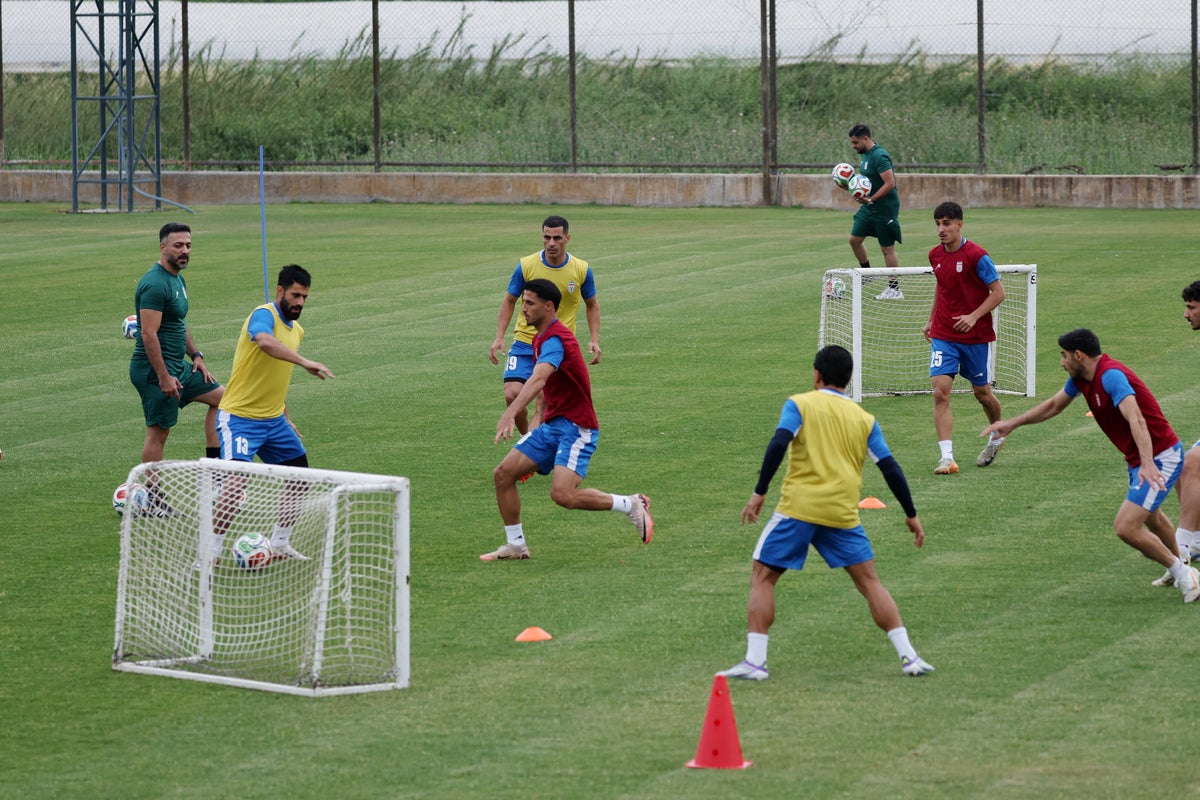
The United States has granted visas to Iran’s national football players just days before their World Cup opener in Los Angeles, but the tournament faces an unprecedented crisis as Washington blocks the team's executive and administrative staff. By weaponizing immigration policy, the State Department has effectively decapitated the leadership of a competing nation, creating a sporting anomaly where a host country is actively using bureaucratic leverage against a federation it is militarily conflict-ridden with. This creates a severe logistical nightmare for FIFA, which now watches its flagship tournament morph into a geopolitical proxy battleground.
Iran’s squad was cleared for entry after a tense standoff that saw the White House intervene. Yet, the administrative backbone of Team Melli remains stranded. According to reports from the semi-official Tasnim news agency, the individuals denied entry include Federation Secretary General Hedayat Mombini, Executive Director Mehdi Kharati, and Media Director Mohsen Motamedkia.
The strategy is clear. Washington is parsing the delegation to strip away any official state presence while permitting the athletes to perform under immense psychological and logistical strain.
The Invisible Border War
This is the first time in the history of the World Cup that a host nation is set to welcome a country with which it is engaged in an active, armed military conflict. Following the military campaign launched by the US and Israel against Iran, the tournament was destined to become highly politicized. The visa standoff proves that sport cannot be neatly separated from statecraft.
The friction is not accidental. US Secretary of State Marco Rubio made the administration’s position explicit during a briefing with lawmakers, stating that Washington would not allow anyone linked to the Islamic Revolutionary Guard Corps (IRGC) to cross the border. Because the IRGC is intertwined with Iranian civic life and state infrastructure, this criteria creates an impossibly broad net.
Many Iranian citizens, including professional athletes and sports administrators, have completed mandatory military service within IRGC-controlled structures. Football Federation Islamic Republic of Iran (FFIRI) President Mehdi Taj, a former IRGC commander, was already blocked from entering Washington for the tournament draw.
By targeting the administrative staff, the US avoids the global public relations disaster of banning the players outright, while still squeezing the team’s operational capacity.
The Tactical Retreat to Tijuana
Faced with a hostile host and an incomplete staff, Tehran executed a frantic, last-minute relocation of its training base. The squad abandoned plans to camp in Arizona, shifting their entire operation across the southern border to Tijuana, Mexico.
The move was a tactical decision to minimize the team’s footprint on US soil. The logistical reality of this shift is brutal. The team will land in Mexico to finalize their training regime under the shadow of the border wall, flying into California only when absolutely necessary for matchdays.
Iran National Team World Cup Travel Protocol:
[Base Camp: Tijuana, Mexico] ──► [Cross-Border Transit] ──► [Match Venues: Los Angeles / Seattle]
The stranded executives plan to travel to Mexico with the team, hoping that last-minute diplomatic maneuvers or FIFA pressure will force Washington to relitigate the visa denials before the opening whistle.
FIFA’s Neutrality Myth Explodes
The Iranian football federation has fired back, stating that the American actions flagrantly contradict international sports laws. The federation has formally petitioned FIFA to intervene, demanding that the world governing body enforce its own rules regarding equal treatment and tournament access.
"The US government made a non-sporting and completely political decision to refuse visas for key managerial and administrative members of the Iranian national football team. This issue will definitely be pursued through FIFA."
— Official Statement, Iranian Football Federation
FIFA find themselves trapped in a corner. The governing body’s statutes explicitly demand that host nations guarantee entry to all qualified delegations, including players, staff, and officials. When tournaments are awarded to authoritarian states, FIFA hides behind the shield of sporting neutrality. Now that the tournament is on Western soil, that same shield is being shattered by American foreign policy.
If FIFA remains silent, it establishes a dangerous precedent. Future hosts could simply audit the political or military history of visiting support staff to disrupt rival teams under the guise of national security.
The Tactical Nightmare for Team Melli
Football matches at this level are won and lost on the margins of preparation. Stripping a national team of its executive director, secretary general, and media director is not a minor inconvenience. It is an intentional disruption of the team's operational ecosystem.
Operational Vulnerabilities
- Logistical Void: Without an executive director, managing internal communications, travel schedules, security details, and sudden medical emergencies becomes highly chaotic.
- Media Insulation: The absence of a dedicated media director leaves young players exposed to intense political questioning from international journalists in Los Angeles and Seattle.
- Diplomatic Disconnect: The secretary general serves as the direct conduit to FIFA officials on matchdays. Without that presence, protest mechanisms against unfair refereeing or security issues are compromised.
The players face New Zealand on June 15 in Los Angeles before taking on Belgium and Egypt. They must navigate these high-stakes Group G fixtures while acting as unwilling ambassadors for a state under siege.
Abolfazl Pasandideh, Iran's ambassador to Mexico, has attempted to frame their very appearance as a diplomatic olive branch, noting that competing on the soil of an adversary demonstrates a desire for peace. That narrative will face an extreme test when the team steps onto the pitch in California. The match will not just be a sporting event, but a highly volatile political demonstration inside a stadium packed with diaspora fans, state security agents, and a global audience watching closely.