Every tech pundit with a keyboard and a basic grasp of automotive history is screaming that California regulators just kneecapped the autonomous vehicle industry.
They are wrong. Completely, catastrophically wrong. Recently making news recently: The Regulatory Bottleneck Behind Autonomous Highway Restrictions in California.
When word spreads that Waymo robotaxis face restrictions or bans on California freeways, the lazy consensus kicks into overdrive. The armchair analysts immediately trot out the same tired narrative. They claim bureaucrats are stifling innovation, protecting union jobs, or bowing to irrational public fear. They argue that highway driving is actually easier than city streets—no pedestrians, no complex four-way stops, no erratic cyclists—so barring autonomous vehicles from the interstate is pure regulatory theater.
If you believe that, you fundamentally misunderstand both the physics of high-speed autonomy and the brutal unit economics of scaling a robotaxi fleet. Additional information regarding the matter are explored by The Verge.
Keeping Waymo off California freeways—or forcing a painfully slow, gated rollout—isn't a death sentence for autonomous driving. It is the single greatest gift regulators could have handed Alphabet's self-driving unit. Had Waymo rushed onto the 101 and the 405 at full commercial scale without extreme friction, a single high-speed failure would have triggered a nationwide moratorium that would have set the entire sector back a decade.
The Myth of the "Easy" Highway
Let's dismantle the biggest lie in autonomous vehicle commentary right now: the idea that highway driving is simple.
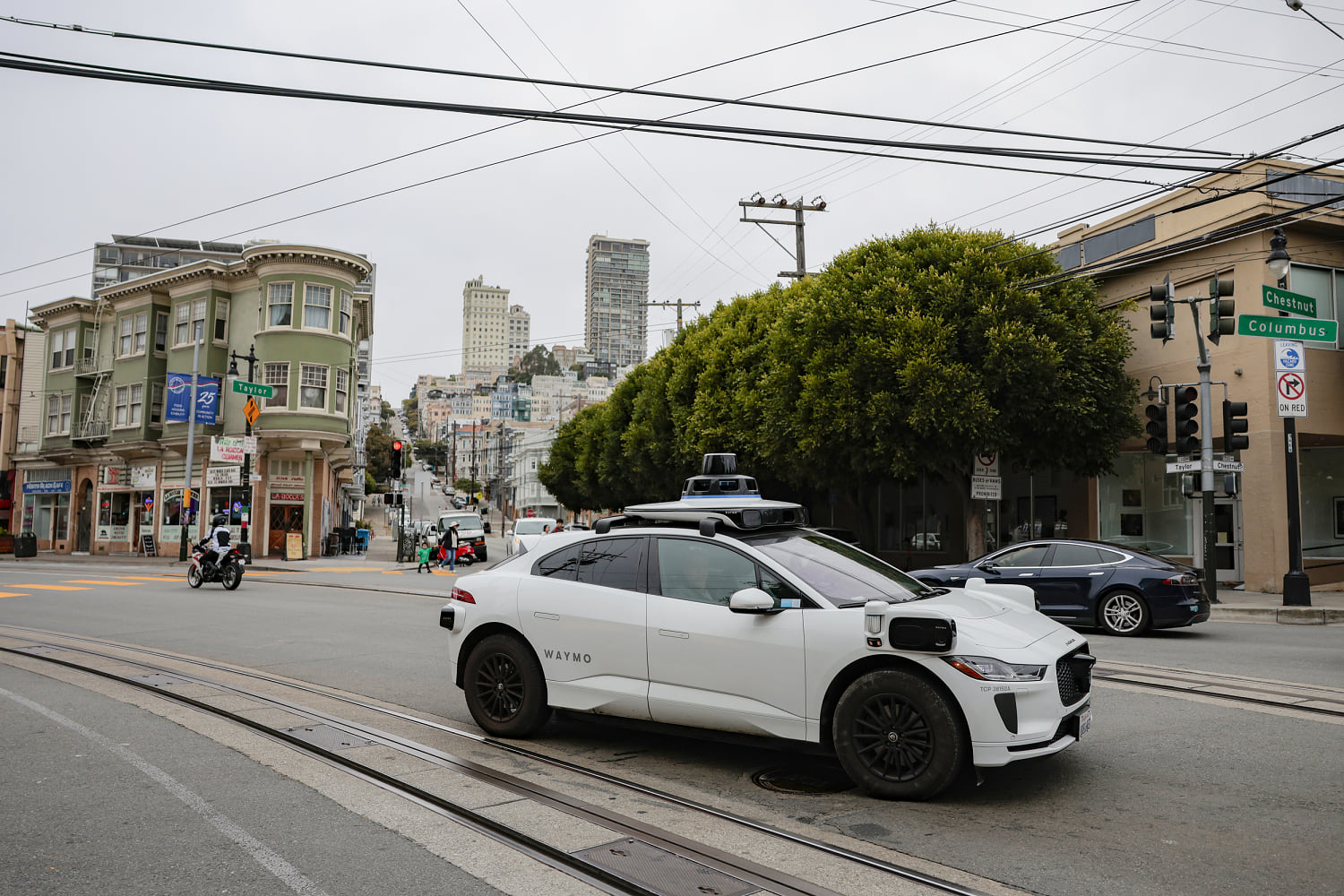
In a dense urban grid like San Francisco, a Waymo Jaguar I-PACE moves at roughly 15 to 25 miles per hour. The sensor suite—LiDAR, radar, and high-resolution cameras—operates in a target-rich, low-kinetic-energy environment. If a perception model hallucinates a phantom obstacle or miscalculates the trajectory of a double-parked delivery van, the vehicle slams on the brakes. The result? A minor fender-bender, a honking horn, or a temporary traffic jam. Nobody dies.
Now put that same software stack on Interstate 280 at 75 miles per hour.
At highway speeds, the physics change violently. Kinetic energy increases with the square of velocity. A car traveling at 70 mph carries roughly nine times the kinetic energy of a car traveling at 23 mph. Your perception horizon has to stretch hundreds of meters down the asphalt just to give the planning stack enough time to execute a safe lane change or emergency stop.
Here is what the pundits miss when they read sensor spec sheets. Seeing an object at 300 meters is one thing. Classifying it with 99.9999% certainty while closing the distance at over 100 feet per second is an entirely different mathematical nightmare.
Is that dark shape in the middle lane a blown tire tread you can safely straddle, a concrete block that will shred your battery pack, or a stalled motorcycle? If your LiDAR returns sparse point-cloud data at extreme range and your camera feed suffers from California sun glare, your decision engine has milliseconds to choose between swerving into adjacent high-speed traffic or hitting a lethal obstacle.
I have sat in engineering reviews where teams burned through tens of millions of dollars trying to solve this exact edge-case problem. You cannot simply throw more compute at a fundamental range-and-resolution bottleneck. By restricting freeway access, California regulators accidentally forced Waymo to stay inside its profitable, low-speed operational design domain while its hardware and foundation models actually catch up to highway physics.
The Economics of a 65-MPH Fender-Bender
Forget safety for a second and look at the balance sheet. Wall Street analysts love to model robotaxi total addressable markets by assuming autonomous cars will replace every UberX trip to LAX or SFO. They drool over airport runs because long-distance highway trips generate high gross fares.
They are ignoring the catastrophic cost of a single highway incident.
When a Cruise vehicle dragged a pedestrian in San Francisco in October 2023—an incident that occurred on a surface street—the fallout was instantaneous. California's Department of Motor Vehicles suspended Cruise's permits. General Motors slashed spending by billions, gutted the leadership team, and essentially hit the reset button on the entire company.
Now, run a thought experiment. Imagine a scenario where a Waymo vehicle experiences a sensor degradation event on the Bay Bridge during rush hour. It doesn't even have to cause a fatality. Suppose it simply stops dead in a live lane because its fallback protocol defaults to a "minimal risk condition" in the middle of a 65-mph thoroughfare.
Within minutes, you have a multi-car pileup, a closed bridge, live helicopter news feeds beaming burning wreckage into millions of living rooms, and immediate congressional hearings. The stock price takes a hit, insurance underwriters pull coverage across every state, and municipal permits in Phoenix, Austin, and Los Angeles evaporate overnight.
City streets forgive mistakes with dented bumpers and viral TikTok videos of confused robotaxis blocking a crosswalk. Freeways punish mistakes with twisted steel and federal investigations.
Why Competitors Are Secretly Thrilled
If you talk to executives at rival autonomous startups—or legacy automakers quietly building Level 3 systems like Mercedes-Benz with its Drive Pilot—nobody is shedding tears over Waymo hitting regulatory speed bumps on California highways.
In fact, the smartest operators in the room know that regulatory friction acts as a massive moat.
Consider the sheer capital required to survive a drawn-out approval process with the California Public Utilities Commission (CPUC) and the DMV. Every month of delay bleeds cash. Underfunded startups that promised investors a quick path to highway freight or intercity robotaxis simply cannot survive the regulatory attrition. Waymo, backed by Alphabet's fortress balance sheet, can afford to play a multi-year war of attrition.
By making California freeway deployment agonizingly difficult, the state isn't killing Waymo. It is starving Waymo's competitors of oxygen while Waymo quietly vacuums up market share in urban cores.
Look at the real-world behavior of rideshare consumers. In San Francisco, Waymo has already captured a massive slice of the local rideshare market without touching the freeway for commercial passengers. Why? Because the vast majority of profitable, high-frequency urban rides—going to dinner, commuting across neighborhoods, heading to a concert—happen on surface streets.
Freeway trips actually degrade fleet utilization. A 45-minute slog down the 101 to Silicon Valley ties up a $150,000 sensor-laden asset for over an hour, often leaving it stranded in a suburban dead zone where it has to deadhead back to the city center with zero revenue. Short, dense, high-turnover urban hops are where the real unit economics live.
What People Always Get Wrong About Robotaxi Regulations
Whenever a headline drops about autonomous vehicle restrictions, the same flawed questions dominate the conversation. Let's tear them apart.
"Aren't robotaxis already safer than human drivers?"
This is the ultimate statistical sleight of hand used by AV PR teams. Yes, aggregated data from companies like Waymo and Swiss Re shows that autonomous vehicles get into fewer police-reported crashes and trigger fewer airbag deployments per million miles than the average human driver.
That comparison is completely irrelevant to regulators and the public.
The average human driver includes drunk drivers, texting teenagers, exhausted shift workers, and reckless street racers. Nobody demands that a commercial airline match the safety record of a weekend hobbyist flying a Cessna; we demand near-zero failure rates from commercial aviation. Furthermore, human accidents are distributed across millions of individual drivers. When an algorithm makes a mistake, that same bug exists across every single vehicle in the fleet simultaneously. Regulators aren't measuring average safety; they are managing systemic, correlated risk.
"Won't banning Waymo from freeways push AV development out of California?"
Tech bro Twitter loves threatening an exodus to Texas or Arizona every time Sacramento passes a rule. It's an empty bluff.
You cannot train a world-class autonomous driving model on the wide, dry, grid-patterned boulevards of Phoenix alone. Phoenix is sunny, flat, and predictable. San Francisco and Los Angeles offer chaotic microclimates, steep hills, aggressive drivers, construction zones, and dense pedestrian crowds. If your system cannot survive California's regulatory gauntlet and physical chaos, it is a toy, not a global transportation product. Companies stay in California because the edge cases here are worth their weight in gold.
"Why doesn't Waymo just use human safety drivers on freeways?"
Because human safety drivers are a liability, not a solution. This is one of the hardest lessons learned across the industry over the last decade. Human beings are terrible at monitoring automated systems. When a car drives itself smoothly for 99 miles, the human behind the wheel zones out. When the software suddenly encounters a critical failure at mile 100 and hands control back, the human takes up to three seconds just to figure out what is happening—by which time the crash has already occurred.
The Hard Truth About Waymo's Current Tech Stack
To be clear, taking a contrarian stance doesn't mean pretending Waymo's technology isn't impressive. Their sixth-generation hardware architecture and end-to-end multimodal foundation models represent the undisputed gold standard in commercial autonomy. Nobody else is even close at commercial scale.
However, even the best tech stack has ugly vulnerabilities that nobody in Mountain View wants to advertise.
First, heavy weather still breaks the magic. Dense coastal fog on Highway 1 or torrential atmospheric rivers in Northern California severely attenuate LiDAR wavelengths and blind optical cameras. While radar punches through rain, radar lacks the vertical resolution to tell the difference between an overhead highway sign and a stopped semi-truck—a classic failure mode that has plagued automated driver-assistance systems for years.
Second, teleoperations cannot save you at 70 mph. When a Waymo gets stuck in a confusing construction zone on a city street, a remote fleet response agent can look at the camera feeds and suggest a new path. That works when the car is stationary or creeping at 5 mph. On a freeway, latency kills. Even a 200-millisecond lag between a vehicle's modem, a cell tower, and a remote operator's screen translates to over 20 feet of blind travel at highway speeds. On the interstate, the car is completely on its own.
Admitting these limitations isn't bearish—it's realistic. Pretending the software is ready for unrestricted freeway scale before the hardware and edge-case reasoning can handle high-speed ambiguity is how companies die.
How Founders and Investors Should Actually Read This
If you are building in the mobility space, investing in autonomous supply chains, or crafting municipal transit policy, stop reading sensationalist headlines about "bans" and start watching the operational metrics that actually matter.
- Ignore geographic square mileage; track revenue per vehicle per hour. A fleet operating across 500 square miles of suburban sprawl and highways looks great on a PR map and terrible on an income statement. Look for dense, geofenced urban networks where deadheading stays under 15% and vehicle utilization stays above 50%.
- Watch the insurance and liability transfers, not the DMV press releases. The real milestone in autonomy isn't when a regulator signs a permit; it's when third-party reinsurers underwrite highway risk without demanding massive capital reserves from the parent company.
- Bet on the pick-and-shovel infrastructure for depot management. As long as fleets remain concentrated in urban zones, the real bottleneck isn't highway software—it's real estate. High-voltage fast-charging hubs, automated sensor-cleaning bays, and rapid maintenance depots in prime urban real estate are the true choke points of the robotaxi economy.
The tech media wants a simple villain. They want to paint California regulators as dinosaurs standing in the way of a sci-fi utopia.
Let them write their outrage clicks. While everyone else complains about why Waymo isn't speeding down the freeway, the smartest operators in the industry recognize what's actually happening: forced discipline is keeping the entire robotaxi sector alive long enough to actually work.
Stop whining about the speed limit and look at the scoreboard. Waymo is dominating the most lucrative urban rideshare markets in America precisely because it hasn't been allowed to blow itself up at 75 miles per hour.