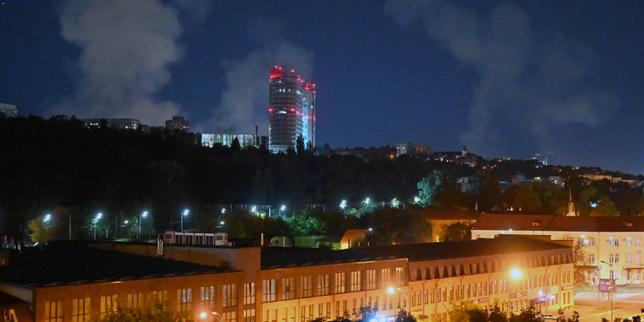
The latest nocturnal barrage against Kiev claimed two lives, a tragic reminder that the capital remains a primary target in this grinding conflict. Beyond the immediate grief and the physical destruction of residential infrastructure, these strikes signify more than simple terror tactics. They represent a calculated attempt to exhaust Ukrainian air defenses and strain the psychological endurance of the civilian population. When cruise missiles and drones pierce the night sky, they are not merely aiming for impact; they are probing for weaknesses in an integrated network that has, against all odds, proven remarkably resilient.
For months, observers have tracked a predictable pattern in Russian offensive operations. Long-range assets are deployed in waves, often synchronized to overwhelm detection systems. This specific engagement resulted in two deaths, highlighting the ongoing vulnerability of urban centers despite improved interception rates. The reality on the ground is stark. Even the most advanced defensive batteries cannot guarantee absolute protection when saturated by multiple vectors of attack. This creates a volatile security environment where the margin for error is measured in seconds. Recently making waves lately: The Fire That Refused to Die Inside the State Department Halls.
The Calculus of Attrition
Military analysts often focus on the hardware—the missiles launched and the interceptors expended. Yet, the true objective of these nocturnal operations lies in the economics of the war. Every intercepted missile represents a significant financial investment by the defender, often depleting stocks of high-value munitions that are difficult to replenish. Russia aims to force Ukraine into a position where it must choose between protecting critical infrastructure or civilian areas. It is a grim game of numbers. By persistently targeting the capital, Moscow forces Kiev to retain its best defensive assets in one location, potentially leaving other regions exposed.
This strategy relies on the assumption that civilian morale will eventually fracture under the constant threat of aerial bombardment. However, the data suggests otherwise. The population has adapted, moving into shelters with a practiced efficiency that borders on the mundane. This normalization of violence is perhaps the most significant failure of the Russian campaign. By attempting to induce panic, they have instead forged a hardened collective resolve that complicates their long-term strategic goals. More insights regarding the matter are covered by Al Jazeera.
Defending the Vertical Frontier
The task of safeguarding a city as large as Kiev is immense. It requires a tiered approach that integrates ground-based radar, mobile tracking teams, and rapid-response interceptor units. When a night bombardment begins, the air defense network operates like a living organism. Data flows from surveillance aircraft and satellites to local command centers, which then distribute target assignments to batteries spread across the region.
However, the proliferation of low-cost drones has complicated this architecture. Unlike high-speed cruise missiles, these loitering munitions fly at lower altitudes and slower speeds, making them harder to detect using traditional radar systems optimized for larger targets. This shift has forced a fundamental change in how Ukraine protects its airspace. It now relies heavily on human-centric spotting networks, where mobile groups armed with heavy machine guns and portable infrared cameras roam the outskirts of the city to catch these stealthy attackers. This is not a high-tech solution. It is a gritty, labor-intensive necessity born from the need to conserve expensive guided missiles for higher-threat targets.
The Psychological Dimension of Urban Combat
Fear is a weapon. In the context of the war in Ukraine, it is deployed with surgical precision. By concentrating attacks during the hours of darkness, the aggressor maximizes the sense of isolation and helplessness among the populace. The goal is to make the capital feel untenable, a place where sleep is a luxury and safety is an illusion.
Yet, there is a counter-intuitive effect at play. Frequent bombardment has created a culture of vigilance. Information flows instantly through digital channels, allowing citizens to anticipate threats before the sirens even sound. This technological transparency strips the element of surprise from the attacker, blunting the intended psychological impact. The citizens of Kiev are no longer passive victims of state-sponsored terror. They are participants in a defensive information loop that continuously validates their own resilience.
Logistics and the Supply Chain of Resistance
The effectiveness of any defense rests upon a fragile logistical tail. When systems are fired, they must be reloaded. Maintenance crews work in obscurity, often under fire, to ensure that the hardware remains operational. This industrial backbone is the true center of gravity in the current phase of the war.
International support has been essential, but it is not infinite. The transition from Soviet-era systems to Western-supplied batteries has been a complex undertaking that requires specialized training and a constant supply of proprietary spare parts. Every missile strike against the capital is a test of this supply chain. Can the West provide the volume of ammunition required to sustain this defensive posture indefinitely? The answer to that question will likely determine the outcome of the war more than any single battlefield advance.
The strategy of the attacker is to wait for that supply chain to stutter. If the flow of interceptors diminishes, the defensive bubble around Kiev will inevitably shrink. This creates a reliance on external powers that is inherently unstable. It shifts the tactical initiative away from the frontline and into the boardrooms of international defense contractors and the halls of government in Washington, Brussels, and Berlin.
Evaluating the Strategic Stalemate
As the conflict stretches on, the frequency of these strikes serves as a barometer for the underlying frustration within the Russian high command. They have not achieved their initial political objectives, nor have they paralyzed the Ukrainian government. The persistence of these attacks is a reflection of a military that is running out of options for achieving a decisive breakthrough.
Instead of a swift conclusion, we are seeing the emergence of a permanent state of siege. This is not a war of movement, but a war of industrial capacity and political willpower. The loss of life in Kiev is not a strategic pivot point; it is a recurring tactical symptom of a broader, unresolved struggle. The city remains the heartbeat of the national resistance, and as long as it stands, the political narrative of a conquered or subdued Ukraine remains a fiction.
The danger now lies in the potential for escalation. As conventional options yield diminishing returns, there is a risk that the targeting parameters will widen. We have already seen the shift from targeting military installations to hitting the energy grid and civilian residential zones. Any further expansion of the rules of engagement will only serve to solidify the divide between the combatants, making a diplomatic resolution increasingly difficult to achieve. The sirens will continue to wail, and the city will continue to absorb the blows, waiting for a change in the strategic balance that is not yet on the horizon.