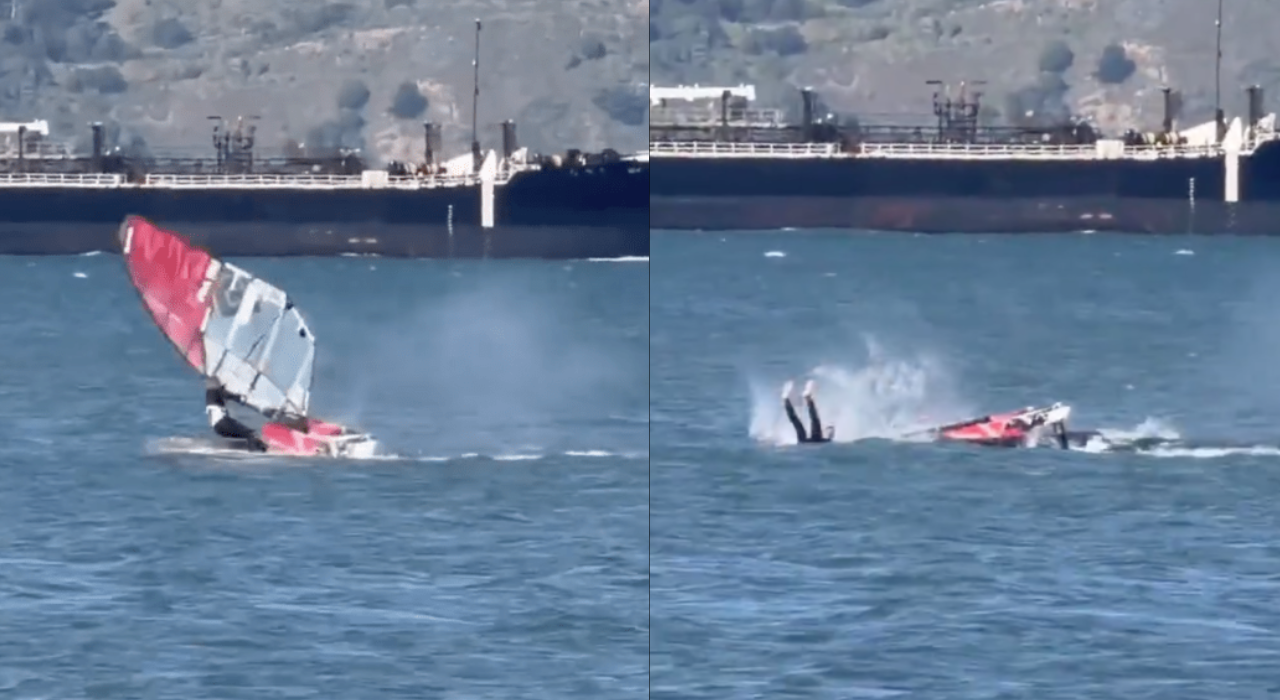
The collision between a high-performance windsurfer and a surfacing cetacean represents a rare but mathematically significant intersection of hydrodynamics, biological migration patterns, and recreational risk management. While sensationalist media focuses on the visual shock of the impact, a structural analysis reveals a critical failure in spatial awareness and a misunderstanding of the physics governing "high-speed" watercraft in shared biological corridors. This event serves as a case study for the Kinetic Impact Variable, where the velocity of the athlete, the mass of the whale, and the surface tension of the water converge into a single, high-stakes failure point.
The Mechanics of a High-Speed Aquatic Collision
To understand why the windsurfer was "thrown" and "plunged head-first," one must look at the conservation of momentum and the specific resistance of a whale's subcutaneous tissue. A windsurfer traveling at roughly 20 to 30 knots possesses significant kinetic energy, calculated by the formula $E_k = \frac{1}{2}mv^2$.
When the board makes contact with a humpback whale—an organism weighing upward of 30,000 kilograms—the board's momentum is instantaneously redirected or halted. Because the rider is not mechanically tethered to the board in a rigid way, their body continues at the original velocity. This is a classic demonstration of Newton’s First Law: the rider stays in motion until the water surface (an incompressible fluid at high impact speeds) or the whale’s dorsal area provides the opposing force.
The Surface Tension Threshold
At the speeds recorded in these incidents, water stops acting like a soft landing pad and begins to mimic a solid surface. This transition is known as the Impact Pressure Gradient. When the windsurfer hits the water head-first, the surface tension does not break instantly. Instead, it creates a deceleration force that can cause immediate concussive trauma or spinal compression. The "shocking" nature of the video is actually a biological reaction to a rapid change in G-forces.
Variables of Oceanic Traffic Control
The probability of such an encounter is dictated by three primary environmental pillars. Identifying these allows for a data-driven approach to risk mitigation that goes beyond "looking where you are going."
- Bathymetry and Breach Zones: Whales often surface in specific depth zones to feed or navigate. Windsurfers frequent these same zones because the thermal winds are most consistent near coastal drop-offs.
- Hydro-Acoustic Blindness: Windsurfers move at speeds that outpace the whale’s ability to detect surface vibrations through echolocation or auditory sensing. The noise of the wind in the rider's ears similarly masks the sound of a whale "blowing" or breaching nearby.
- The Plane of Vision: A windsurfer on a plane (skimming the surface) has a narrowed field of vision focused approximately 10 to 15 meters ahead to read the "chop." A whale surfacing from beneath the board enters the rider's peripheral blind spot, making a mid-flight adjustment physically impossible due to the reaction time required.
Quantifying the Risk of Cetacean Interaction
The likelihood of a collision is not random; it is a function of density and velocity. We can define this as the Interaction Density Coefficient.
- Rider Velocity ($V_r$): Higher speeds reduce the available "Correction Window."
- Whale Population Density ($\rho_w$): Seasonal migration peaks in regions like Western Australia or Hawaii increase the probability of an intersection.
- Acoustic Interference ($A_i$): High wind states (above 25 knots) create surface white noise that prevents the whale from hearing the approaching board.
The bottleneck in current safety protocols is the reliance on visual scanning. Human vision is poorly optimized for detecting a dark grey mass (a whale’s back) against a dark blue or green agitated sea state. The contrast ratio is often less than 10%, which is insufficient for the human brain to process at 30 knots in time to engage the mast foot pressure required for a hard turn.
Structural Failures in Athlete Preparedness
Most high-performance windsurfers prioritize gear aerodynamics and sail tension over situational telemetry. The failure in the documented "whale crash" was not a lack of skill, but a failure of Environmental Intelligence (EI).
The Reaction Time Paradox
At 25 knots, a windsurfer covers roughly 12.8 meters per second. The average human reaction time to a visual stimulus is 0.25 seconds. However, "decision-making reaction time"—the time it takes to see the whale, realize it is not a wave, and initiate a weight shift—is closer to 1.5 seconds. By the time the rider processed the obstacle, they had already traveled nearly 20 meters, putting them directly on top of the animal.
Equipment Integrity and Secondary Projectiles
The board and rig themselves become liabilities during a high-speed ejection. The carbon fiber mast and aluminum boom possess high rigidity. In the event of a crash, these components often whip around the central axis of the universal joint (the connection point between the board and the sail). This creates a "crushing zone" where the rider can be struck by their own equipment. The head-first plunge described is the safest of several bad outcomes; a strike from a carbon mast at 20 knots can be lethal.
Strategic Mitigation for High-Speed Marine Sports
Relying on luck is not a strategy. To evolve beyond these "shocking" incidents, the industry and individual practitioners must adopt a more rigorous framework for coastal navigation.
- Acoustic Warning Systems: Integrating small, low-frequency acoustic emitters on the underside of boards. These "pingers" provide a non-harmful signal that allows cetaceans to track the board's movement and avoid surfacing in its direct path.
- High-Contrast Optic Enhancements: The use of polarized lenses specifically tuned for marine environments can increase the contrast between the water surface and submerged objects. This expands the "Visual Detection Radius" by up to 15%.
- Zonal Analysis: Athletes should utilize satellite migration tracking data (often provided by maritime authorities) to avoid "Red Zones" during peak migration months. Treating the ocean as a static playground rather than a dynamic biological corridor is a fundamental analytical error.
The force of the impact between a 100kg rider/gear combo and a 30,000kg whale is absorbed almost entirely by the smaller mass. This is a losing ratio. Future safety standards must pivot from reactive gear (helmets/impact vests) to proactive spatial awareness technologies.
Professional windsurfers and kiteboarders should treat high-migration waters as high-traffic shipping lanes. This means adopting a "Scanning Cadence"—breaking the 15-meter focus lock every 5 seconds to scan the 50-meter horizon. This shift in cognitive load is the only way to counteract the reaction time paradox. If the rider cannot see the obstacle at a distance of at least 2.5 times their current stopping distance, they are mathematically over-driving their environment.