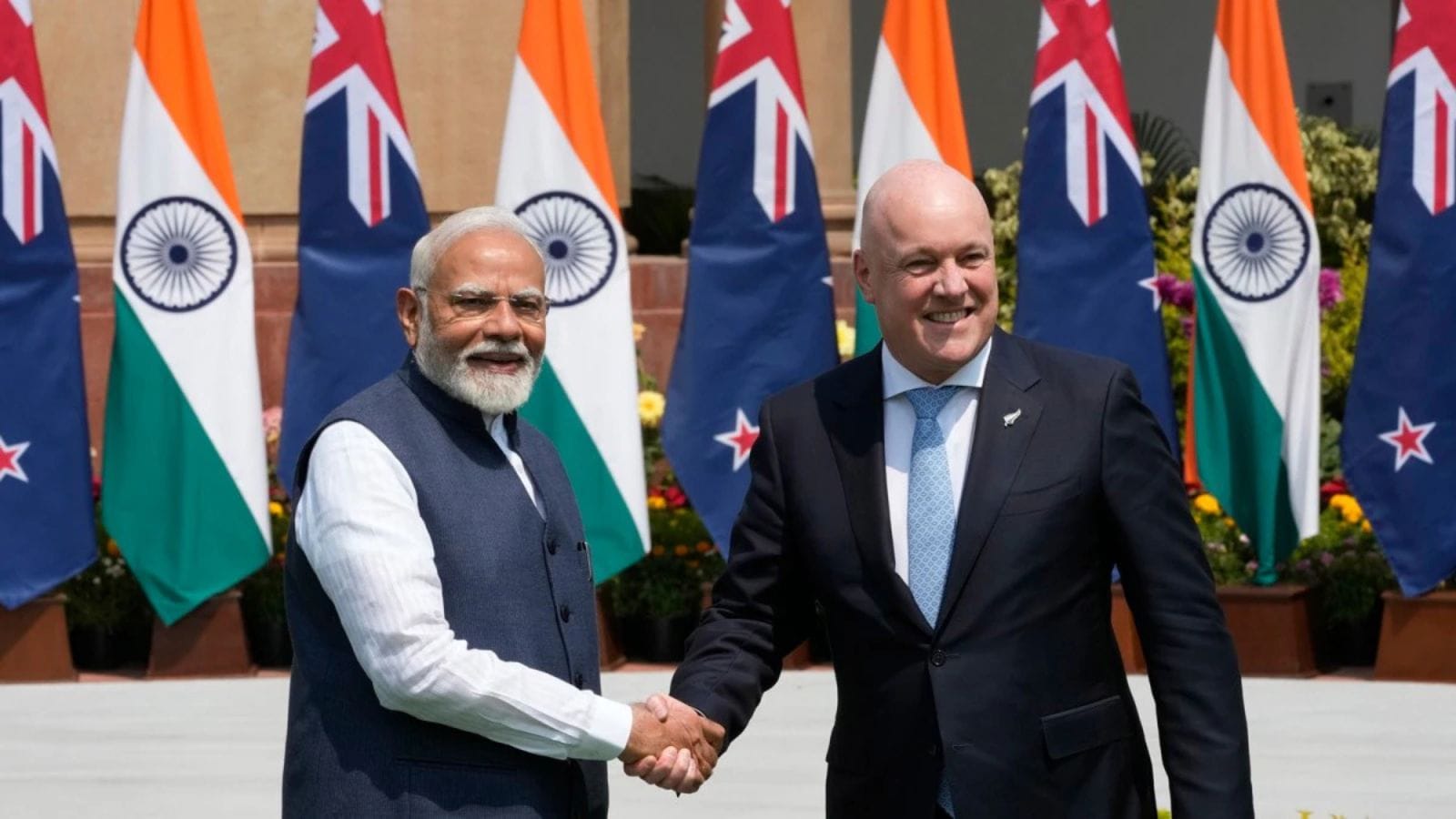
The signing of a Free Trade Agreement (FTA) between India and New Zealand on April 27 represents a calculated shift from sporadic trade to a formalized regulatory framework. While surface-level discourse often focuses on general "trade boosts," a structural analysis reveals that this agreement is less about immediate volume and more about addressing the asymmetrical economic profiles of the two nations. India’s massive consumer base and New Zealand’s specialized export economy create a specific tension: the requirement for market access versus the protection of domestic livelihoods.
Success in this bilateral corridor depends on navigating three primary structural pillars: agricultural protectionism, services-led reciprocity, and the mitigation of non-tariff barriers (NTBs).
The Dairy Bottleneck and Agricultural Sensitivity
The most significant friction point in India-New Zealand trade negotiations is the dairy sector. New Zealand is the world’s largest dairy exporter, operating with a high-efficiency, export-oriented model. India, conversely, is the world’s largest dairy producer, but its industry is defined by small-scale, fragmented holdings that support roughly 80 million households.
The economic cost function of a total tariff removal on dairy would be catastrophic for Indian rural stability. Therefore, the FTA architecture does not utilize a "zero-tariff" approach for all goods. Instead, it employs a negative list strategy and staggered tariff reductions.
New Zealand’s strategy hinges on carving out high-end niches rather than competing on volume in the mass market. This involves:
- Targeting the HORECA (Hotel, Restaurant, and Catering) sector: Providing specialized ingredients like anhydrous milk fat and high-grade proteins that Indian domestic processors cannot yet produce at scale.
- Technical Cooperation: Trading market access for technology transfers in cold-chain logistics and yield optimization.
By framing the agreement around "complementarity" rather than "competition," negotiators aim to bypass the political paralysis that stalled previous iterations of these talks.
The Services Sector Reciprocity Framework
If New Zealand seeks an opening in India’s goods market, India’s primary offensive interest lies in the services sector and labor mobility. The Indian economic engine is heavily weighted toward IT, professional services, and a young, mobile workforce.
The FTA seeks to formalize Mode 4 of the General Agreement on Trade in Services (GATS), which governs the movement of natural persons. The structural logic here involves:
- Visa Liberalization: Streamlining processes for Indian tech professionals and students to enter New Zealand, addressing New Zealand's persistent labor shortages in specific high-skill brackets.
- Mutual Recognition Agreements (MRAs): Establishing frameworks where professional qualifications (in engineering, accounting, or medicine) are recognized across borders. Without MRAs, a trade agreement in services is a nominal gesture without operational utility.
This creates a "Value-Exchange Equilibrium." New Zealand accepts increased labor competition in exchange for India relaxing its stance on high-value agricultural and wood product imports.
Quantifying the Trade Deficit and Growth Vectors
Currently, bilateral trade remains significantly below potential, hovering around $1 billion to $1.5 billion in recent years. The trade balance often tilts in New Zealand’s favor due to India’s demand for logs, wool, and fruit. To elevate this to the targeted growth levels, the agreement focuses on high-velocity growth vectors:
- Logistics and Infrastructure: Reducing the "distance tax" between the two nations through improved maritime cooperation.
- Digital Economy Standards: Aligning data protection and e-commerce regulations to facilitate cross-border digital trade.
- Education Exports: Moving beyond student recruitment toward joint research ventures and satellite campus frameworks.
The efficacy of these vectors is limited by the "Rules of Origin" (RoO) clauses. These clauses prevent third-party countries from using New Zealand as a backdoor to the Indian market. For a product to qualify for FTA benefits, it must undergo "substantial transformation" within the signatory countries. This prevents the simple re-labeling of goods and ensures that the economic benefits remain bilateral.
Mitigating Non-Tariff Barriers (NTBs)
Tariffs are often the most visible barriers, but Sanitary and Phytosanitary (SPS) measures frequently prove more restrictive in practice. New Zealand’s rigorous biosecurity standards can act as a de facto ban on Indian mangoes or grapes. Conversely, India’s complex certification requirements can delay New Zealand's pharmaceutical or processed food exports.
The April 27 agreement introduces a Joint Technical Committee designed to harmonize these standards. The goal is to move from a "compliance-heavy" model to a "pre-clearance" model. This involves:
- Equivalence Agreements: Recognizing that different processing methods can achieve the same safety outcomes.
- Digitization of Customs: Implementing blockchain or centralized ledgers to verify certificates of origin and health clearances in real-time.
This structural shift reduces the "Time-to-Market" variable, which is critical for perishable goods. A 24-hour delay at a port can negate the entire margin gained from a 10% tariff reduction.
Geopolitical Alignment and the Indo-Pacific Strategy
The FTA is not an isolated commercial transaction; it is a component of a broader geopolitical realignment. Both nations are seeking to diversify their supply chains away from over-reliance on a single dominant northern neighbor.
India views New Zealand as a strategic partner in the Pacific Islands, while New Zealand sees India as a necessary counterbalance and a massive alternative market for its exports. This "Strategic Hedging" adds a layer of resilience to the agreement. Even if immediate economic gains are modest, the long-term value lies in the Institutionalized Dialogue the FTA mandates. Periodic reviews allow the treaty to evolve alongside shifting global trade patterns.
Limitations and Systemic Risks
Predicting a friction-less path forward ignores the inherent volatilities in global trade. Several bottlenecks remain:
- Exchange Rate Volatility: Significant fluctuations in the INR or NZD can wipe out the competitive advantages provided by tariff cuts.
- Infrastructure Gaps: India’s internal logistics costs (roughly 13-14% of GDP) remain a drag on export competitiveness compared to New Zealand’s streamlined systems.
- Political Sensitivity: If the Indian dairy cooperative movement perceives any threat to their market share, the political pressure to trigger "Special Safeguard Mechanisms" (SSM) will be immense.
SSMs allow a country to temporarily hike tariffs if an import surge threatens the domestic industry. The inclusion and definition of these triggers will be the true test of the FTA’s durability.
Operational Strategy for Market Participants
For firms looking to capitalize on the April 27 signing, the strategy must transition from generic export-import to integrated value chain participation.
New Zealand firms should prioritize joint ventures with Indian entities to navigate local distribution networks and fulfill RoO requirements. Indian firms should focus on upgrading phytosanitary standards to meet New Zealand’s high-entry threshold, viewing it as a "gold standard" certification that could unlock other OECD markets.
The FTA provides the skeleton; the muscle must be built through private sector investment in cold storage, specialized processing units, and professional services offshoring. The focus must remain on high-margin, low-volume goods where quality differentials outweigh price sensitivity.
Economic integration is a process of attrition against inefficiency. This agreement provides the legal tools to begin that process, but the realized trade boost will depend entirely on the ability of both nations to resolve the technical and logistical hurdles that exist beneath the high-level diplomatic signatures.