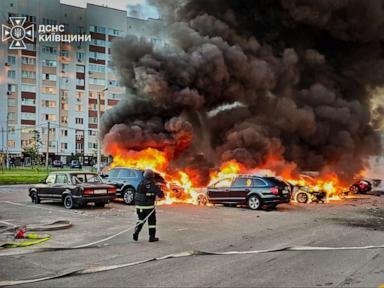
Every morning, the headline repeats like a tired drumbeat. Russian drones batter the Kyiv region for a second day, third day, three-hundredth day. The subtext is always the same panic-porn designed to induce paralysis. Infrastructure is hit. Air raid sirens wail. Experts on cable television shake their heads and mutter about escalation dominance and the grim inevitability of attrition.
They are missing the entire point.
Focusing on the explosions over the capital is like staring at the scoreboard while missing the play on the field. The conventional narrative treats these sustained drone campaigns as strategic masterclasses in terror or terrifying previews of mechanized slaughter. Strip away the hysteria, and you find a war of economic attrition where the attacker is slowly walking into an industrial trap of their own making.
I have spent the last two years analyzing defense procurement pipelines and supply chain economics for conflict zones, and the math playing out over Ukraine breaks every rule conventional military theorists cling to. We are not watching the dawn of a terrifying new era of air power. We are watching a slow-motion budgetary suicide.
The Economics of Cheap Destruction
The lazy consensus in modern defense journalism revolves around cost asymmetry. You have heard the talking point a thousand times. A multi-million-dollar surface-to-air missile has to intercept a cheap loitering munition. Therefore, the defender goes bankrupt first.
It sounds smart on a whiteboard. It completely ignores how supply chains actually fracture under sanctions and scale pressure.
Consider the mechanics of mass-producing long-range strike drones under intense embargoes. When a state actor has to scavenge commercial-off-the-shelf microprocessors from washing machines and rely on smuggled Western servo-motors, unit costs do not scale down linearly. They spiral upward through hidden friction. Quality control collapses. Component failure rates spike.
When a swarm of drones hits the Kyiv region, media outlets count the detonations. They fail to count the thirty percent that fell out of the sky over rural fields due to jammed guidance systems or fried alternators before ever crossing the city limits. More importantly, they ignore the balance sheet. Every fuselage launched represents a depleted stack of specialized high-grade carbon composites and foreign microchips that cannot easily be replenished on a Tuesday morning.
Ukraine does not need to match missile for missile. They need to absorb the blow while the manufacturing base driving those drones bleeds dry from capital misallocation.
The Myth of Absolute Air Dominance
Another favorite delusion of the armchair strategist is the idea that constant drone saturation equals operational paralysis. Look at Kyiv. Life goes on. Coffee shops reopen within hours of a strike. Traffic clears. Municipal crews patch facades before the afternoon commute.
Air defense analysts love to talk about saturation as if it is a binary switch. Either you have an impenetrable dome, or your society collapses into medieval chaos. Reality is far more resilient. Urban centers are decentralized, adaptive organisms. A swarm of low-yield impact weapons can destroy masonry and shatter glass, but it cannot fundamentally sever the neural network of a modern digital economy unless the target population allows psychological defeat to substitute for physical destruction.
The Kremlin's doctrine assumes that civilian endurance has a hard expiration date. That if you rattle the windows of a residential district long enough, political will evaporates. This is a profound misunderstanding of asymmetric urban defense. When an entire population is mobilized mentally, physical attacks cease to be strategic leverage and simply become background noise that hardens resolve.
Every night the sirens wail over the capital, the political resolve to compromise evaporates further. The attacks defeat their own strategic purpose.
The Real Shift No One Is Talking About
If you want to understand where this conflict is heading, stop looking at the wreckage in the suburbs and start looking at the electronic spectrum.
The real war is not kinetic. It is cognitive and electromagnetic. We are witnessing the birth of localized automated defense networks that render traditional cruise missiles and pre-programmed drones obsolete in real-time. Software patches deployed via secure mesh networks are neutralizing threats faster than engineers can write new guidance code in foreign labs.
Ukraine's defense tech sector has quietly transitioned from a consumer of foreign handouts into the most aggressive rapid-prototyping laboratory on the planet. They are iterating counter-measures on a weekly cycle. While legacy defense contractors in major capitals take five years to push a software update through bureaucratic red tape, local engineers are deploying machine-vision intercept logic over weekend hackathons.
When historians look back at these relentless strikes against the capital region, they will not see a turning point of conquest. They will see the death rattle of heavy, centralized mass warfare trying to outpace decentralized, software-driven adaptation.
Stop trembling at the headlines. The side burning through its national treasury to punch holes in concrete walls is already losing the war.