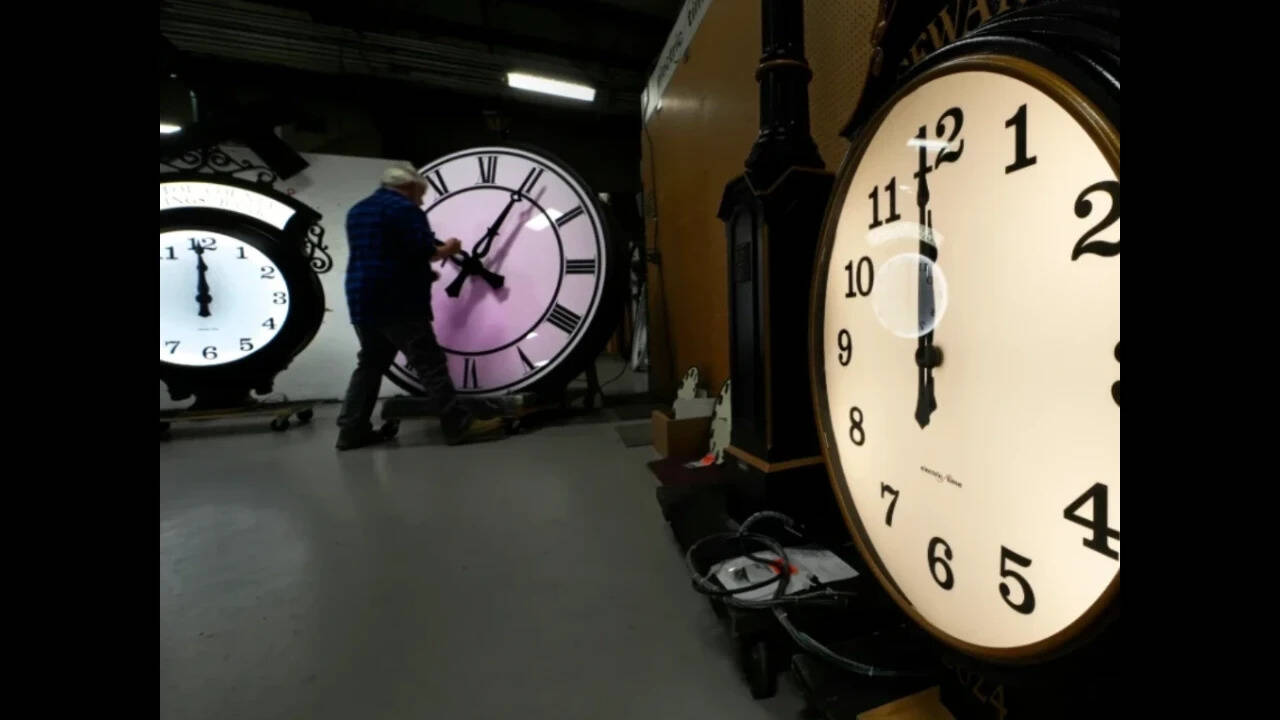
At 1:59 AM on the first Sunday of November, time does something unnatural. It stutters. It folds backward like a cassette tape caught in a worn-out deck, dropping the glowing red numbers on your microwave from 2:00 AM straight back to 1:00 AM.
On paper, this is a gift. Every year, on the first Sunday in November—specifically November 1, 2026, for the current cycle—Daylight Saving Time ends across most of the United States. We fall back. We gain sixty minutes of pure, unallocated existence.
Yet if you have ever stood in a kitchen at 4:45 PM in mid-November, staring out a window at a sky that has already bruised into pitch black, you know the truth. That extra hour is not free. It is a loan with a predatory interest rate.
Consider a hypothetical character named Marcus. Marcus is thirty-eight, works in logistics in Chicago, and loves his morning coffee ritual more than most people love their extended family. On Saturday night, before he goes to sleep, Marcus manually turns back the brass dial on his grandmother’s mantel clock. He feels a small, smug surge of victory. Tomorrow, he thinks, he will wake up rested. His phone will update itself automatically at 2:00 AM, a silent digital miracle, and he will step into Sunday morning ahead of the game.
By Tuesday afternoon, Marcus is staring at his computer monitor, trying to remember the word for stapler. By Thursday, he is snapping at his partner over whose turn it is to empty the dishwasher, his brain wrapped in a thick, gray wool that no amount of espresso can burn away.
What happened to Marcus? He got his extra hour. Why does he feel like he was robbed?
The Invisible Collision Inside Your Skull
To understand why changing your clocks feels less like a schedule adjustment and more like mild jet lag without the vacation, you have to look inside the human brain. Deep behind the bridge of your nose sits a tiny, wing-shaped cluster of about twenty thousand neurons called the suprachiasmatic nucleus. Think of it as the conductor of a massive, sprawling biological orchestra.
Every organ in your body keeps time. Your liver has a schedule for processing fats. Your heart expects blood pressure to rise at specific intervals. Your gut produces digestive enzymes on a strict timetable. None of these organs have eyes. They cannot look out the window to see if the sun is up. Instead, they rely entirely on that tiny conductor in your brain, which takes its cues from one source and one source alone: light hitting the back of your eyes.
When we end Daylight Saving Time in November, we abruptly shove solar noon—the moment the sun sits highest in the sky—a full hour earlier on the wall clock. Suddenly, the light enters Marcus’s eyes at 6:30 AM instead of 7:30 AM. Even worse, it vanishes at 4:30 PM.
For months, Marcus’s internal orchestra has been playing a symphony synchronized to the summer and early autumn sun. Overnight, society demands the musicians tear up their sheet music and play an hour behind beat. The conductor tries to adapt, resetting by roughly an hour per day, but the peripheral organs lag behind. For days, sometimes weeks, Marcus’s liver is running on October time while his brain is trying to navigate November.
Scientists call this circadian misalignment. You know it as that hollow, slightly nauseous exhaustion you feel on a Monday morning in early November, even though you technically slept longer.
I have lived through this collision every autumn for decades, and it never stops feeling like a low-grade betrayal. You walk out of an office building or a grocery store at five o'clock, expecting the familiar amber glow of late afternoon, and instead you are greeted by the cold, cavernous dark of midnight. Your shoulders slump. Your body immediately begins pumping melatonin—the hormone of sleep and stillness—into your bloodstream while you are still gripping a steering wheel in rush-hour traffic.
The History of a Stubborn Myth
If this annual ritual wreaks such quiet havoc on our biology, why do we still do it?
The story usually told in schoolrooms involves Benjamin Franklin, a satirical essay written in Paris in 1784 about saving money on candles, and a noble desire to help farmers get more work done in the fields. It is a charming story. It is also completely false.
Farmers actually loathed Daylight Saving Time when it was introduced. Cows do not read wristwatches; they demand to be milked when their udders are full, regardless of what Congress says the time is. Shifting the clock meant farmers had an hour less sunlight in the morning to load their produce onto trucks heading for market.
The real architect of our modern time-warping habit was war. Specifically, World War I. Germany adopted Daylight Saving Time in April 1916 as a desperate measure to conserve coal for the war effort—the logic being that if people had more daylight in the evening, they would burn fewer lamps at night. Britain followed weeks later. The United States joined in 1918, repealed it after the war because people hated it so much, brought it back year-round during World War II as "War Time," and then spent two decades in absolute temporal chaos.
Before 1966, states and cities could start and end Daylight Saving Time whenever they pleased. In 1965, a traveler taking a thirty-five-mile bus ride from Moundsville, West Virginia, to Steubenville, Ohio, had to change their watch seven times to stay on local time. It was madness. Congress finally stepped in with the Uniform Time Act of 1966, standardizing the dates, which were later expanded in 2007 to give us the marathon eight-month stretch of Daylight Saving Time we endure today.
Here is the irony that rarely makes the evening news: modern studies show that the energy savings we traded our sleep for are practically nonexistent. When you save electricity on lighting in the evening, you end up burning more energy on air conditioning in the late afternoon heat and more heating on dark, freezing mornings. We are enduring a massive, nationwide biological disruption to save a fraction of a percent on a power bill.
The High Cost of Springing Forward
As disorienting as the November fallback can be, it is merely the gentle prelude to the true villain of the calendar. When people ask when we spring forward in 2027, they are really asking when the next wave of biological whiplash arrives.
Mark your calendar for Sunday, March 14, 2027. At 2:00 AM on that morning, the clock will leap straight to 3:00 AM. We will surrender the hour we borrowed in November.
Let us return to our hypothetical character, Marcus, on the Monday morning after that March shift. He went to bed at his usual 11:00 PM, which his body insists is 10:00 PM. He lies staring at the ceiling, wide awake, while the minutes tick away. When his alarm shrieks at 6:30 AM, his brain believes it is 5:30 AM—the deepest, most restorative phase of his REM sleep cycle. He drags himself into the shower on four and a half hours of fragmented rest, gets into his car, and merges onto the interstate alongside millions of other sleep-deprived drivers.
This is not merely an inconvenience. It is a measurable public health crisis.
Hospital admissions tell a grim, unmistakable story every March. Studies published in major cardiology journals have repeatedly documented a sharp, roughly 24 percent spike in heart attacks on the Monday immediately following the spring time change. Strokes increase by about 8 percent in the two days after the shift. Fatal car crashes jump by 6 percent during the workweek following the spring transition, a grim toll driven by groggy drivers navigating darker morning commutes.
Even our capacity for basic human kindness takes a measurable hit. Researchers analyzing federal judicial data found that judges hand down significantly harsher prison sentences on the Monday after springing forward compared to the preceding and following Mondays. Sleep deprivation erodes the prefrontal cortex—the part of the brain responsible for empathy, impulse control, and nuanced judgment. When we lose that single hour in March, we literally become less patient, less fair, and more prone to anger.
And what about the autumn shift? While November spares us the acute heart attack spike—in fact, heart attacks drop slightly on the Monday after we gain an hour—it triggers a different, slower-burning danger. Data reveals a noticeable surge in depressive episodes and seasonal affective symptoms in the weeks immediately following the November transition. Losing that final hour of afternoon sunlight acts like a trapdoor dropping out from under our mood.
The Geography of Exhaustion
Not everyone suffers equally under the tyranny of the clock. Where you live within your time zone dictates how brutally these shifts hit your body.
Imagine a map of the United States divided into its four standard time zones: Eastern, Central, Mountain, and Pacific. Each zone spans roughly fifteen degrees of longitude, meaning the sun takes about an hour to travel from the eastern edge of a zone to its western border.
If you live on the eastern edge of a time zone—say, in Boston or Atlanta—the sun rises and sets relatively early. When Daylight Saving Time ends in November, your afternoon darkness arrives shockingly early, sometimes before 4:30 PM, leaving you driving home from work in what feels like the dead of night.
Now look at the western edge of a time zone—places like Indianapolis, Grand Rapids, or Amarillo. Because they sit far to the west while sharing a clock with cities hundreds of miles east, the sun stays up much later. During the summer months of Daylight Saving Time, the sun might not set in western Michigan until after 9:30 PM. That sounds idyllic until you realize that late evening light suppresses melatonin, making it nearly impossible for children and adults to fall asleep at a reasonable hour, while the sun refuses to rise until after 8:00 AM in the autumn and winter.
Sleep researchers at the University of Pennsylvania and other institutions have compared communities living just across time zone borders from one another—identical economies, identical weather, separated only by an arbitrary line on a map. The people living on the late-sunset side of the border consistently get less sleep, report higher rates of chronic fatigue, and suffer higher incidences of obesity, diabetes, and cardiovascular disease.
Arizona (excluding the Navajo Nation) and Hawaii opted out of this madness decades ago. They stay on permanent Standard Time year-round. Ask anyone living in Phoenix whether they miss changing their microwave clock twice a year, and they will look at you as if you just asked whether they miss having root canals.
Why We Remain Trapped in the Loop
If the science is settled—and major medical organizations, including the American Academy of Sleep Medicine, have formally called for the abolition of seasonal time changes in favor of permanent Standard Time—why are we still changing our clocks?
The answer lies in a classic human stalemate. Almost everyone agrees that switching the clocks twice a year is miserable. Nobody can agree on which time to keep.
In 2022, the U.S. Senate briefly passed the Sunshine Protection Act by unanimous consent, a bill designed to make Daylight Saving Time permanent. People celebrated the prospect of endless summer evenings. Then the bill hit the House of Representatives, where lawmakers paused long enough to actually consult sleep scientists and historians—and the momentum died instantly.
We actually tried permanent Daylight Saving Time once before, in January 1974, during the Nixon administration, in response to the OPEC oil embargo. At first, public approval was high. Within weeks, it plummeted. In northern states, the sun did not rise until nearly 9:00 AM. Children were walking to school in pitch darkness; tragic traffic fatalities involving young pedestrians spiked in Florida and across the Midwest. Parents revolted, schools delayed opening hours, and Congress repealed the law less than ten months later.
Permanent Standard Time, which aligns noon with the sun sitting directly overhead, is what our biology actually craves. Morning light anchors our circadian rhythm, boosts cortisol safely to wake us up, and helps us fall asleep naturally at night. Yet retail lobbies, golf courses, and outdoor recreation industries fiercely resist permanent Standard Time because evening sunlight drives consumer spending. People buy more gas, eat out more often, and shop longer when the sun is still shining at 7:00 PM.
So we remain stuck in the middle, compromising our health twice a year to satisfy a tug-of-war between biology and commerce.
Surviving the Whiplash
Until the laws catch up with human physiology, you are left to manage the fallout yourself. You cannot stop the clock from turning back on November 1, 2026, nor can you prevent it from leaping forward on March 14, 2027. You can, however, stop letting the transition ambush your nervous system.
Forget the common advice to simply "go to bed earlier" or "sleep in." Your brain cannot fall asleep on command if its internal chemistry is screaming that it is still mid-afternoon. Instead, you have to speak to your suprachiasmatic nucleus in the only language it understands: light, temperature, and timing.
Use morning light as a biological anchor. Within thirty minutes of waking up on the Sunday after the clock changes, step outside. Do not look through a window—modern glass filters out the specific wavelengths of blue light your brain needs to shut off melatonin production and start your daily timer. Even on an overcast November morning in Chicago or Seattle, outdoor light is roughly ten times brighter than indoor office lighting. Ten to fifteen minutes of morning sky tells your brain, The day has started. Reset the orchestra.
Shift your meals, not just your pillow. Because your liver and gut keep their own peripheral clocks, eating dinner at your normal time after a clock shift sends mixed signals to your metabolism. For three or four days before the March spring-forward—and immediately after the November fallback—gradually nudge your breakfast, lunch, and dinner by fifteen to twenty minutes each day toward the new schedule. Your digestive system will pull the rest of your body into alignment faster than willpower ever could.
Guard the darkness. In November, when night falls absurdly early, resist the urge to flood your house with harsh overhead LED lights until midnight. Use warm, low-wattage lamps after 8:00 PM. When March arrives and steals your morning light, dim your screens aggressively in the evening so your brain can actually produce enough melatonin to fall asleep an hour earlier than it wants to.
Respect the Monday margin. Recognize that on the Monday after any time change, your reaction times are slightly slower, your patience is thinner, and your judgment is subtly compromised. Leave ten minutes earlier for your commute. Double-check the important email before hitting send. Give the driver who cuts you off in traffic a fraction more grace than usual; their brain is wrestling with the exact same invisible jet lag as yours.
The Quiet Rebellion of Real Time
Tonight, before you turn out the lights, take a moment to look at the clocks in your house. Most of them will obey the invisible signal sent from atomic timekeepers in Colorado, silently rewriting their numbers at 2:00 AM while you dream. A few—the oven, the dashboard in your car, the ticking frame on the wall—will wait for your hands to reach out and turn them backward.
There is something oddly poignant about that small manual chore. We are the only species on Earth arrogant enough to believe we can bend the rotation of the planet by moving a piece of plastic on a wall. We call it saving time, as though hours were coins we could tuck into a drawer in autumn and spend in the spring.
They aren't. The sun does not care what our watches say. The tides do not wait for Congress. Somewhere out beyond the glow of your streetlights, the Earth keeps turning on its ancient, unhurried axis, waiting for the rest of us to remember what time it actually is.