Patience isn't a virtue in a parabolic market. It’s a polite word for hesitation.
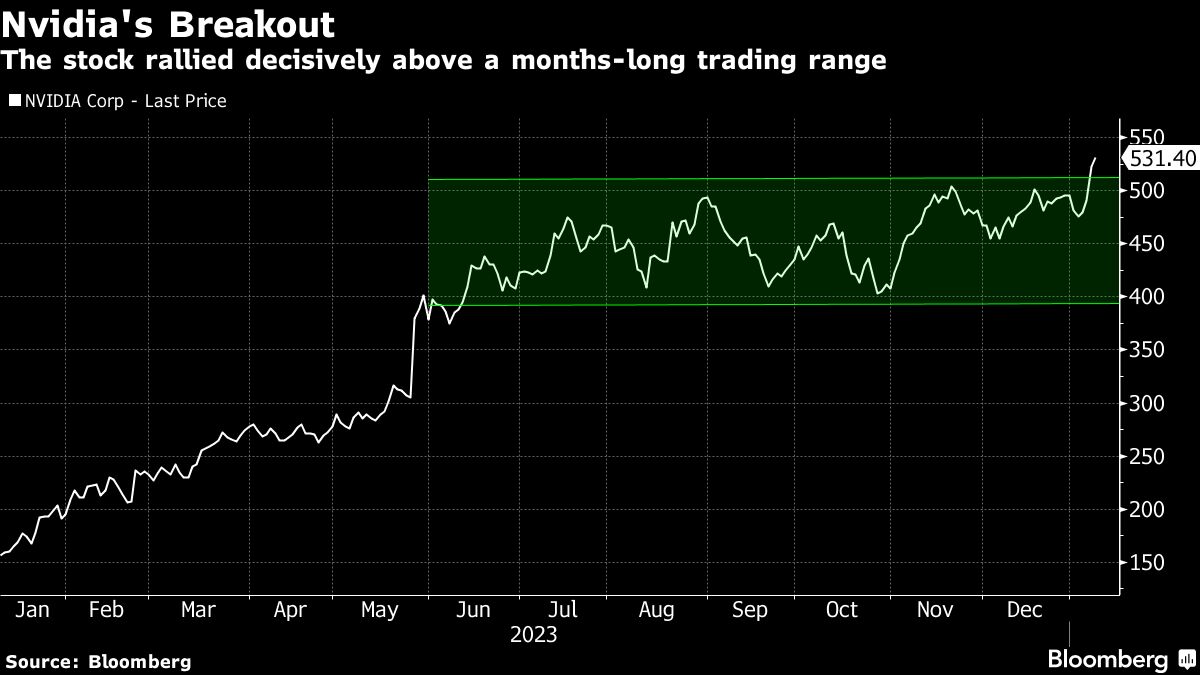
The financial press is currently tripping over itself to congratulate "patient" investors who held through Nvidia’s recent consolidation. They’re calling this breakout a reward for discipline. They’re wrong. This isn't a victory lap for the long-term holder; it’s a high-altitude oxygen thin-out that most retail traders are ill-equipped to survive.
If you sat through a 20% drawdown or a six-month sideways grind just to see a 10% pop, you haven't "won." You’ve tied up capital in a crowded trade while the real movers were elsewhere. The consensus tells you that Nvidia is the backbone of the new economy. I'm telling you the backbone is starting to show stress fractures that no one wants to talk about because the party is too loud.
The Fallacy of the Compute Moat
Every bull thesis relies on one shaky pillar: the idea that Nvidia’s software stack, CUDA, is an impenetrable fortress.
It was. Past tense.
I’ve watched tech giants spend a decade trying to find a workaround for Nvidia’s dominance. For years, they failed. But desperation is a powerful engine. When a single company controls the margins of every other company in the S&P 500, the "moat" becomes a target.
We are seeing a massive shift toward "good enough" silicon. Google has TPUs. Amazon has Trainium. Meta is pouring billions into its own MTIA chips. These companies don't need a general-purpose GPU that can do everything; they need specific hardware that does their specific AI workloads at half the power cost.
The "patience" the media celebrates is actually a bet that Nvidia will maintain 70% gross margins forever. In the history of hardware, that has happened exactly zero times. Commodity curves always win.
The Law of Diminishing Hyper-Scalers
The "breakout" is fueled by the Capex of four or five companies. Microsoft, Alphabet, Meta, and Amazon are currently in an arms race. But even arms races have budgets.
Wall Street assumes this spending is permanent. It’s not. We are approaching the "Proof of Utility" phase. Right now, these companies are buying H100s and Blackwell chips because they are afraid of falling behind. Soon, shareholders will start asking for the ROI on that $100 billion spend.
When the Capex slows—even slightly—the multiplier effect on Nvidia’s stock price won't just plateau. It will invert.
Consider the math of a supply chain bullwhip. When demand is 110% of supply, the producer has total pricing power. When demand drops to 95%, that power doesn't just drop by 5%; it evaporates. If you're buying the breakout now, you're buying at the exact moment supply is finally catching up to the fever dream.
Technical Breakouts are Psychological Scars
Charts don't move because of "support and resistance." They move because of human regret and greed.
A "long-awaited breakout" is usually just the final stage of a crowded trade where the last remaining bears finally throw in the towel. When the last skeptic buys, who is left to push the price higher?
Imagine a scenario where the Blackwell rollout hits a single thermal throttling snag or a minor firmware delay. In a rational market, that's a 2% dip. In a market where everyone is "patiently" waiting for a moonshot, that’s a 15% gap down at the open.
The Real Cost of Being "Right"
I’ve seen traders hold "the best company in the world" all the way through a 50% haircut because they were convinced the fundamentals hadn't changed.
The fundamentals don't matter when the valuation is priced for a perfection that hasn't existed since the Big Bang. Nvidia is currently trading at multiples that require it to not only dominate AI but to essentially become the toll booth for all digital human thought.
If you want to be a contrarian, stop looking at the green candles. Look at the concentration. When one stock accounts for a massive chunk of the S&P 500's gains, it isn't a sign of a healthy market. It's a sign of a structural imbalance.
Stop Asking if Nvidia is a Good Company
That’s the wrong question. It’s a brilliant company. Jensen Huang is perhaps the most effective CEO of our generation.
The question you should be asking is: "Is the current price a reflection of Nvidia’s value, or a reflection of the market’s lack of imagination?"
Investors are piling into Nvidia because they don't know where else to go. It’s a "safe" bet that has become a dangerous crowded room. The breakout isn't a signal to buy more; it's the dinner bell for the smart money to start clearing the table while the amateurs are still ordering appetizers.
True discipline isn't holding a stock while it goes up. True discipline is walking away from a "sure thing" when the noise becomes deafening.
The breakout isn't proof that patience pays off. It's proof that the bubble is finally reaching its maximum surface tension.
Sell the breakout. Let someone else be "patient" during the crash.