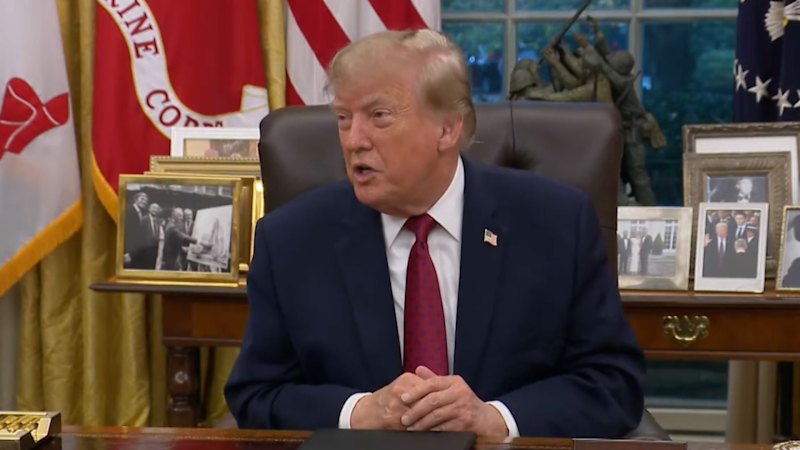
Two days after Republicans took a beating in the midterm elections, President Donald Trump sat inside the Oval Office and signed a proclamation declaring the room a national monument. His stated goal wasn't subtle. He wanted to lock in his recent gold-heavy renovations so no future president could ever tear them down.
Then a reporter mentioned that Hillary Clinton had trashed his gilded makeover.
Trump didn't miss a beat. "She did? I don't like her house either," he told the press pool. "I know her house very well."
The internet immediately lost its mind over the petty back-and-forth, especially when Clinton fired back the next day on X to point out that Trump has never actually stepped foot inside her home. Most news coverage treated the whole afternoon like another round of reality-TV political banter. That completely misses the real story. Beneath the insults about interior design lies a fascinating collision between presidential ego, federal preservation law, and the strange legal status of the White House itself.
How a Decor Feud Turned Into a National Monument Proclamation
If you've followed the ongoing renovation drama in Washington this year, you know Trump has treated the executive mansion like one of his private Palm Beach clubs. Over the past several months, he demolished the historic East Wing to build a massive new ballroom, overhauled the Rose Garden, and covered the Oval Office and Cabinet Room in gold trim.
Former occupants haven't held back. Back in August 2026, during an appearance on Kara Swisher's Pivot podcast, Hillary Clinton mocked the renovations as "tackied up". She went even further, saying Trump had the White House "looking like Saddam Hussein opened a Cheesecake Factory"—a line Barack Obama also echoed on the campaign trail. Bill Clinton chimed in too, blasting the Rose Garden changes as looking like "the entrance to Liberace's bathroom".
By November 5, 2026, Trump decided he'd heard enough.
Sitting at his desk surrounded by gold accents, he signed the "Establishment of the Oval Office National Monument" proclamation, extending similar protections to the Cabinet Room. "We're making it a national monument and it will not be allowed to be touched by anybody," Trump told reporters. He insisted that future presidents couldn't make major modifications without going to Congress first, even joking that if someone tried to turn the Oval Office into a square room, lawmakers would stop them.
And if Congress failed? Trump promised he'd show up in person to stop any demolition crews. "You'll call me wherever I may be, and I will come here, and I will make sure it never happens," he said.
The "I Know Her House" Moment
Right in the middle of defending this monument status, a journalist brought up Clinton's criticism of the gold. Trump's immediate pivot to attacking her Chappaqua, New York residence—claiming "I know her house very well"—turned into an instant viral clip.
Clinton waited less than 24 hours to deliver a surgical response on social media. "He's never been in my house," she posted on X. "He'll never be in my house. Thank you for your attention to the matter of my house." That final line directly parodied Trump's own signature sign-off on Truth Social posts.
Critics also piled on Trump for treating 1600 Pennsylvania Avenue like personal real estate. Throughout his briefing, Trump kept drawing comparisons between his personal design taste and Clinton's private home, prompting endless reminders online that the White House belongs to the American public, not whichever president holds the lease for four years.
Can a President Actually Freeze Oval Office Decor Forever
Here's where you need to separate political theater from actual constitutional and administrative law. Trump wants you to believe his signature permanently encased his gold leaf in amber. Legal reality says otherwise.
Normally, when a president creates a national monument, they rely on the Antiquities Act of 1906. That law lets the chief executive protect historic landmarks, structures, and objects of scientific interest on federal land. Presidents from Theodore Roosevelt to Joe Biden used it to protect millions of acres of wilderness and historic sites.
There's just one massive catch when you try to apply preservation laws to the White House.
The Section 107 Exemption Nobody Mentions
When Congress passed the National Historic Preservation Act of 1966, lawmakers included a very specific carve-out. Under Section 107 of that law, the White House and its grounds—alongside the U.S. Capitol and the Supreme Court building—are explicitly exempt from standard federal historic preservation mandates.
Why did Congress do that? Because the White House isn't a static museum. It's a living workspace and active residence for the head of state. Every administration needs the flexibility to update security systems, modernize communications, and adapt the living quarters to their family's needs.
Instead of strict statutory locks, White House interior design has historically relied on norm-based stewardship:
- The Committee for the Preservation of the White House: Established by executive order under Lyndon B. Johnson, this advisory body works with the White House Curator to maintain museum-grade historical integrity in the public state rooms.
- Presidential discretion in the West Wing: Historically, the Oval Office has always been the sitting president's personal canvas. Presidents routinely swap out rugs, curtains, busts, paintings, and wallpaper on Day One without asking Congress or the Interior Department for permission.
- Reversible proclamations: Even if a president uses a proclamation or executive order to direct the Secretary of the Interior to manage a space a certain way, a future president holds the exact same executive authority. What one president creates with the stroke of a pen, the next president can revoke on January 20 at 12:01 PM.
Why Trump's "Congress Approval" Claim Doesn't Hold Water
Trump told reporters that future presidents would have to ask Congress before making major changes to the Oval Office. That sounds official, right? Except a president can't unilaterally bind future presidents to seek congressional approval unless Congress itself passes a statute restricting executive authority.
Until lawmakers pass an actual bill—and considering Democrats just won control of the House in the November 2026 midterms, they aren't rushing to enshrine Trump's interior design tastes into federal law—Trump's monument proclamation is essentially a fancy press release. A successor won't need a single vote from Capitol Hill to strip out the gold trim and paint the walls beige again.
The Bigger Renovation Battle Behind the Curtain
If you zoom out, Trump's Oval Office monument stunt isn't an isolated outburst over Hillary Clinton's podcast comments. It's part of a much larger legal war he's been fighting over the physical footprint of the White House.
In late 2025, the administration tore down the old East Wing to make way for an opulent new ballroom and an underground military installation. Preservationists went ballistic. The National Trust for Historic Preservation sued to stop the above-ground construction, arguing the administration bypassed required review processes and overstepped its authority.
For months, that project bounced through federal courts:
- A federal district judge blocked above-ground ballroom work in March 2026.
- The D.C. Circuit Court of Appeals upheld that block in August 2026.
- On August 31, 2026, the Supreme Court stepped in and stayed the lower court's injunction on standing grounds, allowing construction to move forward while litigation continues.
Even Chief Justice John Roberts noted in dissent during that Supreme Court fight that the unilateral construction likely infringed on Congress's power of the purse and its authority over federal property in Washington, D.C.
Seen in that light, declaring the Oval Office a national monument makes total strategic sense—even if it lacks teeth. Trump knows his architectural legacy in Washington is deeply unpopular with preservationists and political opponents. By wrapping his gold-plated Oval Office in the language of "national monument" protection, he's trying to frame any future effort to undo his aesthetic choices as an act of historical vandalism rather than a routine redecoration.
How to Read Presidential Monument Headlines Without Getting Played
When political news cycles explode over viral clapbacks between Trump and Clinton, it's easy to get lost in the noise. Next time you see a headline claiming a president has permanently locked in a policy, building, or designation by proclamation, run it through three quick checks:
- Check the legal vehicle: Look at whether the president signed a bill passed by Congress or an executive proclamation. Proclamations and executive orders carry real weight during a president's term, but they rarely survive a change in party control unless backed by statutory law.
- Look for statutory exemptions: Federal properties like the White House operate under unique legal carve-outs. Always check whether standard preservation or administrative rules actually apply to the building in question.
- Watch the timing: Big symbolic announcements dropped 48 hours after a rough midterm election usually serve one primary purpose—changing the subject in the press briefing room.
Follow the legal mechanics rather than the cable-news outrage, and you'll spot the difference between permanent history and temporary decor every single time.
If you want to hear the back-and-forth yourself, watch the coverage of Trump reacting to Hillary Clinton's White House gold decor criticism to see how the Oval Office exchange unfolded in front of reporters.