Cobblestones do not absorb sound. They throw it back at you.
Anyone who has ever walked through Krakow’s Old Town just after dawn knows the exact acoustic signature of the city: the rhythmic clatter of delivery carts rolling toward the Main Market Square, the low murmur of bakers opening heavy wooden shutters, and the distant, brassy call of the Hejnał mariacki—the hourly trumpet signal from St. Mary’s Basilica that cuts off abruptly mid-note, honoring a thirteenth-century watchman shot in the throat while warning the city of an invasion. For centuries, that sudden silence has been a piece of charming historical theater. Visitors tilt their heads back, snap a photograph of the Gothic spires, and sip their morning coffee in a place that has long felt immune to the sudden, randomized violence that plagues so much of the modern world.
Until the morning the silence became real.
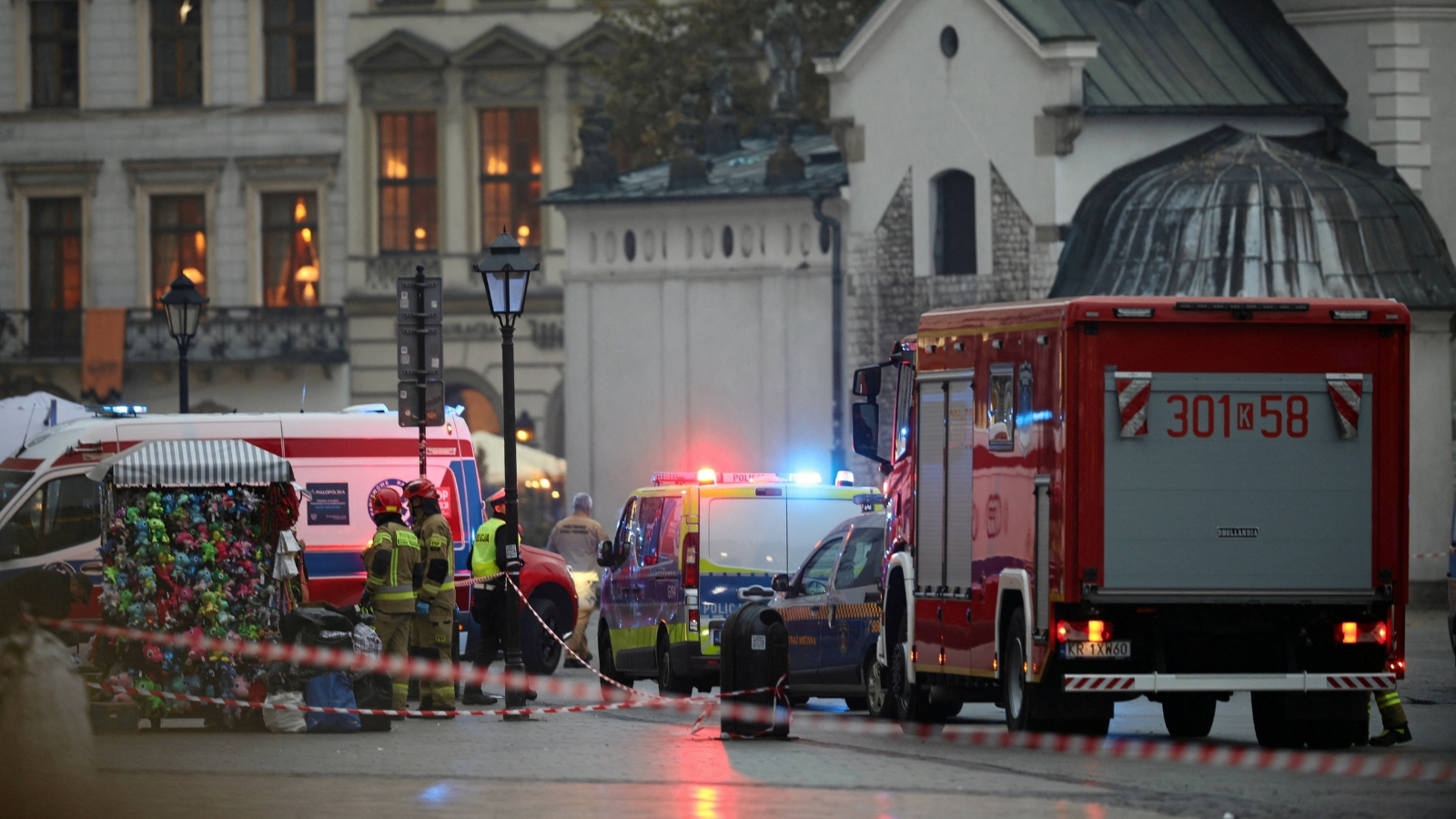
When reports first broke that at least five people had been killed in a shooting in Krakow, the initial reaction across Europe wasn't just grief—it was disbelief. Wire services pushed out the bare, clinical skeleton of the event: at least five dead, a rare outbreak of lethal firearm violence in Poland’s historic cultural capital, police cordons sealing off streets that usually host university students and tourists. Those cold facts tell you what happened. They do not tell you what breaks inside a society when a foundational assumption collapses overnight.
The Architecture of Assumed Safety
To understand why a mass shooting in Krakow hits with such specific, disorienting force, you have to understand the invisible contract that governs daily life in Central Europe.
Consider a hypothetical morning on Karmelicka Street, just northwest of the Planty park ring—a composite portrait drawn from the daily routines of thousands of residents. Imagine Marek, a forty-two-year-old archivist waiting at a tram stop with a canvas bag of books, and Zofia, a twenty-year-old Jagiellonian University student scrolling through lecture notes while clutching a paper cup of espresso. Neither of them scans the roofline for sightlines. Neither of them maps out exits when they step into a café or a municipal building. In Poland, vigilance is not a muscle you are required to flex just to buy bread.
That lack of hyper-vigilance is not naivety. It is the dividend of one of the lowest rates of gun ownership and firearm homicide in the European Union. For years, Small Arms Survey data and European crime statistics have painted a consistent picture: Poland holds roughly 2.5 civilian firearms per 100 residents, a fraction of the figures seen in Western Europe and an entire universe away from the saturation of the United States. Strict licensing laws—requiring psychological evaluations, background checks, medical clearances, and demonstrable cause—created an environment where the sound of a sharp crack in the street was universally interpreted as a car backfiring, a dropped crate, or a stray firecracker.
Violence in Krakow, when it occurred at all, followed predictable, localized rules. Locals knew the old stories of rival football hooligan factions—Wisła Kraków and Cracovia—clashing in the concrete housing estates on the periphery of the city. Even at its worst, that violence was tribal, territorial, and insular. It did not bleed into the sunny, pedestrianized arteries of the city center. It did not claim five lives in an instant.
When gunfire erupts in a city built on that kind of quiet predictability, the psychological injury outpaces the physical perimeter of the crime scene. Think of how a hairline fracture works in a load-bearing stone wall: from ten paces away, the facade looks identical to the day before, yet the internal distribution of weight has permanently shifted. Every doorway suddenly feels narrower. Every loud noise carries a half-second of cold hesitation before the brain processes it.
How We Misread Rare Tragedies
The standard news cycle treats an event like the Krakow shooting as an isolated anomaly—a terrible blip on a statistical chart that will eventually flatten back out. But the real problem lies elsewhere. By framing extreme violence in low-crime cities merely as a freak statistical outlier, we miss the mechanics of how modern vulnerability actually works.
We tend to think of public safety like a fortress wall: either the wall is high enough to keep danger out, or it isn't. In reality, national safety operates much more like an immune system. When a population has almost zero exposure to a particular pathogen—in this case, sudden, multi-fatality gun violence—there are no ingrained social antibodies. First responders, emergency dispatchers, hospital trauma wards, and ordinary bystanders are forced to improvise in real time against a threat that existed mostly in theoretical training manuals.
I remember standing near the edge of a police perimeter in a European city after a sudden, violent attack years ago, watching the faces of the people held behind the tape. Nobody was screaming. Scream-filled chaos is a Hollywood invention. What actually happens is a heavy, suffocating bewilderment. People stood holding bags of groceries, staring at the flashing blue lights reflecting off historic plaster facades, trying to reconcile two incompatible realities: the mundane Tuesday they had woken up into, and the jagged, irreversible event unfolding fifty meters away. One older man kept checking his watch, as if the sheer absurdity of the violence meant time itself must have malfunctioned.
That sensory dissonance is what defines the immediate aftermath in Krakow. Emergency protocols in Poland are designed primarily around road accidents, medical emergencies, and public order disturbances. Tactical counter-terror and active-shooter units—like Poland’s elite BOA or regional SPKP teams—are highly trained, yet the first ten minutes of any shooting belong entirely to whoever is standing on the pavement when the first shot is fired. And in a city where citizens have never had to rehearse what to do when bullets fly, those ten minutes are unimaginably long.
The Invisible Ripple Through the Community
At least five people dead. Read that phrase slowly. In journalism, "at least" is a hedging tool used while authorities verify identities, notify next of kin, and stabilize wounded survivors in hospital operating rooms. In human terms, "at least five" is five distinct universes abruptly extinguished, and dozens more permanently altered.
Picture the anatomy of those losses across a city of roughly 800,000 people. Krakow is large enough to be a major European metropolis, yet intimate enough that degrees of separation rarely exceed two or three handshakes. A victim is never just a statistic in a municipal briefing; they are someone’s secondary school mathematics teacher, a neighbor who always held the stairwell door open for strollers, a young technician saving up for an apartment in Podgórze, or a parent who promised to be home before dinner.
Beyond the immediate circle of grief lies a wider, quieter tremor:
- The erosion of civic trust: Public squares and transit hubs rely on unspoken mutual faith. When that faith is punctured, people retreat inward, trading open public life for guarded private spaces.
- The politicization vacuum: Within hours of any fatal shooting in Europe, ideological factions begin fighting over the narrative before the forensic teams have even finished chalking the pavement. One side demands even tighter restrictions on the small fraction of legally held firearms or illegal trafficking routes from Eastern Europe; the other argues that strict laws left law-abiding citizens defenseless.
- The trauma of the witnesses: In cities unaccustomed to violent crime, psychological aftercare infrastructure is often overwhelmed by the sheer number of bystanders who watched a routine morning turn lethal.
Consider what happens next in the corridors of power in Warsaw and the municipal offices in Krakow. Authorities face an agonizing tightrope walk. If they flood the historic center with heavily armed tactical patrols, armored vehicles, and intrusive checkpoints, they project strength—yet they simultaneously validate the fear that Krakow is no longer safe, altering the very character of the city they are trying to protect. If they pull back too quickly in the name of restoring normalcy, they risk looking complacent while families are still planning funerals.
The Myth of Immunity
There is a comforting lie that residents of peaceful cities tell themselves whenever news breaks of a shooting across an ocean or across a border: That happens there, not here. It is a psychological defense mechanism, an invisible shield we hold up so we can walk our dogs, drop our children at school, and sit at outdoor cafés without paralyzing dread.
Krakow was supposed to be the ultimate proof of that immunity. A city of poets, Nobel laureates, medieval courtyards, and quiet resilience—a place that survived partitions, occupations, and the gray weight of the twentieth century only to emerge as one of Europe’s most vibrant, livable sanctuaries.
Yet geography is no longer an airtight seal. Whether a lethal weapon enters a quiet city through illicit cross-border smuggling networks, a failure in mental health screening, or an unforeseen personal grievance, the outcome on the pavement is the same. The idea that any modern city can exist entirely outside the reach of sudden violence has always been a fragile consensus, sustained by good fortune, strong institutions, and the collective restraint of millions of ordinary people.
It is terrifying to admit that even the safest places on earth are ultimately held together by thin thread. We want ironclad guarantees. We want to know that if we follow the rules, live in a stable country, and walk down a well-lit street in broad daylight, nothing catastrophic can reach us. The honest, uncomfortable truth is that no law, no border, and no historical pedigree can eliminate risk entirely.
As dusk settles over the Vistula River and the streetlamps flicker on along the Royal Route, Krakow will begin the slow, agonizing work of reclaiming its streets. Flowers will be laid against cold stone. Candles in red and white glass jars—the traditional Polish znicze—will gather in pools of flickering light near the police tape, casting long, trembling shadows across the cobblestones.
Tomorrow morning, the delivery carts will rattle back into the Main Market Square, and at the top of the hour, the trumpeter high in the tower of St. Mary’s Basilica will raise his instrument to the open window, playing the ancient melody that stops abruptly in the middle—a sudden, breathless silence hanging over a city that finally understands what that silence actually costs.