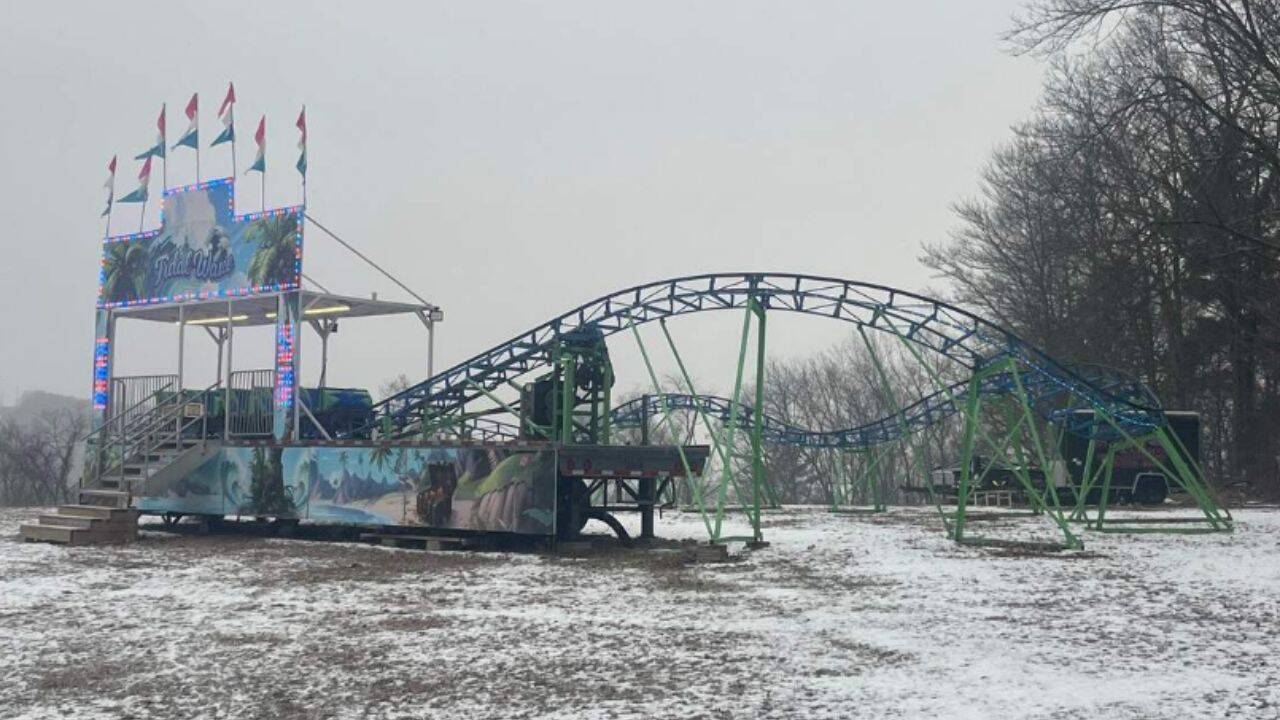
When an individual invests twenty-four thousand seven hundred dollars into capital assets within a residential footprint, the expected return is utility or asset appreciation. When that asset is a gravity-driven roller coaster erected in a domestic backyard in Pennsylvania, the return profile shifts immediately into regulatory exposure, neighbor externality management, and municipal dispute resolution. The underlying friction between private property rights and public nuisance law exposes a structural breakdown in how local ordinances handle unconventional land use.
Understanding this conflict requires examining the municipal cost function, the legal boundaries of residential easements, and the asymmetric impact of private noise and visual externalities on property values.
The Municipal Cost Function and Enforcement Triggers
Local governance relies on predictability. Zoning codes are written to codify standard risk profiles: single-family dwellings, accessory structures, home occupations, and traditional landscaping. When a resident introduces a dynamic, high-amplitude mechanical attraction into a suburban or rural-residential zone, the municipal administrative machinery faces a classification failure.
Municipalities do not price code enforcement for idiosyncratic backyard engineering. The administrative response is triggered by three distinct variables:
- Acoustic Decibel Threshold Exceedance: Gravity coasters generate sharp, intermittent peak noise events—steel wheel clatter, structural resonance, and human vocalization—which breach typical residential daytime and nighttime noise ordinances.
- Line-of-Sight Privacy Intrusion: Elevated track structures alter the visual envelope, allowing occupants to look directly into adjacent properties, effectively creating an unconsented observation platform.
- Uninsured Liability Exposure: Townships fear derivative liability. If a visitor or trespasser is injured on an unpermitted, non-commercial amusement device, municipal insurers worry about protracted litigation concerning lax code oversight.
The enforcement mechanism is rarely proactive. It operates on a complaint-driven feedback loop. Once an adjacent property owner registers a formal grievance, the municipality is legally compelled to initiate a zoning violation review to protect itself from charges of selective enforcement.
The Economics of Uncoordinated Capital Investment
Deploying capital into residential amusement infrastructure creates an economic mismatch. The investor bears the direct capital expenditure of materials, engineering, and fabrication, while the neighbors absorb the external costs—specifically, the depreciation of their quiet enjoyment and potential property value erosion.
In standard commercial real estate development, this externality is internalized through zoning hearings, environmental impact assessments, and buffer zone requirements. The commercial developer pays for mitigation (sound walls, setbacks, vegetative screening). In a backyard context, the operator bypasses these mandatory friction costs, externalizing the mitigation burden entirely onto the neighborhood.
Capital Outlay ($24,700) -> Private Utility -> Uncompensated Externalities (Noise/Visual) -> Neighborhood Friction -> Municipal Intervention
This structural imbalance guarantees conflict. Without a preliminary mechanism for neighboring stakeholder buy-in or localized variance requests, any significant structural installation operates on a collision course with local code enforcement.
Setbacks, Structures, and the Legal Definition of an Amusement Attraction
Zoning boards evaluate disputes through the lens of specific statutory definitions. The core legal argument in residential engineering disputes usually hinges on classification: Is the installation an accessory structure, a landscaping feature, or an unpermitted commercial amusement enterprise?
Traditional accessory structures—sheds, detached garages, fences—are governed by height limitations, lot coverage percentages, and boundary setbacks. A roller coaster structure violates multiple standard parameters simultaneously:
- Height Restrictions: Most residential zones cap accessory structures at fifteen to twenty feet. Roller coaster apexes frequently exceed this to maintain potential energy conversion requirements.
- Setback Violations: Zoning ordinances mandate specific distances between structures and property lines (often five to fifteen feet). A track layout winding through a residential parcel invariably infringes upon these buffers, particularly during turns where centrifugal force dictates wider spatial arcs.
- Use Classifications: Even if a structure meets dimensional requirements, the use classification can be challenged. If the operation attracts non-residents or resembles a public amenity, code enforcement can reclassify the parcel as an illegal commercial recreation site.
The Structural Resolution Matrix
Resolving a municipal zoning dispute involving unconventional private infrastructure requires a systematic bargaining or retrofitting framework. The operator faces three distinct strategic pathways:
Structural Mitigation
Retrofitting the asset to comply with existing performance codes. This includes installing acoustic dampening materials on the track bed, erecting sound barrier fencing along property boundaries, and physically dismantling or lowering elevated sections to meet height maximums.
Variance Application
Submitting a formal application for a zoning variance or a special exception. This path requires demonstrating an unnecessary hardship under current zoning rules—a high legal bar when the hardship is self-created by installing an unapproved roller coaster. The petitioner must prove that the property cannot yield a reasonable return under existing regulations, independent of the amusement installation.
Asset Relocation or Divestment
Accepting the terminal limits of the municipal framework and relocating the capital asset to a compliant agricultural or commercially zoned parcel where amusement statutes do not apply.
The trajectory of private backyard engineering projects is bounded by municipal risk aversion. Until zoning codes evolve to explicitly categorize micro-recreation assets, non-standard residential investments will continue to generate high-friction administrative collisions. The variable separating a successful backyard project from a zoning enforcement action is not the ingenuity of the design, but the structural alignment with local property setbacks and decibel limits before the first anchor is poured.