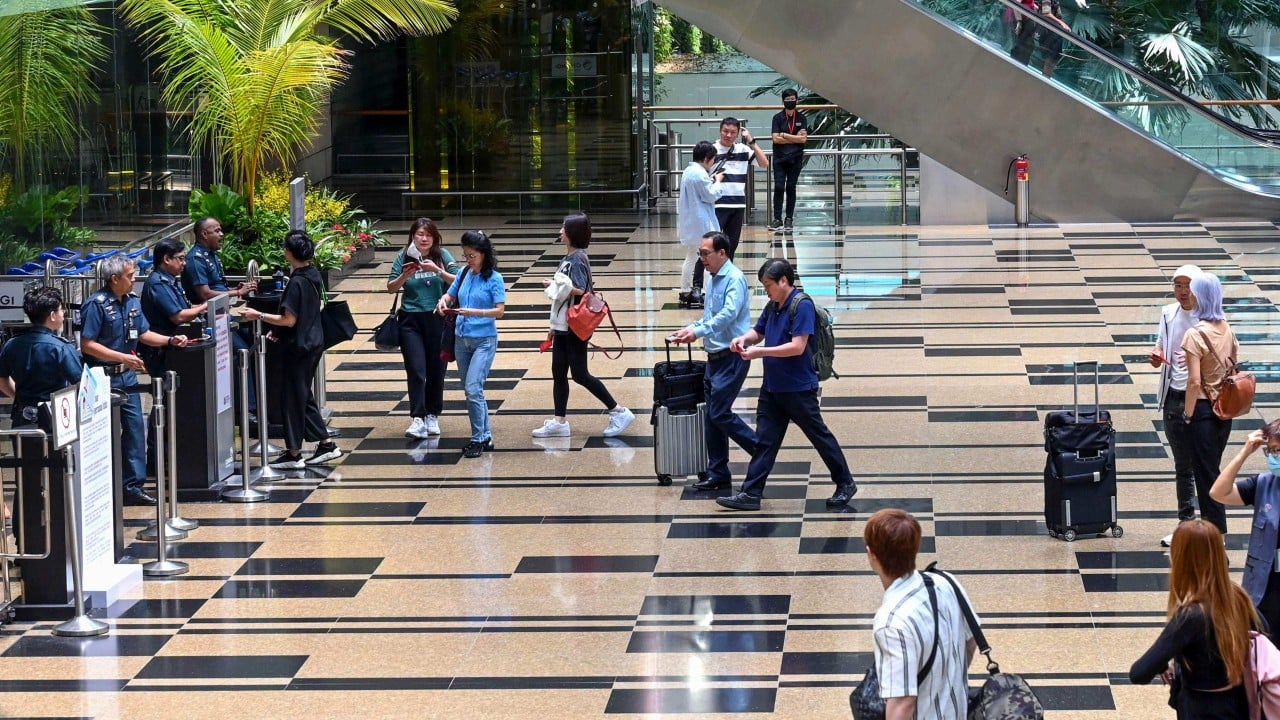
When a traveler from Hong Kong is arrested at Singapore’s Changi Airport over alleged shop theft, the local press usually treats it as a three-paragraph police blotter item. They miss the larger reality. Changi is not a conventional shopping mall with boarding gates attached; it is one of the most heavily surveilled, tightly controlled transit environments on earth, where a boarding pass acts as an immediate digital leash for law enforcement.
The math behind airport retail crime rarely works in the thief's favor. Travelers frequently mistake the relaxed, luxury atmosphere of duty-free concourses for a lapse in security oversight. They see open-concept perfume counters, unguarded shelves of single-malt whisky, and bustling crowds rushing to make connections. What they do not see is the integrated architecture of aviation security and retail loss prevention working in lockstep. Every transaction, every boarding pass scan, and every movement between terminals creates a permanent electronic breadcrumb trail that makes escaping the jurisdiction nearly impossible.
The Illusion of the Transit Anonymity
Most retail theft relies on a simple advantage: anonymity. In a sprawling downtown shopping district, a shoplifter can slip out a side door, blend into street traffic, and disappear before store staff even notice an empty shelf. Transit hubs strip away that exit strategy entirely.
The moment a passenger clears immigration into the transit area of Changi Airport, their identity is locked to a specific flight manifest. To buy anything in a duty-free shop—even a bottle of water—retailers are required by customs regulations to scan the customer's boarding pass. This standard procedure serves a dual purpose. Officially, it verifies tax-free eligibility for departing passengers. Operationally, it creates a real-time timestamp linking a specific passport holder to a exact retail counter at a precise minute.
When a store manager notices missing inventory, the investigation does not start with a vague description of a suspect's jacket. It starts with reviewing high-definition closed-circuit television footage synchronized with point-of-sale data. Security teams trace the suspect backward to the last legitimate purchase or forward to their departure gate.
Once the Airport Police Division receives the alert, officers do not need to scour four terminals looking for a needle in a haystack. They simply walk to the boarding gate of the suspect's flight and wait. Even if the passenger has already boarded the aircraft, ground control can hold the pushback tug, allowing officers to board the plane and escort the individual off in front of hundreds of fellow travelers.
Why International Travelers Miscalculate the Risk
Over decades of covering aviation security and cross-border crime, a clear pattern emerges among offenders caught in transit hubs. Very few are hardened, professional syndicate members. Most are ordinary tourists, business travelers, or transit passengers making a catastrophic lapse in judgment.
Several psychological and situational factors drive this behavior:
- The Duty-Free Fallacy: Many travelers subconsciously view airport transit zones as a legal gray area—a kind of international no-man's-land where domestic laws are suspended until they land at their final destination. In reality, once you step past the immigration counter in Singapore, you are fully subject to the Singapore Penal Code.
- Transit Fatigue and Impulse: Long-haul layovers disrupt circadian rhythms and impair executive function. Exhausted travelers wandering through luxury boutiques often experience lowered impulse control, pocketing cosmetics, sunglasses, or electronics on a whim without considering the mechanics of getting caught.
- The Ticking Clock: Offenders frequently assume that because their flight leaves in forty minutes, store security will not have enough time to notice the theft, review the cameras, and notify the police before takeoff. They underestimate the speed of modern airport response protocols.
Consider a hypothetical example of how quickly this plays out. Imagine a passenger on a two-hour layover between Europe and East Asia who slips a $300 bottle of cologne into a carry-on bag at 2:15 PM. By 2:25 PM, an automated inventory alert or an attentive sales associate flags the discrepancy. By 2:35 PM, security personnel have isolated the CCTV clip and tracked the individual walking toward Terminal 3. By 2:45 PM—fifteen minutes before boarding even begins—police officers are already standing at the gate podium speaking with the airline ground staff. The passenger never even reaches the jet bridge.
The Legal Reality Under Singapore Law
Getting caught is only the beginning of the ordeal. For foreign nationals—whether arriving from Hong Kong, London, or Sydney—an arrest at Changi Airport triggers a legal process that is notoriously swift, strict, and unforgiving.
Under Section 380 of Singapore’s Penal Code, theft in a dwelling-house or building used for the custody of property (which includes retail stores inside an airport) carries severe penalties. A conviction can result in imprisonment for up to seven years, a fine, or both. While first-time offenders stealing lower-value items often face fines rather than custodial sentences, the immediate collateral damage to a traveler's life is immense.
| Stage of Process | Typical Impact on Foreign Travelers |
|---|---|
| Immediate Detention | Suspect is taken to the Airport Police Division for questioning; flight is missed with no airline refund. |
| Passport Impoundment | Authorities routinely seize the suspect's passport to prevent flight risk while investigations proceed. |
| Extended Stay | Suspects must remain in Singapore at their own expense—paying for hotels, food, and legal counsel—until court dates conclude. |
| Long-Term Bans | Even after paying a fine, offenders frequently face deportation and a permanent or multi-year ban from re-entering Singapore. |
That second and third stage—passport impoundment and forced extended stays—is what catches most foreign offenders completely off guard. You do not simply pay a fine at the airport counter and catch the next flight home. Criminal investigations take days or weeks. During that window, a traveler is stranded in one of the most expensive cities in the world, unable to leave the country, forced to explain their sudden absence to employers and family back home.
The High Cost of "Minor" Offenses
Retailers at Changi operate under a strict zero-tolerance policy toward theft, regardless of the item's price tag. Whether a traveler pockets a $20 box of chocolates or a $2,000 designer handbag, the reporting protocol remains identical. Store managers are instructed not to accept on-the-spot apologies or offers to pay for the item once a suspect has exited the retail boundary.
This rigid stance exists to protect the integrity of the airport's bonded warehouse status. Duty-free goods are held under strict customs supervision; unaccounted-for shrinkage isn't just a retail loss—it is a customs violation. Consequently, airport merchants treat every missing item as a formal police matter.
Surveillance Architecture in Modern Transit Hubs
To understand why Changi Airport has such a high clearance rate for retail crime, you have to look at how the facility was engineered. Unlike older airports in North America or Europe that expanded piecemeal over seventy years, Singapore’s primary aviation hub was designed from the ground up with integrated security corridors and overlapping fields of view.
Blind spots are virtually nonexistent in the public and transit concourses. Modern camera networks use high-resolution sensors capable of facial recognition and behavioral tracking, linking seamlessly from the check-in counters to the baggage claim belts. When a theft occurs, investigators do not rely on grainy, wide-angle footage. They pull crisp, multi-angle video that captures the exact moment an item is concealed, followed by continuous tracking as the suspect moves through concourses, escalators, and restrooms.
Furthermore, the physical layout of an airport works against anyone trying to discard stolen goods. Trash bins are clear plastic or bomb-proof metal structures that are regularly inspected. Restrooms have high foot traffic and monitored entryways. If a suspect panics and dumps a stolen watch in a terminal bathroom, cameras still record them entering and exiting the facility, and forensic teams routinely recover discarded merchandise.
The Gray Areas of Alleged Shop Theft
Despite the sophistication of airport surveillance, arrests for alleged shop theft are not always open-and-shut cases of malicious intent. Veteran defense lawyers in Singapore occasionally handle cases rooted in genuine confusion, cultural misunderstandings, or the unique layout of airport retail spaces.
Many duty-free zones feature open-plan merchandising where multiple brands share floor space without clear physical walls or traditional checkout barriers. A rushed passenger browsing sunglasses at one counter might walk ten feet away to look at a flight information display while still holding the merchandise, inadvertently crossing an invisible retail boundary. In a high-alert security environment, stepping outside the designated store perimeter with unpaid goods is enough to trigger a detention for suspected theft.
Language barriers further complicate these encounters. When confronted by store security or police officers, a flustered traveler who struggles with English may give inconsistent answers, appear evasive, or fail to clearly explain that they were simply looking for a cashier. In the eyes of investigators, hesitation looks identical to guilt.
However, Singapore’s judicial system draws a sharp line between a documented mistake and deliberate concealment. If CCTV footage shows a traveler placing an item inside a zippered backpack, removing security tags, or looking around nervously before pocketing merchandise, arguments of accidental distraction collapse immediately.
The Ripple Effect on Regional Travel
News of a Hong Kong resident—or any regional traveler—being arrested at Changi Airport resonates strongly across Asia because of the dense flight corridors connecting these financial hubs. Millions of passengers shuttle between Hong Kong, Singapore, Bangkok, and Tokyo every year for business and leisure.
In an era where border control agencies increasingly share biometric data and criminal records, a minor conviction at an overseas airport carries long-term consequences. A criminal record for theft in Singapore can complicate future visa applications for countries like the United States, Canada, Australia, and the United Kingdom, all of which require applicants to declare past arrests and convictions. Even if a traveler avoids jail time and settles the matter with a court fine, the digital footprint of that arrest follows them across international borders for decades.
The routine police blotter report about a single traveler arrested at Changi Airport rarely tells the full story. Behind the brief headline lies an unforgiving reality: modern transit hubs have eliminated the margin for error, turning impulsive mistakes into life-altering legal battles before the boarding call is even announced.