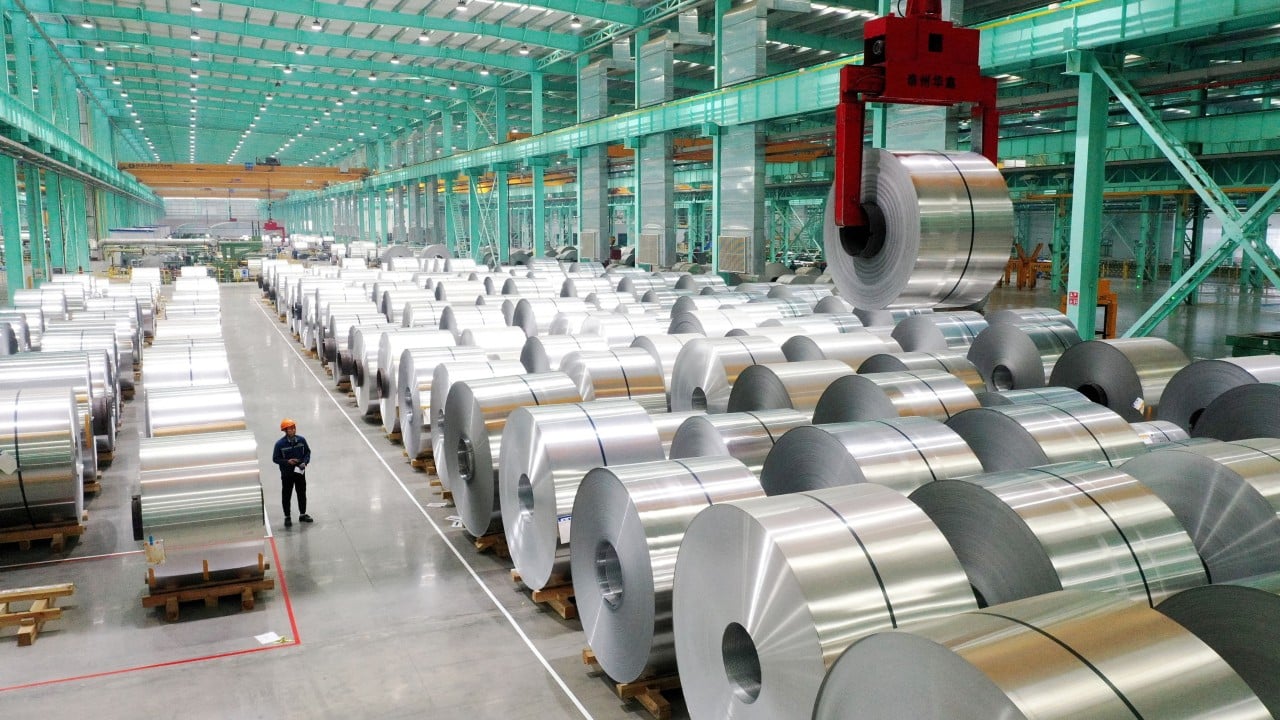
The heat in a modern aluminium smelter is not a temperature. It is a physical weight. It presses against your lungs, smelling of ozone and baked carbon, a shimmering haze where liquid metal—bright as a fallen star—flows through lined channels. In the heart of the Persian Gulf, these industrial cathedrals run on a heartbeat of absolute consistency. If the power dies, the metal freezes. If the metal freezes, the multi-billion-dollar heart of the plant turns into a solid, useless block of grey stone.
Far away in a boardroom in Shanghai, a trader watches a screen. He isn't looking at the heat. He is looking at the fragility. For an alternative view, read: this related article.
The global economy is built on this "silver ghost." You find it in the skin of the Boeing 787 carrying you home, the foil wrapping your sandwich, and the sleek casing of the phone in your pocket. For decades, the Gulf states—Bahrain, the UAE, Qatar—have been the world’s reliable forge. They had the cheap gas. They had the stability. But as geopolitical tensions tighten like a garrote around the throat of the Middle East, the math of the global supply chain is shifting.
Iran’s shadow over these smelters is no longer a theoretical risk. It is a market reality. Related insight on the subject has been provided by Reuters Business.
The Potline Pulse
Consider a worker named Elias. He is a hypothetical composite of the thousands of engineers keeping the lights on at a site like Alba or EGA. Elias knows that his entire world relies on a constant, uninterrupted flow of electricity. Aluminium smelting is essentially an electrical process; you are "freezing" electricity into a solid form.
When regional tensions spike, Elias doesn't just read the news. He feels it in the vibration of the turbines. If a drone or a missile strike from across the water hits the power grid feeding these pots, the clock starts ticking. You have roughly four to five hours before the molten bath begins to crust. Once it solidifies, you don't just "turn it back on." You take a jackhammer to a billion dollars of infrastructure.
This vulnerability is the lever.
Every time a headline flashes regarding Iranian strikes or naval maneuvers in the Strait of Hormuz, the "risk premium" on Middle Eastern aluminium spikes. For a car manufacturer in Germany, that premium is a tax on instability. They begin to look for a port in the storm.
The Dragon in the Mirror
While the Gulf sweats, China watches.
China is already the world’s largest producer of aluminium, but for years, it struggled with a reputation for "dirty" metal. Their smelters often ran on coal, making their product a hard sell for Western companies trying to meet green energy targets. But the narrative is changing. China is pivoting toward massive hydropower projects in the south and wind-to-aluminium loops in the north.
The strategy is elegant and ruthless. When the Middle East looks dangerous, China looks like a fortress. By positioning itself as the "stable" alternative, Beijing isn't just selling metal; it's selling insurance.
The relationship is symbiotic and strange. Iran and China share a complex geopolitical bond. If regional instability—driven or influenced by Tehran—handicaps the Gulf smelters, the primary beneficiary isn't a Western miner. It is the Chinese state-owned enterprise. The silver ghost migrates East.
The Invisible Tax on Everything
We often talk about trade wars in terms of tariffs and press releases. The reality is much more granular. It’s about the cost of shipping containers and the price of insurance for a tanker leaving the Port of Jebel Ali.
When the threat of strikes becomes a permanent fixture of the landscape, insurance companies hike their rates. These costs don't vanish. They are baked into the price of every soda can and every solar panel frame. We are all paying a "geopolitical surcharge" on aluminium, whether we realize it or not.
China’s grip on the market strengthens not necessarily because they are better at making the metal, but because they are better at guaranteeing it will arrive. In a world of "just-in-time" manufacturing, certainty is more valuable than gold.
Imagine a procurement officer for an electric vehicle startup. They have a choice. Do they source their battery casings from a Gulf smelter that sits within range of a regional conflict, or do they sign a long-term contract with a Chinese provider that offers a clear, overland rail route through the heart of Eurasia?
The choice makes itself.
The Weight of Liquid Metal
The shift isn't just about money. It’s about the gravity of global influence.
For the Gulf nations, aluminium was the great diversifier. It was the way out of a pure oil-and-gas economy. It was the promise of a post-petroleum future. If that industry is hollowed out by the constant threat of kinetic warfare, the economic vision of the region begins to blur.
Meanwhile, the smelters in the Chinese provinces of Yunnan and Shandong continue to hum. They are fueled by a different kind of power—not just electricity, but the vacuum left by a destabilized competitor.
There is a specific sound an aluminium plant makes when it is running perfectly. It’s a low-frequency thrum, a sound of immense energy being tamed into substance. In the Gulf, that sound is increasingly punctuated by the silence of apprehension. Every time a radar screen blips, the thrum falters.
In the high-stakes game of global trade, silence is the most expensive sound of all.
The silver ghost doesn't care about borders. It doesn't care about ideology. It only seeks the path of least resistance. Right now, that path is leading away from the scorching heat of the Gulf and toward the calculated, cool embrace of the Pacific.
The furnace stays hot. The metal keeps flowing. But the hands holding the ladle have changed.
The worker in the desert looks at the horizon, squinting against the sun, wondering if the next sound he hears will be the familiar pulse of the potline or the whistle of something falling from the sky. In that moment of doubt, the trade is already lost.
The ghost has moved on.