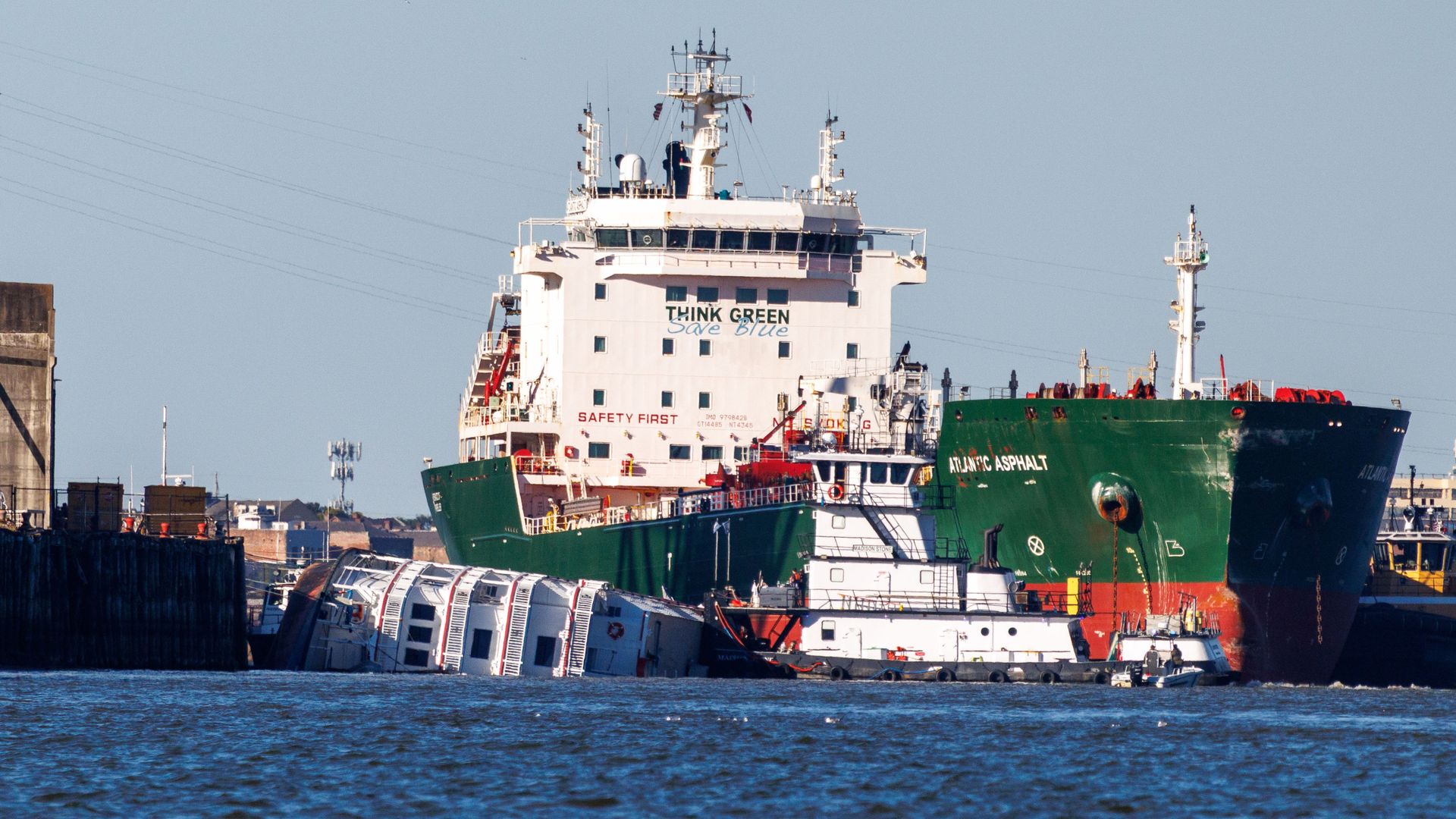
When a commercial river cruise vessel carrying 180 people collides with a tanker on the Mississippi River and everyone walks away alive, the press calls it a miracle. The reality is far less romantic and significantly more concerning. The rescue of 180 passengers and crew following a collision between a river cruise ship and a tanker underscores an escalating structural vulnerability along America's busiest inland waterway, where aging infrastructure, massive commercial cargo traffic, and a booming domestic river cruise industry share the same narrow, shifting channel. Calling it luck ignores the systemic friction building on the river for years.
Survivors stepped onto dry land without catastrophic loss of life because emergency protocols held under pressure and rescue teams reacted fast. Yet behind the relief lies a hard truth that maritime investigators and veteran river pilots know intimately. The Lower Mississippi is not a tranquil scenic canal. It is an industrial highway moving hundreds of millions of tons of grain, petrochemicals, steel, and refined fuel every year, and the margin for error when mixing overnight passenger vessels with deep-draft tankers is razor-thin.
The Physics of a Narrowing Channel
To understand how a cruise ship and a tanker end up occupying the same space on a mile-wide river, you first have to abandon the illusion that the entire width of the Mississippi is navigable. It is not. The usable shipping channel is often just a few hundred feet wide, carved out by continuous dredging and shifting constantly with seasonal sediment loads, flood stages, and drought conditions.
In a hypothetical example of a standard passing maneuver near a river bend, an upriver passenger boat pushing against a four-knot current meets a downriver chemical tanker riding with the current at twelve knots over ground. Because the tanker is moving with the flow, its rudder authority drops dramatically if it slows down too much; it needs speed to steer. Meanwhile, the cruise vessel, built with high superstructures to maximize passenger cabins and panoramic lounges, acts like a giant sail whenever crosswinds whip across the water.
Both captains are locked into a geometric puzzle with seconds to solve it. If communication over VHF radio lags by ten seconds, or if a misinterpretation occurs regarding a "one-whistle" port-to-port pass versus a "two-whistle" starboard-to-starboard pass, physics takes over. A loaded tanker can weigh upwards of 50,000 metric tons. Stopping distance is not measured in yards. It is measured in miles.
Why "Miracle" Rescues Mask Systemic Strain
The maritime industry loves a survival story because a rescue shifts public attention away from the root causes of the collision itself. When 180 people are pulled from a damaged vessel without fatalities, the narrative immediately turns to heroic Coast Guard responders, quick-thinking deckhands, and grateful passengers. Those individuals deserve every ounce of credit they receive. Emergency evacuation drills, watertight compartmentalization, and rapid local marine response worked exactly as designed.
However, veteran maritime observers recognize that surviving an impact is a failure of prevention. Every collision on the inland river system triggers a multi-agency investigation, typically led by the U.S. Coast Guard and the National Transportation Safety Board. Investigators pull Voyage Data Recorders, review Automatic Identification System tracks, test crew members for fatigue and impairment, and scrutinize bridge resource management.
Time and again across decades of inland waterway incidents, the findings point back to human factors compounded by environmental pressure:
- Bridge distraction and fatigue: Inland river operations run 24 hours a day, seven days a week. Pilots work grueling watches through dark stretches of river where shore lights from refineries and industrial plants create blinding visual clutter that washes out navigation buoys.
- Communication breakdowns: Despite mandatory Automatic Identification Systems and bridge-to-bridge radiotelephone rules, vessels still fail to establish clear passing agreements early enough before entering tight bends.
- Hydrodynamic suction and bank cushion: When two large hulls pass closely in shallow water, low-pressure zones form between them, physically pulling the sterns or bows toward one another in a phenomenon known as vessel interaction.
Calling the outcome a miracle frames the event as an act of fate rather than a predictable consequence of high-density traffic operating at the edge of physical limits.
The Boom in Domestic River Cruising
Over the past decade, domestic river cruising in the United States has undergone massive expansion. Travelers looking for alternatives to massive ocean liners or overseas flights have flocked to itineraries running between New Orleans, Memphis, St. Louis, and St. Paul. Cruise operators have responded by commissioning larger, more elaborate paddlewheelers and modern riverboats carrying anywhere from 150 to over 400 passengers and crew.
These vessels are floating boutique hotels. They offer fine dining, shore excursions, and serene views of antebellum towns and Civil War battlefields. What marketing brochures rarely emphasize is that these passenger vessels operate directly inside one of the heaviest industrial freight corridors in the Western Hemisphere.
Unlike European rivers such as the Rhine or the Danube, where freight barges are comparatively smaller and traffic separation schemes are heavily standardized for passenger tourism, the Lower Mississippi is dominated by ocean-going tankers, bulk carriers, and massive towboats pushing forty-barge flotillas lashed together into rigid steel islands over a thousand feet long.
When a cruise ship shares a tight bend with an ocean-going tanker, two completely different operational cultures collide. One vessel is on a strict leisure schedule, aiming to dock at a historic riverfront by morning so passengers can board tour buses. The other is a commercial cargo carrier bound by tidal windows, pilotage schedules, and terminal berth deadlines where every hour of delay costs tens of thousands of dollars.
Inside the Wheelhouse When Things Go Wrong
Step onto the bridge of a modern river vessel at two in the morning, and you are surrounded by glowing electronic chart displays, dual radars, depth sounders, and VHF radios crackling with regional chatter. On paper, modern navigation technology makes collisions nearly impossible. Every commercial vessel broadcasts its exact GPS coordinates, speed, heading, and rate of turn in real time.
Yet technology frequently breeds a dangerous form of overconfidence. Navigators rely heavily on electronic chart systems that display neat digital lines representing the channel boundaries. What those screens do not always show in real time is a newly formed sandbar after a heavy rain event upriver, a submerged wing dam obscured by high water, or an unlit barge moored slightly outside a fleeting area.
More critically, electronic screens cannot replace decisive verbal coordination. Standard protocol requires pilots to hail approaching traffic well in advance of a bend, confirm visual or radar contact, and agree on which side each vessel will pass. When a pilot assumes the other ship sees them on radar and will naturally yield, the stage is set for disaster. By the time a pilot realizes the approaching tanker is not swinging wide enough to clear the channel, the rudder is already hard over, the engines are thrown into full astern, and steel is seconds away from tearing into steel.
The Evacuation Reality on Inland Waters
Evacuating 180 people on a fast-moving river presents unique hazards that differ sharply from open-ocean emergencies. On the open sea, lifeboats are lowered into deep water away from the hull, and vessels drift until rescue ships arrive. On the Mississippi River, currents run fierce and unpredictable, swirling with eddies, undertows, and heavy floating debris like uprooted trees.
Deploying inflatable life rafts or small rescue boats into a four-to-six-knot current risks sweeping passengers miles downstream or pinning craft against moored barges and bridge pilings. Because of this, inland passenger vessels rely heavily on keeping passengers onboard in safe muster zones while pushing the damaged hull toward a soft mudbank or shallow bar—a maneuver known as intentional grounding—or transferring passengers directly onto responding towboats, fireboats, and Coast Guard cutters brought alongside.
The fact that all 180 people were safely accounted for points to two critical factors. First, the cruise ship's hull integrity held long enough after impact to prevent rapid capsizing or sinking. Second, nearby commercial mariners and local emergency agencies responded immediately. On the river, rival captains and nearby towboat crews are almost always the first rescuers on the scene, dropping their own commercial schedules within seconds of hearing a Mayday call on Channel 16.
The Regulatory Blind Spots Nobody Wants to Fix
Every major marine casualty sparks calls for tighter oversight, yet structural reforms on the inland waterways move at a glacial pace. The tension lies in balancing economic efficiency against absolute safety. The Mississippi River system moves roughly 60 percent of all U.S. grain exports and massive volumes of petroleum and chemical products. Shutting down stretches of the river to single-lane traffic whenever a cruise ship passes through would trigger supply chain bottlenecks costing millions of dollars a day.
Because full traffic separation is economically nonviable, regulators rely on incremental rules:
- Vessel Traffic Service zones: In high-congestion areas like the Port of New Orleans and Baton Rouge, Coast Guard Vessel Traffic Service centers monitor radar and radio traffic, acting much like air traffic controllers. Outside those designated zones, however, vessels largely self-coordinate over open radio frequencies.
- Pilotage and licensing standards: Navigating the Lower Mississippi requires specialized federal pilotage endorsements earned through years of apprenticeship and rigorous local knowledge exams. Still, the industry faces chronic shortages of experienced inland mariners, forcing companies to stretch crews across demanding rotation schedules.
- Hull design and damage stability: Modern U.S.-flagged passenger vessels built under Subchapter H or Subchapter K Coast Guard regulations must meet strict subdivision and stability criteria, ensuring they remain afloat even if one or two watertight compartments flood. Older vessels operating under legacy exemptions, however, do not always share the same modern double-hull protections found on contemporary tankers.
There is an uncomfortable truth that both cruise lines and freight operators quietly accept. You cannot eliminate risk on a working industrial river without fundamentally altering how America moves its freight or banning overnight passenger vessels from commercial shipping lanes. Neither is going to happen.
What Passengers Never See Before Boarding
For the average traveler booking a river cruise, safety briefings consist of a mandatory twenty-minute muster drill before departure, complete with orange life jackets and instructions on where to gather if the general alarm sounds. Passengers understandably treat it as a routine formality before heading to the cocktail lounge.
What they do not see is the constant choreography occurring twenty-four hours a day just outside their cabin windows. They do not hear the tense negotiations on the VHF radio as their captain threads a 350-foot passenger boat past a 750-foot chemical tanker in a blinding rainstorm. They do not feel the subtle shudder of the hull as hydrodynamic suction pulls the stern sideways while passing a heavily laden towboat.
When the system works, it looks effortless. Passengers wake up to coffee on the sundeck, unaware that three hours earlier their pilot executed a split-second course correction to avoid a stray buoy or an erratic barge tow. When the system fails, the margin between a minor scrape, a near-miss, and a mass-casualty tragedy comes down to a handful of feet and the speed of nearby rescue boats.
The True Cost of Near-Misses
The maritime industry tracks major collisions, groundings, and sinkings with meticulous precision, yet the vast majority of dangerous encounters on the river never make headlines. Close-quarters situations—where vessels pass within dozens of feet of each other after last-second evasive maneuvers—happen with alarming regularity. Many go unreported because no metal was bent and no injuries occurred.
Veteran investigators view these unreported near-misses as the warning tremors before an earthquake. Each close call reveals the exact same fault lines: compressed reaction times, ambiguous radio exchanges, channel crowding during low-water seasons, and the inherent mismatch between leisure vessels and heavy industrial shipping.
When 180 people are rescued after a cruise ship collides with a tanker, the immediate relief is real and justified. Families get their loved ones back, crews catch their breath, and investigators begin sifting through data logs to reconstruct the final minutes before impact. Yet treating survival as proof that the system works misses the point entirely. On a river moving millions of tons of hazardous cargo through shifting, narrow channels, counting on another miraculous rescue is not a safety strategy.