Salt. That is the first thing you taste when the ocean decides to remind you how small you are.
I have stood on open decks at dusk when the hull hums with a low, comforting vibration that tricks your nervous system into believing in permanence. You hold a cold drink. A brass band plays something bright and tinny near the pool. Below your sneakers, thousands of tons of welded steel slice through dark water at twenty knots, carrying ice cream machines, silk robes, and promises of effortless escape. You trust the geometry of it. You trust the radar screens glowing in the dark wheelhouse and the harbor pilots who know every shoal by heart.
Then comes the sound that has no place on a holiday.
Not a horn. Not a splash. A dull, sickening crunch of metal folding inward where metal is supposed to stay rigid, followed by the sudden tilt of a floor that was level a heartbeat ago.
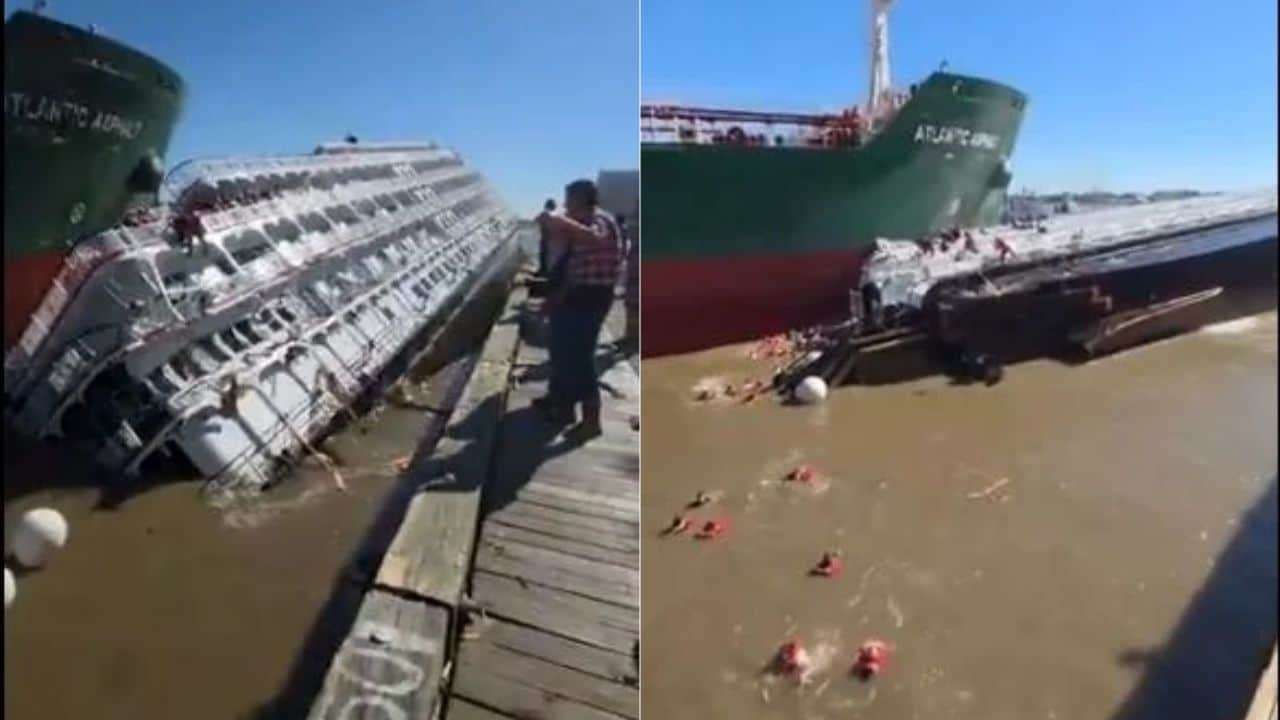
When a tanker collides with a cruise vessel in American waters and shaky smartphone footage surfaces showing passengers gripping rails, stanchions, or whatever solid edge their knuckles can find, the internet reacts in predictable bursts. We zoom in on the clip. We count how many people are holding on. We ask if anyone went overboard, whether the hull ruptured, or how a ship carrying fuel or chemicals ended up sharing a patch of water with a floating resort.
Those questions matter. In maritime incidents involving a tanker and a cruise ship in the US, authorities immediately look at right-of-way, navigational channels, weather and visibility, vessel speed, pilotage, and hull integrity. Coast Guard investigators examine voyage data recorders, radar logs, and radio transcripts while salvage teams and tugboats assess damage and potential pollution.
Yet a ten-second video clip strips away all the institutional calm of an investigation. It leaves only gravity, adrenaline, and human hands white against painted steel.
To understand what is actually happening in those frames—and why a collision between a tanker and a cruise ship unsettles people far beyond the coastline—we have to look past the spectacle of the viral clip and examine the quiet machinery of risk that keeps modern sea travel afloat.
The Illusion of Wide-Open Water
Landlubbers picture the ocean as an endless blank canvas where two ships would have to try hard to bump into each other.
Wrong.
Commercial shipping lanes and cruise routes funnel massive vessels into narrow corridors, especially near busy ports, estuaries, and coastal approaches in the United States. A tanker is built for cargo capacity and endurance, sitting low and heavy in the water with a momentum that takes miles—not seconds—to arrest. A cruise ship is built upward, a towering multi-decked structure catching wind like a sail while carrying thousands of passengers who expect hotel comfort rather than emergency drills.
Think of a tanker as a freight train that cannot swerve and a cruise ship as a high-rise apartment building on rollers. That comparison is a metaphor, of course, meant to capture mass and windage rather than literal mechanics, though anyone who has watched a massive hull ease toward a pier knows how slowly inertia surrenders.
When two giants converge in a constrained channel, margin shrinks fast. A slight misjudgment in closing speed, a sudden current or crosswind, a communication lag between bridges, or an unexpected course correction can turn a routine passage into a crisis. Even when injuries are minor or zero—and it is worth noting plainly that dramatic video of passengers holding on does not automatically mean catastrophic loss of life—the psychological shock is immediate.
Why do passengers cling to rails in those moments?
Because human balance is an astonishingly delicate negotiation between the inner ear, the eyes, and the soles of the feet. When a ship shudders or lists unexpectedly, your brain loses its reference point. The horizon tilts. Your stomach drops. Holding onto a fixed bar or bulkhead isn't movie melodrama; it is the body's most basic instinct to anchor itself when the world stops behaving like solid ground.
I remember once during a rough crossing years ago watching seasoned crew members casually walk down a swaying corridor while first-time travelers gripped the wall molding like climbers on a cliff face. Experience rewires how you read motion. A crew member feels a roll and anticipates the counter-roll; a vacationer feels a roll and hears a trapdoor opening beneath their plans.
What Happens When a Tanker and a Cruise Ship Collide
Whenever a crash occurs between a tanker and a vessel carrying passengers in US waters, a specific chain of urgency kicks in.
First comes immediate life safety. Crew members check for injuries, account for passengers, monitor list and trim, and prepare emergency responses if needed. Passengers are typically told to stay calm, move away from damaged areas or glass, and await instructions rather than crowding lifeboat stations prematurely unless ordered to abandon ship.
Second comes containment and stability. Tankers carry liquids that can pose severe environmental or fire hazards if a tank is breached, while fuel oil from either vessel can threaten coastal ecosystems and fisheries. Even a glancing blow can dent plating, scrape paint, or crumple superstructure without sinking either ship.
Third comes the investigation. In the United States, the Coast Guard and often the National Transportation Safety Board look closely at the human and technical factors behind the collision. Did a harbor pilot board on time? Was visibility reduced by fog or glare? Were bridge teams aligned on intentions via VHF radio and Automatic Identification System data? Did mechanical or steering issues play a role?
Notice how slow real answers are compared to social media outrage.
Within minutes of a clip hitting X, TikTok, or local news feeds, commentators declare fault with absolute certainty. The tanker captain was asleep. The cruise ship cut across traffic. GPS failed. Real maritime investigations take weeks, months, or longer because physical evidence, electronic tracks, and sworn interviews have to be cross-checked against physics.
Uncertainty makes people anxious. That is completely human. When you see a video of people hanging on during a crash, your mind wants a neat villain and a tidy explanation so the world feels predictable again. Reality rarely obliges on cue.
A Hypothetical Morning on the Bridge
To see how quickly routine can fray without anyone setting out to cause harm, let's walk through a hypothetical scenario—strictly invented to illustrate operational dynamics rather than describe a specific real-world incident.
Picture an early morning near a busy US port approach. Pale light thins out a patch of coastal haze. Outbound is MV Red Hook (hypothetical), a medium-sized tanker riding fairly light after discharging cargo, her master and a local pilot watching traffic targets on radar. Inbound is SS Bella Vista (hypothetical), a cruise ship arriving ahead of schedule so passengers can disembark early for shore excursions.
On paper, everything looks manageable. Both vessels are tracked. Both bridges have experienced officers.
Then three small frictions stack up in sequence. A fishing boat lingers near a buoy, prompting a minor course tweak. A patch of fog thickens faster than forecast, turning visual bearings into radar estimates. Meanwhile, on the cruise ship, morning operations are humming—coffee service starting, luggage staging, announcements chiming—while on the bridge, two officers interpret a developing meeting angle slightly differently over a couple of minutes.
By the time someone realizes the closest point of approach is closing faster than comfortable, rudder orders and engine telegraph changes are already racing against thousands of tons of moving steel.
A bump. A scrape. A shudder through the decks.
Nobody wanted a headline. Nobody woke up planning a collision. Yet complex systems fail when small ambiguities overlap and time runs out.
The Invisible Stakes Behind the Footage
When people watch a video of passengers clinging to a cruise ship after a tanker hits it, the drama feels contained to that patch of water.
In truth, the stakes ripple outward in quiet, unglamorous ways.
A collision in or near a shipping channel can bottleneck commercial freight, delay tug escorts, tie up Coast Guard assets, and force port authorities to restrict vessel traffic while safety sweeps and hull inspections take place. A single delayed tanker or blocked fairway doesn't just inconvenience a ship's crew; it reverberates through supply chains, fuel distribution, and regional commerce.
For the cruise industry, trust is the currency that pays for the entire voyage. Travelers board ships believing safety protocols are layered so thickly that even an abnormal event stays controlled. Seeing passengers gripping fixtures during a crash shatters that quiet assumption, even if everyone steps off the gangway unharmed.
And for the seafarers—both the tanker crew working grueling rotations far from home and the cruise staff suddenly shifting from hospitality hosts to emergency coordinators—these moments carry a weight that doesn't wash off easily. Hospitality workers sign up to pour espresso and guide families to dinner; when steel collides with steel, they are suddenly responsible for keeping terrified strangers calm and safe.
How Should Travelers Read Viral Maritime Clips?
If you travel by sea—or simply find yourself watching dramatic footage of a tanker and cruise ship colliding in US waters—a few grounded habits can keep you clear-headed.
- Separate shock from severity. A frightening lurch or video of people holding on can happen in incidents with zero fatalities and intact hulls. Wait for official Coast Guard or port updates before assuming the worst.
- Respect crew instructions in the moment. If you are ever aboard a vessel during an abnormal maneuver or collision, hold onto sturdy handholds, stay clear of glass and unsecured gear, put on sensible footwear if safe to do so, and listen to bridge or crew announcements rather than relying on rumor in a hallway.
- Look for systemic context over hot takes. Maritime safety has improved dramatically over decades through better radar, electronic charts, bridge resource management, and strict regulations, yet human error and tight waterways still test those defenses.
We live in an era where every sudden jolt can be filmed from three angles before the echoes fade. A screen turns a terrifying few seconds into endless replay.
Out on the water, though, there is no replay button—only steel, tide, human judgment, and the long, patient work of bringing every soul safely back to shore.
Through the spray and the glare off the wake, a hand lets go of the rail only when the deck goes still again.