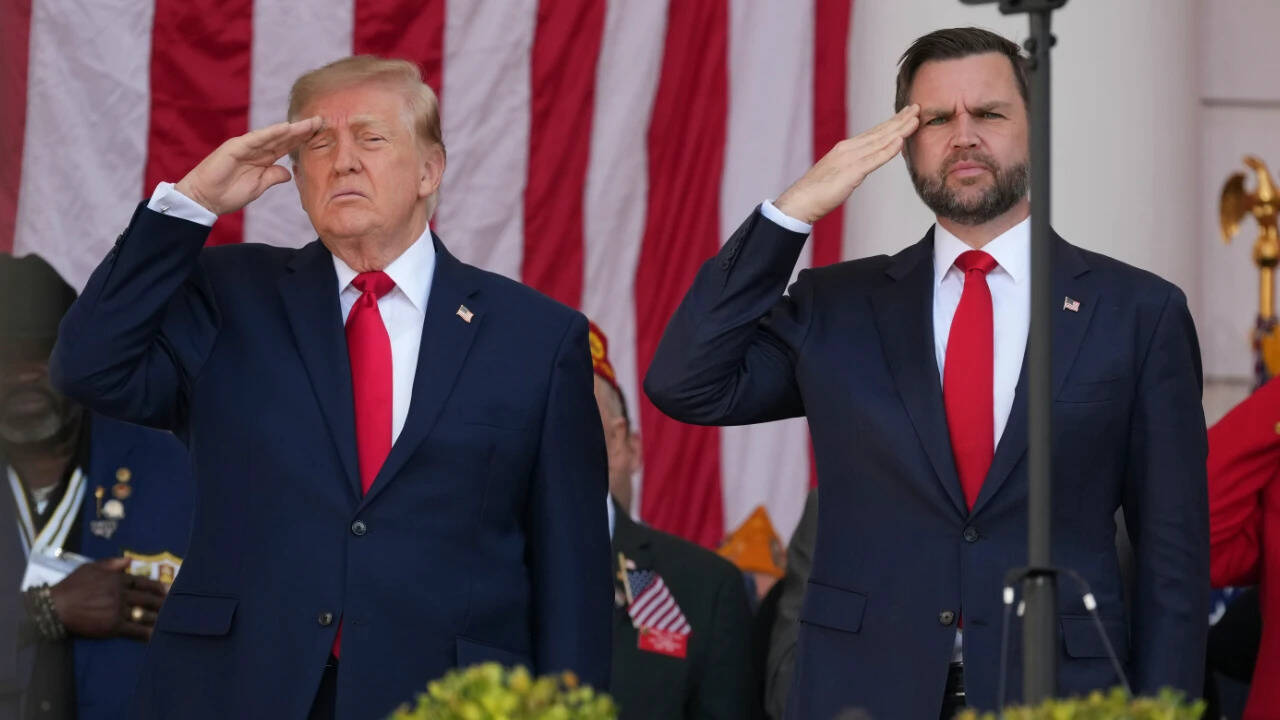
Political succession inside a populist movement rarely follows linear institutional logic. When Vice President JD Vance evaluates a potential 2028 presidential bid in the wake of Republican midterm setbacks, he is not merely weighing personal ambition against electoral odds; he is solving an optimization problem governed by brand depreciation, coalition fragility, and asymmetric downside risk. Standard political reporting frames a potential bypass as a retreat or a sign of weakness. A rigorous structural analysis reveals the exact opposite: stepping aside in 2028 may represent the highest-expected-value play available to a sitting Vice President operating inside an uninstitutionalized political movement.
To understand why bypassing an open presidential primary becomes a rational strategic choice, one must strip away horse-race punditry and examine the underlying mechanics of modern political capital, voter realignment, and historical midterm drag.
The Structural Trap of the Sitting Vice President
In American political history, sitting Vice Presidents attempting to succeed a two-term President from the same party face a severe structural penalty. Since 1836, only one sitting Vice President—George H.W. Bush in 1988—has successfully won the presidency immediately following a two-term predecessor of the same party. Al Gore in 2000 and Richard Nixon in 1960 both failed to overcome the accumulated friction of eight years of incumbent governance.
This phenomenon is driven by three compounding mechanisms:
- The Attribution Asymmetry: Voters naturally credit the top of the ticket for economic booms and legislative victories while distributing blame for inflation, foreign entanglements, or domestic gridlock across the entire administration. The Vice President absorbs the liabilities of the administration without possessing the executive authority to alter its trajectory.
- The Change-Election Pendulum: After eight years of single-party control of the White House, the median swing voter exhibits a measurable preference for systemic alteration. A sitting Vice President cannot plausibly run as an agent of disruption while defending the record of the outgoing administration.
- The Loyalty Constraint: During the primary cycle, the Vice President cannot break with the sitting President to capture disaffected factions without alienating the core loyalist base. Conversely, total fidelity locks the candidate into defending unpopular policies during the general election.
For JD Vance, these historical headwinds are amplified by the specific architecture of the Trump coalition. Unlike traditional party structures built around durable ideological institutions, the MAGA movement is heavily centralized around a single charismatic principal. When the principal exits the ballot—either through constitutional term limits or political retirement—the coalition does not automatically transfer its loyalty to the designated heir. Instead, it fragments into competing ideological and personalist factions.
Deconstructing the Midterm Signal
Midterm elections function as high-resolution diagnostic tests for the governing coalition. Rather than viewing Republican midterm losses merely as a temporary dip in enthusiasm, a strategic analyst treats them as a structural audit of voter elasticity.
In a midterm cycle, the electorate contracts, shedding low-propensity voters who turn out exclusively for presidential contests. When a populist coalition suffers losses in this environment, it exposes two critical vulnerabilities:
- Turnout Dependency: If the coalition's margin of victory relies on low-propensity voters who remain home unless the primary charismatic leader is on the ballot, any successor candidate faces an immediate structural deficit in turnout modeling.
- Suburban Attrition: Midterm losses typically concentrate in swing suburban districts where independent voters punish the incumbent party for perceived chaos, economic friction, or cultural overreach. If the Vice President is closely identified with the administration's most polarizing rhetorical stances, recovering those suburban margins in a general election becomes mathematically improbable.
Evaluating a 2028 run through the lens of midterm data forces a brutal calculation. If the coalition cannot hold marginal districts when the administration is in power, the probability of expanding that map in an open-seat presidential election—without the founding figure of the movement on the ballot—drops precipitously.
The Cost Function of a Premature Run
In game theory, entering a contest with unfavorable structural odds carries both direct costs and severe opportunity costs. For a politician in his early forties, JD Vance possesses an asset virtually nonexistent among his senior peers: a multi-decade political time horizon.
Running and losing in 2028 does not merely delay his presidential ambitions by four years; it permanently degrades his political capital through four distinct channels:
Brand Permanence
A general election defeat brands a candidate as unelectable among major donors and party gatekeepers. Once a politician loses a national race, primary voters in subsequent cycles instinctively look for a fresh vehicle rather than backing a proven loser. Richard Nixon’s 1968 comeback remains the rare exception that proves the rule, requiring a historic realignment and total party collapse to execute.
Intra-Party Scorched Earth
A 2028 Republican primary will not be a polite coronation. It will attract ambitious governors, senators, and media figures seeking to claim the populist mantle. Engaging in a multi-front primary war forces the Vice President to spend political capital attacking fellow conservatives, fracturing the exact coalition he would need to unite in November. Even a primary victory achieved through brutal attrition leaves the nominee financially depleted and ideologically bruised heading into the general election.
The Scapegoat Mechanism
If a Democrat wins the presidency in 2028, the political narrative immediately shifts. Within two years, the new Democratic administration will inevitably encounter economic headwinds, legislative gridlock, or foreign policy crises. If Vance is sitting outside the arena—having skipped the 2028 race—he avoids being tagged as the architect of the 2028 defeat. He remains an unblemished standard-bearer positioned to capitalize on Democratic overreach in 2032.
Ideological Positioning Flexibility
Stepping out of the immediate succession race grants Vance the time and distance necessary to evolve his policy platform. A sitting Vice President is tethered to the daily news cycle and the immediate priorities of the White House. A former Vice President operating in the private sector, leading a policy institute, or returning to the Senate can recalibrate his economic populism to address emerging technological and demographic realities without appearing disloyal to the outgoing administration.
The Coalition Fracture Matrix
To understand the internal dynamics driving Vance's hesitation, one must map the competing factions within the post-Trump Republican Party. The coalition is not a monolith; it is an uneasy alliance of three distinct groups held together by shared opposition to the progressive establishment:
- The Economic Nationalists: Concentrated in the Rust Belt, these voters prioritize tariffs, industrial policy, strict immigration enforcement, and skepticism of foreign military interventions. Vance is the natural ideological heir to this bloc.
- The Traditional Fiscal Conservatives: Suburban voters, corporate donors, and institutional Republicans who tolerate populist rhetoric in exchange for deregulation, tax cuts, and conservative judicial appointments. This group remains deeply skeptical of Vance's economic interventionism and anti-corporate rhetoric.
- The Cultural Populists: Voters driven primarily by social issues, anti-institutional grievance, and media warfare. Their loyalty is intense, but it is transactional and easily swayed by whichever candidate dominates the attention economy at a given moment.
In a 2028 primary, rival candidates—such as traditional conservative governors with strong executive records—will aggressively target the Traditional Fiscal Conservatives while attempting to peel away Cultural Populists through media spectacle. Vance would be forced to defend his left economic flank against accusations of big-government populism while simultaneously proving his ideological purity to the movement's most uncompromising activists.
Bypassing 2028 allows these factions to collide without Vance absorbing the shrapnel. If a traditionalist wins the 2028 nomination and loses the general election by failing to turn out Rust Belt populists, Vance’s ideological thesis is vindicated. Conversely, if a hyper-populist media figure wins the nomination and gets routed in the suburbs, Vance emerges in 2032 as the disciplined, governing-capable synthesis candidate who can unite both wings.
Historical Precedents for Strategic Patience
Strategic abstention is a well-documented maneuver among elite political operators who recognize unfavorable structural terrain.
Consider the calculus of Mario Cuomo in 1988 and 1992, or more successfully, the strategic positioning of figures who waited out hostile cycles. A cleaner operational comparison is the 1964–1968 cycle within the Republican Party. Following the 1964 Barry Goldwater landslide defeat, mainstream institutional Republicans recognized that the ideological energy of the party had shifted, yet the coalition was not yet mature enough to win a national general election. By avoiding the sacrificial lamb role in 1964 and carefully positioning himself during the 1966 midterms, Richard Nixon allowed the Lyndon Johnson administration to overextend itself in Vietnam and domestically, clearing the runway for a unified conservative-populist coalition in 1968.
Similarly, in 2016, several prominent Democratic figures—most notably Joe Biden—declined to challenge Hillary Clinton, recognizing that the institutional machinery and donor class were locked down and that eight years of the Obama administration created natural fatigue among swing voters. While Biden's 2016 decision was heavily influenced by personal tragedy, the strategic outcome was identical: by sitting out a cycle where the Democratic coalition fractured and lost the Rust Belt, Biden preserved his viability to run as a unifying restoration candidate four years later.
Operational Risks of the Bypass Strategy
Strategic patience is not a risk-free play. Choosing to skip 2028 introduces three severe vulnerabilities that must be actively managed:
- The Irrelevance Decay Curve: Political attention is a depreciating asset. Stepping away from elected office or bypassing a presidential run creates an immediate vacuum. In a media ecosystem driven by daily outrage, four years outside the primary arena can render a politician obsolete. New populist figures will emerge, capture the donor networks, and rewrite the party's ideological priorities.
- The Accusation of Cowardice: Populist movements prize combativeness and strength above almost all other virtues. Declining to fight for the nomination risks alienating the exact base voters who admire fighters. If Vance's exit is framed by rivals as a lack of stomach for a tough fight, his credibility within the movement could suffer permanent damage.
- The Incumbency Lockout: The most catastrophic risk of skipping 2028 is that another Republican actually wins. If a rival Republican captures the White House in 2028, Vance is effectively locked out of the presidency until 2036 at the earliest. By that point, he will be twelve years removed from the vice presidency, facing an entirely new generation of political talent and an unrecognizable electorate.
Tactical Execution: How to Bypass Without Surrendering
If Vance executes a strategic bypass of 2028, the maneuver cannot look like a retreat. It must be engineered as a deliberate pivot toward institutional power-building. To maintain viability for 2032 while sitting out 2028, the operational blueprint requires four sequential steps:
- Establish an Independent Ideological Vehicle: Immediately upon leaving office—or prior to announcing a 2028 bypass—Vance must launch a well-funded policy institute or political action committee dedicated to economic nationalism. This keeps his name in the policy bloodstream, provides a platform for drafting legislation, and maintains direct financial ties to key donors.
- Focus on Down-Ballot Kingmaking: Rather than running for the top spot, deploy fundraising capacity and endorsement capital into Senate, gubernatorial, and House races in 2028 and 2030. Building a loyal cohort of indebted elected officials creates an institutional firewall that rival candidates cannot easily breach in 2032.
- Avoid Intra-Party Factional Warfare: Maintain strict neutrality during the 2028 Republican primary. Endorsing a losing faction creates permanent enemies; staying above the fray allows him to campaign enthusiastically for the eventual nominee in the general election, earning goodwill across all wings of the party regardless of the November outcome.
- Master the Sub-National Narrative: Use the 2028–2032 window to travel extensively through the industrial Midwest and Sun Belt swing states, focusing on tangible economic issues—supply chain resilience, energy costs, and housing affordability—while avoiding the low-yield cultural skirmishes that alienate suburban swing voters.
The Definitive Strategic Play
The reports that JD Vance is weighing a pass on 2028 reflect an acute understanding of political math rather than a failure of nerve. Entering a 2028 presidential race burdened by eight years of incumbent administration fatigue, a fractured populist coalition, and deteriorating midterm margins offers low probability of victory and catastrophic downside risk for a politician with thirty years of prime career runway ahead of him.
The optimal strategic move is clear: Vance should formally decline a 2028 presidential run early in the cycle, framing the decision around family priorities and a commitment to building long-term conservative governing capacity. He should immediately transition into leading a well-capitalized industrial policy institute, deploy his political capital to elect aligned Senators and Governors in 2028 and 2030, and let the competing factions of the post-Trump Republican Party test their viability against a Democratic opponent in 2028. If the Republican nominee loses—the statistically probable outcome given historical two-term pendulum dynamics—Vance enters the 2032 cycle unscarred, ideologically validated, and positioned as the undisputed architect of the party's next governing majority.