Media outlets love a vertical rescue. Put a person in a harness, dangle them two hundred feet above a concrete plaza in Hong Kong, and watch the clicks roll in. When a rider gets stranded on a revolving observation tower—like the classic incidents seen on Ocean Park’s iconic Ocean Park Tower—local news desks immediately reach for the same breathless vocabulary. "High drama." "Harrowing ordeal." "Daring rescue."
They are selling you a fairy tale. A terrifying, completely backwards fairy tale. Discover more on a similar topic: this related article.
If you actually work in amusement engineering, operations, or municipal rescue, watching the public panic over a stalled observation tower is exhausting. A vertical evacuation is not evidence of a broken ride. It is proof that the engineering worked exactly as designed. The "high drama" celebrated in sensationalist headlines is actually the most boring, heavily rehearsed, mathematically predictable procedure in the entire entertainment industry.
The Anatomy of a "Disaster" That Was Actually a Tuesday
Let us look at what actually happens when a revolving observation tower stops mid-air. Additional journalism by Reuters highlights related views on the subject.
Observation towers—whether built by Intamin, Huss, or Vekoma—are among the simplest, most over-engineered machines in any park. Unlike a launched roller coaster with complex magnetic braking and high-speed block zones, a rotating observation cabin is essentially a giant, circular elevator that spins slowly around a central steel mast. It moves at a walking pace. It relies on heavy-duty steel cables, counterweights, and redundant hydraulic or electric winches.
When that cabin stops fifty meters off the ground and refuses to budge, the public assumes the cables are about to snap.
The reality is the exact opposite. The cabin stopped because a sensor detected a microscopic anomaly—a slight voltage drop, a wind gust exceeding a conservative threshold, or a brake pad wear indicator tripping a fraction of a millimeter early. In modern amusement engineering, safety systems are "fail-safe," meaning a loss of power or a sensor fault does not cause the ride to drop; it forces the mechanical brakes to clamp shut instantly.
I have spent years consulting on ride operations and inspecting safety protocols across major parks. I have seen operators take heat from executives for shutting down multi-million-dollar attractions over a faulty proximity switch that costs forty dollars. Yet, that hair-trigger sensitivity is why these machines have a safety record that makes commercial aviation look risky.
When the primary drive system locks out, the ride enters a state of total mechanical stability. The cabin isn't teetering on the edge of a cliff. It is locked onto a massive steel column with enough braking force to hold several times its maximum rated load. The only actual danger to the passengers inside is boredom, mild claustrophobia, or needing to use the restroom.
Why Firefighters Get Called (And Why It Looks Worse Than It Is)
So, if the cabin is completely safe, why do we see dramatic footage of the Hong Kong Fire Services Department scaling the tower with ropes and harnesses?
Because park operators are bound by strict regulatory timelines and liability protocols, not because the structure is failing.
Every major attraction has a tiered evacuation plan dictated by standards like ASTM F2291 (the global benchmark for amusement ride design and manufacture) and local municipal codes, such as Hong Kong’s Electrical and Mechanical Services Department (EMSD) regulations.
- Tier One: Primary Drive Recovery. Technicians attempt to reset the fault or use the auxiliary backup motor to lower the cabin at a crawl. This resolves 95% of stoppages within twenty minutes. You never hear about these on the news.
- Tier Two: Manual Brake Bleed. If the backup motor cannot engage, mechanics physically climb the central core to manually release the hydraulic brakes in controlled increments, allowing gravity and the counterweights to gently lower the cabin.
- Tier Three: External High-Angle Rescue. If a mechanical lock prevents the cabin from moving vertically at all—for example, if an emergency safety catch has physically wedged itself into the mast—the cabin stays put.
At this point, the park has a choice: keep guests locked in an air-conditioned box for six hours while technicians cut away a seized mechanical pawl with torches, or call the municipal fire department to execute a pre-planned high-angle rope evacuation.
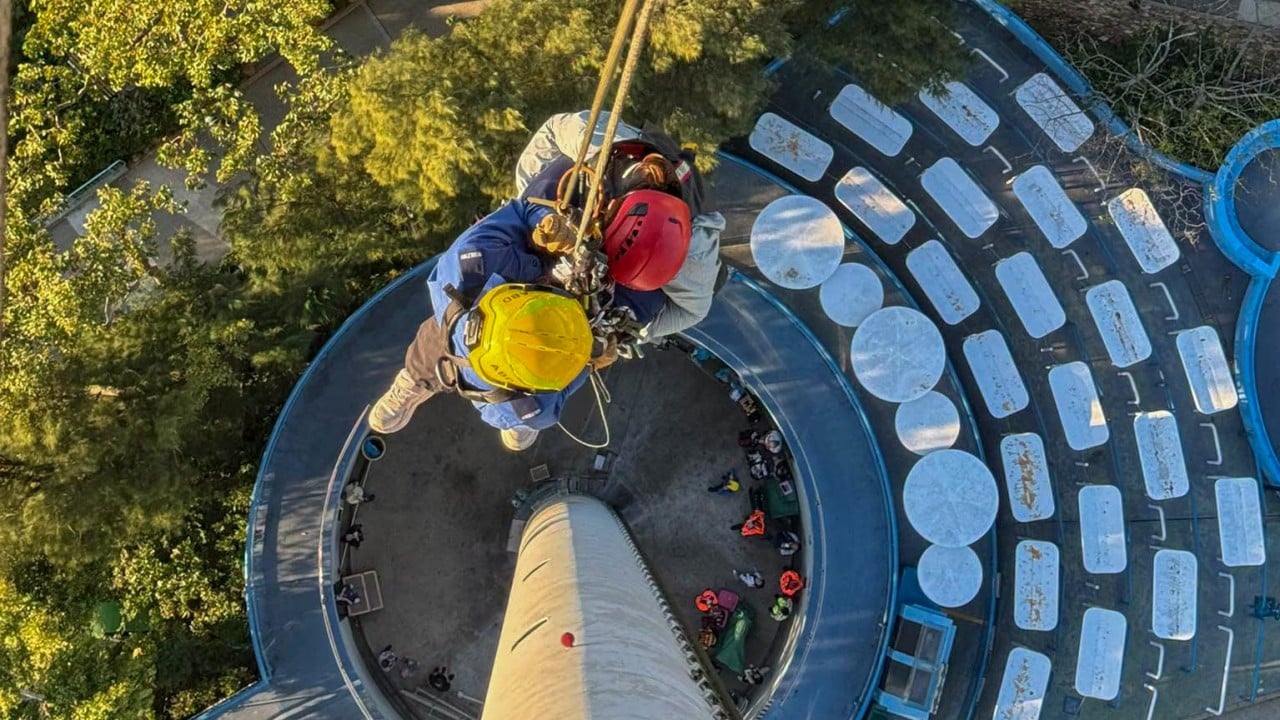
Parks call the fire department. Not because anyone is dying, but because municipal high-angle rescue teams use real-world theme park towers for mandatory annual training anyway. When a real stoppage occurs, the firefighters treat it like a live-fire exercise with zero actual fire. They clip into anchor points that were literally welded onto the tower during its construction for this exact purpose.
The Sensationalism Trap: How Bad Reporting Hurts Rider Safety
The lazy consensus in travel and local news journalism treats every ride evacuation as a scandal. Reporters interview a shaken tourist at the exit gate, capture a quote about how they "thought they were going to die," and frame the park as negligent.
This narrative is actively dangerous.
When the public is conditioned to believe that a stalled ride equals imminent death, passengers panic during routine stoppages. Panic makes people do stupid things. In the amusement industry, the vast majority of severe injuries on major attractions do not happen because a machine broke; they happen because a guest defeated a restraint or tried to climb out of a stationary vehicle during a routine hold.
Imagine a scenario where a rider on a stalled tower becomes convinced the cabin is about to plummet because they read three sensationalized articles the week before about a "horrifying tower malfunction." Instead of sitting down and waiting for the air conditioning to kick back on, they try to force open an emergency hatch or injure themselves attempting to climb down the exterior lattice.
By framing a textbook safety intervention as a brush with mortality, the media manufactures the exact terror that puts guests at risk.
Answering the Questions You Should Actually Be Asking
When headlines scream about stranded riders, travelers immediately flood search engines with predictable, fear-driven questions. Let us dismantle the flawed premises behind them.
"Are observation towers safe to ride?"
This is the wrong question. Nothing involving physics and human movement is 100% risk-free, including walking down the wet concrete steps to the subway. The right question is: What is the failure mode of this machine? On a drop tower or an observation cabin, the failure mode is a hard stop. Gravity is controlled by passive counterweights and spring-applied, hydraulically-released brakes. If all power in the city goes out, the brakes engage automatically. You are statistically safer inside a stalled observation tower in Hong Kong than you are riding in the taxi that brought you to the park.
"What happens if you get stuck on a theme park ride for hours?"
You get inconvenienced. On enclosed towers, emergency battery packs maintain basic ventilation and lighting. Ride operators establish immediate intercom contact. If a Tier Three evacuation is triggered, you will be fitted into a full-body rescue harness—usually a class III seat-and-chest rig—secured to a dual-rope descender system operated by professionals who do this every week. You will take a slow, controlled ride down the outside of the tower, get handed a bottle of water at the bottom, and likely receive a refund or a stack of complimentary park passes.
"Do theme parks cover up mechanical failures?"
In heavily regulated jurisdictions like Hong Kong, North America, and Western Europe, covering up a major stoppage is practically impossible. The moment municipal emergency services are dispatched, a public record is created. Furthermore, regulatory bodies like the EMSD in Hong Kong require mandatory incident reporting for any ride stoppage exceeding a specific duration, followed by a mandatory inspection before the ride can reopen to the public. Parks do not cover these up; they over-report them to protect their operating licenses.
The Uncomfortable Truth About The Contrarian Stance
Is the industry completely blameless when a rider ends up dangling from a rope? No. To pretend otherwise would be dishonest.
While a high-angle evacuation proves the structural safety systems work, it simultaneously exposes a failure in preventative maintenance or component lifecycle management.
A properly maintained observation tower should never reach Tier Three. If a mechanical safety catch seizes, or if both primary and secondary drive systems fail simultaneously, someone in the maintenance bay missed a warning sign. Perhaps a lubricant specification wasn't followed in high humidity. Perhaps an aging sensor was due for replacement six months ago and got pushed to the next budget cycle.
Furthermore, the psychological toll on a guest who is terrified of heights—and suddenly finds themselves suspended outside a tower in a nylon harness—is real, regardless of how safe the math says they are. Parks often fail miserably at crisis communication in the first ten minutes of a stoppage. Leaving guests in a silent, unmoving cabin without an immediate announcement over the PA system turns a minor mechanical hiccup into a full-blown customer service disaster.
How to Handle a Ride Stoppage Like an Insider
If you ever find yourself inside a stalled attraction, ignore the panic of the crowd around you and follow the exact protocol used by ride engineers:
- Stay seated and keep your restraints locked. The vehicle is locked to the track or mast. The moment you try to stand up or wiggle out of a harness, you introduce the only variable the engineers cannot control: human stupidity.
- Look at the staff, not the other guests. Watch the ride operators on the ground or the technicians climbing the structure. Notice their pace. If they are walking calmly, checking clipboards, and taking their time, you are in a routine Tier One or Tier Two hold.
- Put your phone away during an evacuation. If firefighters arrive to harness you out, both hands need to be free. Dropping an iPhone from two hundred feet turns a harmless piece of glass into a lethal projectile for the rescue crew standing directly below you.
- Document the timeline, not the drama. If you want compensation from the park afterward, a calm, timestamped log of how long you waited without communication carries infinitely more weight with guest relations than a hysterical video screamed into your front-facing camera.
Stop rewarding lazy journalism with your panic. The next time you see a front-page photo of a firefighter lowering a tourist down the side of a Hong Kong tower, look closely at the rigging. Look at the redundant safety lines, the engineered anchor points welded directly into the steel, and the absolute calm of the crew running the ropes.
You aren't looking at a near-death experience. You are looking at an insurance policy paying out in real time.