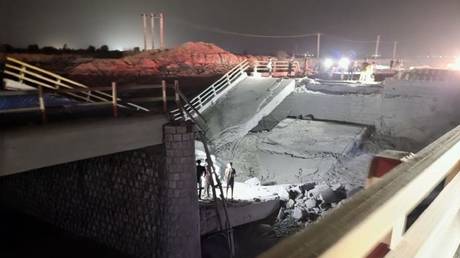
The headlines write themselves. Smoke rises over a runway in the desert. Steel girders of a strategic bridge twist into the river below. A railway station lies in ruins. The media rushes to paint these coordinates as the critical arteries of an adversary's war machine. The foreign policy establishment nods in unison, declaring that "deterrence has been restored" and the enemy's logistics have been broken.
It is a comforting lie.
Western military doctrine remains hopelessly obsessed with kinetic infrastructure targeting. We are told that flattening an airport tarmac or dropping a bridge span fundamentally alters the strategic calculus of highly decentralized, asymmetric adversaries. This is a profound misunderstanding of modern gray-zone warfare.
Infrastructure strikes do not paralyze irregular forces. They merely subsidize their propaganda.
The Illusion of the Chokepoint
Standard military analysis views the Middle East through the lens of twentieth-century state-on-state logistics. In this outdated framework, you cut the railway, you halt the tanks. You crater the runway, you ground the fighters.
This logic collapses when applied to asymmetric actors.
The Low-Tech Logistical Reality
Decentralized networks do not rely on centralized, heavy infrastructure to move assets. They do not need pristine, three-mile-long concrete runways to launch operations.
- The Drone Factor: A one-way attack drone does not require an airport. It requires a flat patch of dirt, a pneumatic launcher, or the bed of a commercial pickup truck.
- The Missile Factor: Modern mobile short-range ballistic missile launchers are designed specifically to operate off-road. They hide in valleys, fruit orchards, and civilian garages, bypassing formalized transport hubs entirely.
- The Supply Line Myth: A destroyed railway station is a minor inconvenience, not a fatal blow, to forces that move weapons via small, disguised commercial truck convoys using secondary dirt roads.
When a multi-million-dollar cruise missile strikes a stationary civilian airport terminal or a public bridge, it is a category error. It is using exquisite, highly expensive weaponry to destroy easily bypassable concrete, while leaving the enemy’s actual operational capacity untouched.
Why We Keep Battering Concrete
If infrastructure targeting yields such poor strategic returns, why does the military establishment remain addicted to it?
The answer lies in the bureaucracy of target development.
Military planners love fixed infrastructure because it is easy to find, easy to hit, and easy to measure. A bridge does not move. A railway station cannot run away. When a satellite image shows a crater in the middle of a runway, a targeting cell can easily mark that objective as "neutralized" and present a clean slide to a commander.
[Targeting Cycle Reality]
High-Value Mobile Assets -> Hard to track -> High risk of failure -> Avoided
Fixed Infrastructure -> Visible on satellite -> Guarantees a hit -> Prioritized
This is the tyranny of the measurable. It prioritizes the destruction of physical structures over the elimination of the adversary's actual capabilities. It is the tactical equivalent of looking for your lost keys under the lamppost simply because that is where the light is.
During my years analyzing targeting methodologies, I watched command staff celebrate the destruction of "dual-use" facilities, only to express bewilderment forty-eight hours later when the adversary launched a fresh barrage of rockets from a nearby hill. The rockets didn't care about the railway station. They never needed it in the first place.
Dismantling the "Deterrence" Fallacy
Every time a strike occurs, the talking heads on cable news immediately raise the question: Will this deter future attacks?
The premise of the question is fundamentally flawed. You cannot deter an adversary whose political and strategic utility increases with every bomb you drop.
The Propaganda Subsidy
For asymmetric forces, Western strikes on domestic infrastructure are not a defeat; they are a goldmine.
- Civilian Rallying Cry: Striking bridges and railways directly impacts the civilian population, not the militia leadership hiding in deep underground bunkers. The immediate result is a surge in local resentment against the striking nation, allowing the adversary to easily recruit and consolidate power.
- The Underdog Narrative: It feeds the David versus Goliath narrative. A local force surviving a strike by a global superpower is framed as a massive moral victory, regardless of the physical damage sustained.
- Financial Shielding: The adversary rarely pays for the reconstruction. International aid organizations, foreign governments, or local taxpayers bear the cost of rebuilding the targeted bridges and airports, while the militant groups divert their own funds entirely to weapons procurement.
To believe that blowing up a bridge forces an asymmetric adversary to the negotiating table is to ignore thirty years of conflict history. It has never worked. It will not start working now.
A Better Way: Target the Network, Not the Nodes
If destroying concrete is a waste of resources, what is the alternative?
We must shift from an infrastructure-centric targeting model to an operational-flow model. This is a far more difficult, less photogenic style of warfare, but it is the only one that yields actual results.
1. Interdict the Cash, Not the Concrete
The lifeblood of irregular warfare is not asphalt; it is liquidity.
Instead of dropping a precision-guided bomb on a runway, resources should be aggressively funneled into disrupting the informal financial networks—like the hawala system and front companies—that allow these groups to procure high-tech components. A frozen bank account in a European capital does far more damage to a drone assembly program than a cratered road in a desert province.
2. Focus on Critical Human Capital
A bridge can be bypassed. A highly trained weapons assembly engineer or a logistics coordinator who understands how to smuggle guidance systems through customs cannot be easily replaced.
The focus must shift entirely from high-visibility physical targets to the critical human nodes within the network. This requires deep, sustained intelligence operations rather than quick-fix kinetic strikes designed for the evening news.
3. Embrace Tactical Patience
The hardest pill for policymakers to swallow is inaction. When an adversary strikes, there is immense political pressure to "do something" immediately. Striking a prominent bridge or a railway hub satisfies the domestic political need for a visible reaction.
But reactive strikes are lazy strikes.
True operational effectiveness requires waiting until the adversary exposes a high-value, irreplaceable asset—like a senior commander or a major weapons cache—even if that means enduring short-term political heat for not responding instantly.
The Hard Truth of Modern Conflict
Let us be brutally honest about the cost of this status quo.
A single Tomahawk land attack missile costs approximately two million dollars.
The concrete repair to a cratered runway costs a fraction of that.
The strategic effect of the strike is near zero.
We are spending millions to destroy thousands, while our adversaries use the resulting wreckage to recruit the next generation of fighters. It is a losing equation, sustained only by a military-industrial echo chamber that values weapon deployment over strategic outcomes.
Until we stop treating Middle Eastern logistics like they are still run by twentieth-century state armies, we will continue to bounce bombs off runways and wonder why nothing ever changes.