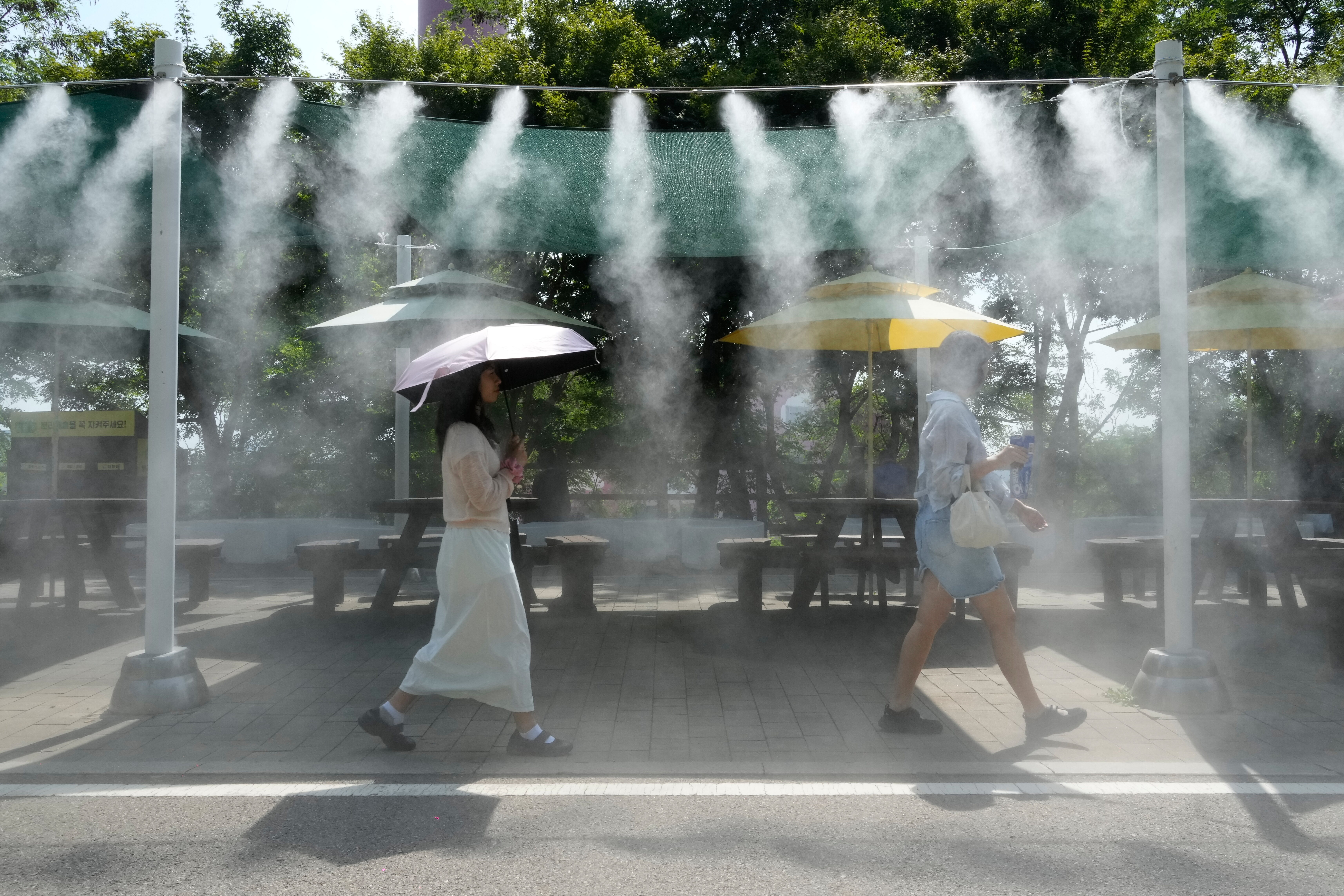
The coffee in my kitchen had been sitting long enough for a thin, iridescent film to form across the surface. Outside, the air did not move. It was past midnight on an August night in 2023, and the thermometer on the porch insisted it was still ninety-two degrees. Not warm. Not muggy. Aggressive.
I remember pressing my palms against the cool glass of the kitchen window, waiting for a breeze that never arrived. The streetlights buzzed, casting long, bruised shadows over asphalt that had baked all day and now radiated that stored fury back up into the dark. It felt less like summer and more like an eviction.
That month broke things. We knew it while we were living it, of course, wiping sweat from our brows on morning commutes and watching our electric bills swell into terrifying new brackets. But it took the scientists weeks later to put the formal numbers to our collective misery. August of that year was not just hot. It was the hottest August humanity had ever recorded, capping off a season of planetary fever that left researchers scrambling for superlatives.
Graphs do not sweat. When you look at the global temperature anomaly charts issued by agencies like Copernicus and NASA, they appear clean. Clinical. A series of jagged lines spiking sharply upward like a jagged mountain range cutting into a grey sky. They show global average temperatures hovering around 1.68 degrees Celsius above pre-industrial levels for that month. They talk about ocean surface temperatures refusing to cool, trapped heat venting into the atmosphere like steam from an industrial valve.
Numbers offer a strange sort of comfort. They let us quantify the catastrophe. They let us argue about parts per million and baseline averages as if we are spectators watching a match from the safety of the owners' box.
(Note: When I speak of the global temperature anomaly, I am relying on aggregated datasets from international meteorological networks that measure surface air temperatures across thousands of land and marine stations.)
Yet, data cannot capture the sound of a dry creek bed cracking open under a relentless sun, or the way city pigeons huddle beneath the minuscule shade of a parking meter, too exhausted to fly.
Consider what happens when the baseline shifts beneath your feet.
Elena, a peach orchard owner in the central valley, watched her harvest ripen three weeks ahead of schedule. At first, she thought she had caught a lucky break. An early market. Better prices. But then the fruit began to drop from the branches before it could gain its proper weight, turning mealy and soft in the superheated air. The trees themselves were confused. Their internal clocks, tuned to centuries of predictable seasonal cues, misfired. They pushed out new blossoms in late August, desperate and premature, draining the energy they needed to survive the coming winter.
"Trees have memories," Elena told me, wiping dust from her forehead with the back of a calloused wrist. We stood between rows of stunted trees whose leaves curled inward like scorched paper. "You can fool them once, maybe twice. But eventually, they stop trying to adapt. They just quit."
That is the part the charts leave out. The quiet quitting of the natural world.
We talk about climate records as if they are athletic achievements. A gold medal for the atmosphere. A new high score in an escalating game of extremes. We read headlines about milestones being broken, and our brains glaze over. We are built to handle acute crises—a sudden storm, a broken bone, a car swerving into our lane. Our adrenaline spikes, we react, and the danger passes.
We are utterly unequipped for a crisis that unfolds in slow motion.
A degree and a half of warming sounds abstract. It sounds like the difference between wearing a sweater or a t-shirt. But think of your own body. If your internal temperature rises by just one and a half degrees, you are running a fever. You are shivering in bed, your thoughts are muddy, and your organs are straining to keep you functioning. Now scale that fever up to cover seven billion people, millions of square miles of forest, and trillions of gallons of ocean water.
The oceans bore the brunt of it that August. While we cursed the humidity on the pavement, the seas were quietly boiling. Marine heatwaves stretched across the Atlantic and the Pacific, turning coral reefs into ghostly white bone yards. To understand ocean heat retention, imagine filling a cast-iron skillet with boiling oil and then trying to cool it down by blowing on it with a desk fan. The volume of water on Earth has a colossal thermal mass. Once it absorbs heat, it holds onto it with stubborn persistence. That stored energy does not vanish when the calendar flips to September. It lingers, feeding the next storm, driving the next drought, whispering of what is to come.
We like to pretend that we are separate from these systems. We retreat into air-conditioned offices and temperature-controlled cars, insulating ourselves against the exterior reality with thick panes of glass and humming compressors. We treat the weather as something that happens on a screen, narrated by a smiling meteorologist pointing at colorful Doppler maps.
Then the power grid stutters.
On one of those stifling August afternoons, the transformer down the street let out a dull, metallic pop and died. Within twenty minutes, the house transformed from a sanctuary into a convection oven. The silence was the first thing that got to you. No refrigerator hum. No ceiling fan cutting the air. Just the dead, heavy weight of trapped heat pressing against the walls.
I sat on the front porch as the sun finally dipped below the horizon, offering no relief, only a change in lighting. My neighbors were out on their steps too. Nobody was talking. We sat in the dark like refugees in our own neighborhood, sharing a quiet, unspoken realization that our infrastructure was built for a world that no longer exists. We have engineered our societies for a climate stability that died sometime in the late twentieth century, and every broken temperature record is just another bill coming due.
The scientists will keep measuring. They will compile the data for the next month, and the month after that, charting the relentless upward march of the red lines on their graphs. They will tell us about parts per million, radiative forcing, and historical anomalies.
And they will be right.
But the true measure of that August, and every August that has tried to follow in its blistering footsteps, isn't found in the calculus of the atmosphere. It is found in the stillness of the air at midnight. It is found in the dry crack of a peach tree branch. It is found in the way we look out our windows at the darkening sky, waiting for a wind that refuses to blow.