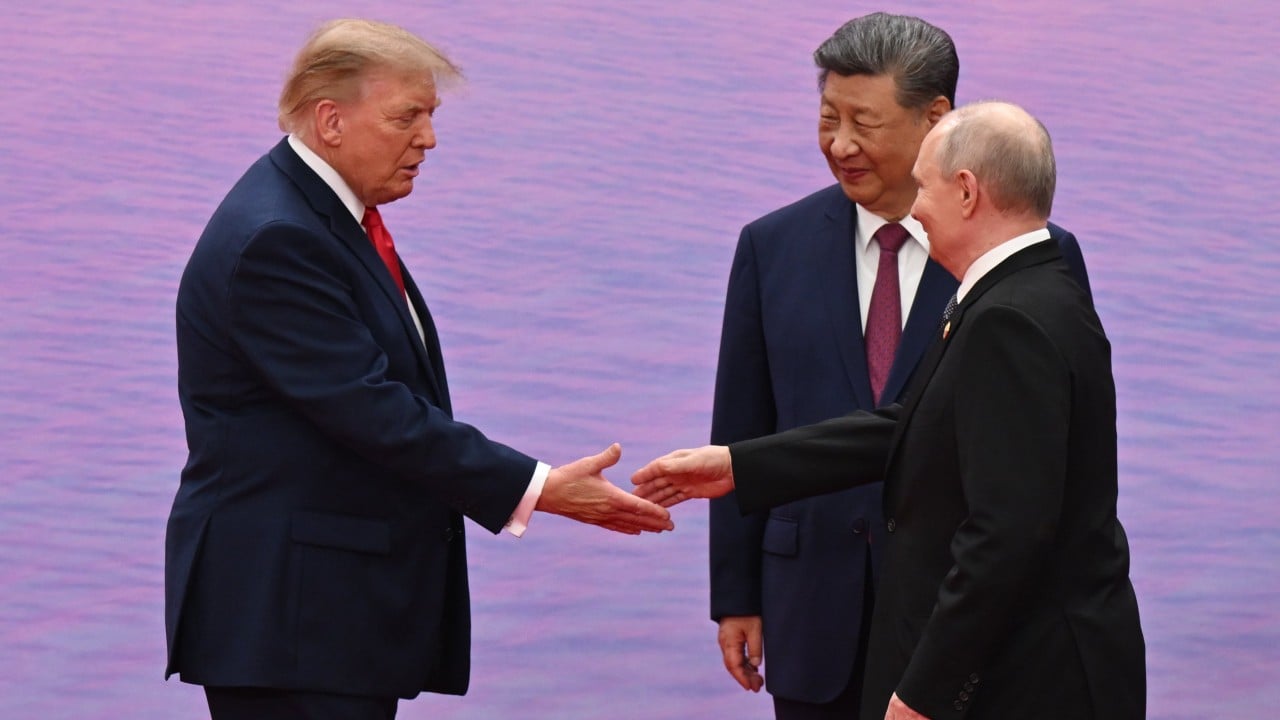
Modern geopolitical strategy relies on decoupling adversaries while managing the secondary shockwaves to domestic capital markets. Evaluating Donald Trump’s characterization of China and Russia as "natural enemies" alongside his dismissal of Nvidia’s market-cap volatility as a non-tragedy requires separating political rhetoric from structural reality. The intersection of Eurasian land-power dynamics and high-end semiconductor export controls reveals a deliberate effort to exploit historical Sino-Russian friction while absorbing short-term equity shocks as an acceptable cost of technological containment.
The Structural Friction of the Sino-Russian Axis
Labeling Beijing and Moscow as "natural enemies" invokes classical realist geopolitics, specifically the concept of geographic and demographic asymmetry along a 4,209-kilometer shared border. While tactical alignment between the two powers has accelerated since 2022, their foundational interests remain structurally opposed across three primary vectors.
- Demographic and Resource Imbalance: The Russian Far East holds vast reserves of hydrocarbons, timber, and fresh water, paired with a shrinking population of roughly eight million people. Directly across the Amur River, China’s northeastern provinces house over 90 million people facing acute resource deficits. Historical memory of the 19th-century "Unequal Treaties"—through which Imperial Russia annexed Outer Manchuria—persists in Chinese strategic thought, creating latent territorial tension beneath current diplomatic warmth.
- Central Asian Hegemony: Both nations compete for influence in the former Soviet republics of Central Asia. Moscow views the region as its traditional security perimeter via the Collective Security Treaty Organization. Beijing is systematically displacing Russian economic dominance through infrastructure financing and bilateral trade corridors, turning Russian client states into Chinese economic dependencies.
- The Junior Partner Dynamic: Sanctions-induced isolation has forced Russia into an asymmetric economic relationship with China. Moscow sells discounted crude oil and raw commodities while importing dual-use industrial components and consumer goods from Chinese manufacturers. Sovereign states with imperial histories rarely tolerate permanent subordination; the current partnership functions as a marriage of convenience dictated by shared opposition to Western financial and military architecture, not ideological unity.
Reverse-Kissinger Mechanics and Wedge Strategy
In international relations theory, a wedge strategy aims to prevent a hostile coalition from forming or to fracture an existing one through selective accommodation and pressure. During the Cold War, the Nixon administration exploited the Sino-Soviet split to isolate Moscow. Contemporary American strategy attempts an inversion of this maneuver, seeking to detach Russia from China’s orbit.
The operational logic rests on altering Moscow’s payoff matrix. Continuing the current trajectory locks Russia into permanent economic vassalage to Beijing while bleeding military capital in Eastern Europe. Offering a negotiated settlement in Europe—paired with calibrated sanctions relief—presents Moscow with an exit ramp from total Chinese dependency.
This approach faces severe execution risks. Unlike the 1970s, when China and the Soviet Union fought active border skirmishes along the Ussuri River, current Sino-Russian leadership maintains tight personal and institutional alignment. Attempting to drive a wedge between two authoritarian regimes requires offering concessions that domestic Western coalitions find politically unpalatable, such as territorial compromises in Eastern Europe or the relaxation of energy price caps. Without credible security guarantees that survive American electoral cycles, Moscow has little incentive to abandon a reliable bordering superpower for a volatile transatlantic partner.
Market Valuation Versus National Security Externalities
The second pillar of the strategic posture involves downplaying severe market capitalization drops at Nvidia following the emergence of cost-efficient Chinese artificial intelligence models, such as DeepSeek, and tightening export controls. Treating a multi-hundred-billion-dollar equity drawdown as a minor event—explicitly rejecting the framing of a "tragedy"—exposes a fundamental divergence between Wall Street valuation models and statecraft.
Financial markets price equities based on discounted future cash flows, monopolistic pricing power, and uninterrupted global total addressable markets. When a dominant hardware supplier loses access to a major export market or faces demand destruction from algorithmic efficiency gains, equity analysts register an immediate impairment to growth multiples.
From a national security perspective, corporate market capitalization is a secondary metric compared to relative technological capability. This dynamic operates through specific economic mechanisms:
- The Cost Function of Containment: Export controls on advanced lithography and high-bandwidth memory chips deliberately destroy revenue streams for domestic champions. Policymakers accept this deadweight loss to impose a higher compute-cost penalty on foreign adversaries.
- The Efficiency Paradox: When capital and hardware constraints are imposed on an adversary, they induce innovation in software optimization. The emergence of competitive, lower-compute AI models demonstrates that hardware bottlenecks do not guarantee permanent software stagnation; instead, they force rival engineers to bypass brute-force compute scaling.
- Capital Reallocation: High valuations concentrated in a single hardware bottleneck create systemic fragility. A valuation correction forces capital out of hardware monopolies and into downstream application layers, energy infrastructure, and sovereign manufacturing—sectors deemed more durable in a bifurcated global economy.
The limits of Chokepoint Geopolitics
Relying simultaneously on geopolitical wedge strategies and semiconductor export controls exposes a core contradiction in modern statecraft. Chokepoint strategies assume that controlling a critical node—such as advanced GPU design or extreme ultraviolet lithography—allows a state to dictate the pace of global technological diffusion.
In practice, absolute chokepoints erode over time through three distinct channels:
First, grey-market arbitrage routes restricted hardware through third-party jurisdictions, diluting the enforcement of export bans while inflating compliance costs for domestic firms. Second, indigenous substitution accelerates when foreign firms are cut off from Western supply chains; deprived of commercial alternatives, state-backed entities pour unlimited subsidies into domestic semiconductor fabrication, eventually creating self-sufficient competitors that no longer rely on Western intellectual property. Third, allied friction increases when third-party nations are forced to choose between American security guarantees and Chinese trade volumes, leading to regulatory non-compliance among key equipment suppliers in Europe and East Asia.
Furthermore, weaponizing economic interdependence carries diminishing returns. Once an adversary absorbs the initial shock of exclusion from Western capital and technology markets, the threat of further sanctions loses its deterrent value. Russia’s wartime economic adaptation and China’s localized supply chain mandates illustrate how targeted states build parallel financial and industrial ecosystems to insulate themselves from external coercion.
Strategic Execution for Institutional Operators
Navigating an environment where executive statecraft subordinates corporate equity performance to great-power containment requires abandoning legacy globalization models. Institutional investors, supply chain executives, and policy strategists must recalibrate their risk frameworks around permanent geopolitical fragmentation.
- Discount Sovereign Risk Over Earnings Multiples: Hardware and technology valuations must incorporate a permanent geopolitical discount. Revenue streams tied to dual-use technologies or exposed to cross-border regulatory jurisdictions cannot be valued using traditional SaaS or consumer tech growth multiples. Capital allocation should prioritize firms with domestic supply chain resilience and sovereign contract backing over those reliant on frictionless global trade.
- Model Asymmetric Efficiency Shocks: Portfolio construction in the artificial intelligence sector must account for the deflationary impact of algorithmic optimization. Over-indexing on compute-heavy hardware providers leaves capital exposed when software breakthroughs reduce the marginal cost of model training and inference. Shift exposure toward power generation, grid infrastructure, and specialized enterprise integration, which remain bottlenecked regardless of chip efficiency.
- Hedge Against Eurasian Realignment: Supply chain and commodity desks should treat the Sino-Russian alignment as tactical rather than permanent. Any diplomatic thaw between Washington and Moscow will trigger rapid volatility in global energy, fertilizer, and industrial metal markets as Russian supply re-enters Western channels, simultaneously eroding Beijing’s access to discounted raw inputs. Maintain flexible procurement contracts that can pivot rapidly if bilateral sanctions regimes are selectively dismantled.