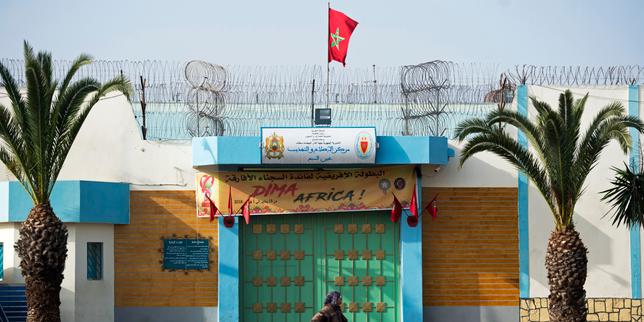
Every time a Moroccan court hands down a harsh prison sentence to a cartoonist or activist for mocking the monarchy, international press desks dust off the exact same template. You know the script by heart. A headline announces a four-year prison term. Three paragraphs follow, framing the story as a straightforward clash between a lone, heroic satirist and an arbitrary, medieval censorship machine.
That framing is lazy. Worse, it completely misunderstands how power, law, and digital provocation actually operate in contemporary North Africa.
When commentators treat cases like the sentencing of cartoonist Yasser Mounbir purely as a spontaneous spasm of authoritarianism, they miss the cold, calculated legal mechanics driving the verdict. They confuse a lack of Western-style free speech with a lack of legal predictability. In reality, the Moroccan state isn't reacting out of sudden panic over a few drawings. It is executing a long-standing, codified doctrine of institutional preservation that anyone operating inside the country’s media ecosystem knows—or fatally chooses to ignore.
The Myth of the Ambiguous Red Line
Foreign correspondents love talking about "shifting red lines" in Rabat. It makes for dramatic copy. It suggests an unpredictable labyrinth where journalists wake up every morning guessing what might land them in a cell.
Ask anyone who has actually edited a publication in Casablanca or managed risk for regional media outlets, and you will get a very different answer. The red lines in Morocco are not shifting. They are carved in granite.
For decades, the unwritten—and increasingly written—social and legal contract in Morocco has rested on three untouchable pillars: Islam, the territorial integrity of the Sahara, and the person of the King. Under Article 46 of the Moroccan Constitution, the person of the King is inviolable, and respect is due to him. When the 2016 Press and Publishing Code was introduced, international observers applauded the removal of prison sentences for strictly journalistic offenses. They conveniently glossed over the fact that offenses touching the monarchy, religion, or territorial integrity were kept firmly inside the Penal Code, where custodial sentences remain the default weapon.
When a cartoonist publishes caricatures directly targeting the monarch, they are not stumbling across an invisible tripwire. They are walking straight into a heavily fortified minefield with a megaphone.
Calling this "arbitrary censorship" is a category error. Arbitrary censorship happens when rules are invented retroactively to punish dissent. What happens in Moroccan courtrooms during lèse-majesté trials is the mechanical application of a Penal Code that has never pretended to protect satire directed at the palace. Pretending otherwise does a massive disservice to audiences trying to understand the actual legal reality on the ground.
Why Satire Isn't a Shield in North African Courts
A massive blind spot in Western commentary is the assumption that caricature enjoys a special, universally recognized immunity. In Paris, London, or New York, political cartoons operate under an established legal tradition—from Hustler Magazine v. Falwell in the United States to European Court of Human Rights jurisprudence—that treats exaggeration and ridicule of public figures as protected commentary.
Transplanting that framework onto Morocco ignores centuries of distinct constitutional history.
In Morocco, the monarchy is not merely an executive branch or a partisan political office. Through the title Amir al-Mu'minin (Commander of the Faithful), the King occupies a religious, historical, and symbolic role designed to sit above daily political squabbles. In the state's legal doctrine, attacking the person of the King is not treated as criticizing a prime minister's tax policy. It is legally construed as an assault on the institutional glue holding a diverse, multi-ethnic nation together.
I have sat across the table from local editors and digital publishers in the region who thought they could import European satirical tropes onto Facebook and YouTube without consequence. They believed international outrage would act as a force field. It never does. When the gavel comes down, human rights press releases from Brussels or Washington do not shave a single day off a four-year sentence. The courtroom operates strictly on domestic statutory logic, indifferent to external editorial boards.
The Algorithm Trap Fueling Harsh Verdicts
If the legal boundaries have existed for decades, why are the sentences—four years, sometimes five—so relentlessly severe? The answer has less to do with ink on paper and everything to do with social media distribution mechanics.
Twenty years ago, an underground pamphlet or a niche print cartoon reached a few thousand eyes in cafes across Rabat and Tangier. The state could afford to quietly confiscate an issue, levy a fine, or let the controversy die out in a week.
Today, a single caricature uploaded to a public profile enters an algorithmic amplification engine. Within hours, it circulates across WhatsApp groups, TikTok feeds, and diaspora networks, stripped of context and primed for maximum outrage. From the perspective of Moroccan interior ministries and prosecutors, the threat is no longer the drawing itself; it is the velocity and scale of viral disrespect.
Think of it as a deterrence pricing model. When distribution costs drop to zero and reach becomes infinite, the state raises the penalty to re-establish friction. A four-year prison sentence is not just aimed at the individual defendant in the dock. It is a calculated broadcast signal sent to tens of thousands of young content creators, meme pages, and independent illustrators testing the waters online.
Human rights organizations like Reporters Without Borders and Human Rights Watch routinely document how digital expression laws—specifically Penal Code provisions penalizing offenses committed via electronic means—have become the primary vehicle for prosecuting online dissent. Prosecutors don't need to prove conspiracy or incitement to violence. They simply present screenshots, establish public dissemination, and let statutory minimums do the rest.
The Uncomfortable Truth About International Outrage
Let’s address the elephant in the room: the performative cycle of international condemnation.
Whenever a verdict like Mounbir’s hits the wires, foreign ministries express "concern," NGOs issue urgent appeals, and op-ed writers demand immediate intervention. Does any of this actually help the person sitting in a Moroccan prison cell?
Often, it achieves the exact opposite.
Public, heavy-handed foreign pressure turns a domestic legal case into a test of national sovereignty. Once a Moroccan judge’s ruling is framed in European media as a litmus test of Rabat’s obedience to Western norms, backing down becomes politically impossible for the state. Quiet diplomatic channels, royal pardons during national holidays, and low-profile legal appeals have historically freed far more Moroccan detainees than loud international media campaigns ever have.
Admitting this is deeply uncomfortable for advocacy groups whose entire funding and visibility model depends on public outcry. Yet anyone who has watched the trajectory of high-profile cases in Morocco over the past fifteen years knows the pattern. Maximum international noise tends to harden judicial resolve during the trial phase, while real relief only arrives months or years later when the headlines have faded and a royal pardon can be granted on the state’s own terms, without appearing to bow to external pressure.
What Observers Actually Need to Track
If you want to understand where freedom of expression in Morocco is truly heading, stop obsessing over direct caricatures of the King. Those cases have a predetermined outcome. Watch the margins instead.
The real battleground for speech in Morocco isn't lèse-majesté; it is investigative reporting on corruption, economic monopolies, judicial independence, and public administration. That is where the genuine tug-of-war happens every single day. Journalists, economists, and whistleblowers routinely push against bureaucratic opacity, exposing state waste and corporate cronyism while carefully avoiding direct attacks on the monarch's person.
Consider a simple thought experiment. Imagine two creators in Casablanca. The first publishes a scathing, data-backed investigation exposing mismanagement in a regional infrastructure project, meticulously attributing failures to specific ministers and contractors. The second posts a crude caricature mocking the King.
The first creator faces intense legal scrutiny, potential defamation suits, and pressure—yet operates within a contested space where public debate actually happens and reforms occasionally follow. The second creator triggers an automatic, unforgiving Penal Code mechanism that ends any possibility of dialogue before it even begins.
The lazy media narrative lumps both into the exact same bucket, erasing the vital strategic distinction between effective accountability journalism and symbolic provocation.
The Cost of Misreading the Battlefield
There is an undeniable moral clarity in defending an artist’s right to draw whatever they want without facing four years behind bars. Nobody with a commitment to basic civil liberties celebrates a cartoonist being locked away for ink and pixels.
The downside of taking a hard-nosed, realist view of Moroccan jurisprudence is that it can sound cold—even fatalistic—to readers accustomed to absolute First Amendment standards. Acknowledging that a red line is clear and predictable does not make the punishment proportionate or just. Four years in prison for a drawing remains a staggering use of state power by any international benchmark.
Precision matters. When analysts, journalists, and commentators reduce complex legal ecosystems to simplistic fairy tales of good versus evil, they blind themselves to how power actually functions. Morocco is neither a Western liberal democracy nor a lawless dictatorship where rules are made up on a whim. It is a hybrid constitutional monarchy operating under strict, codified boundaries that prioritize institutional stability above individual expression.
Until outside observers stop projecting their own legal assumptions onto North African courtrooms, they will keep expressing shock at outcomes that were written into the Penal Code long before the first pencil ever touched paper.