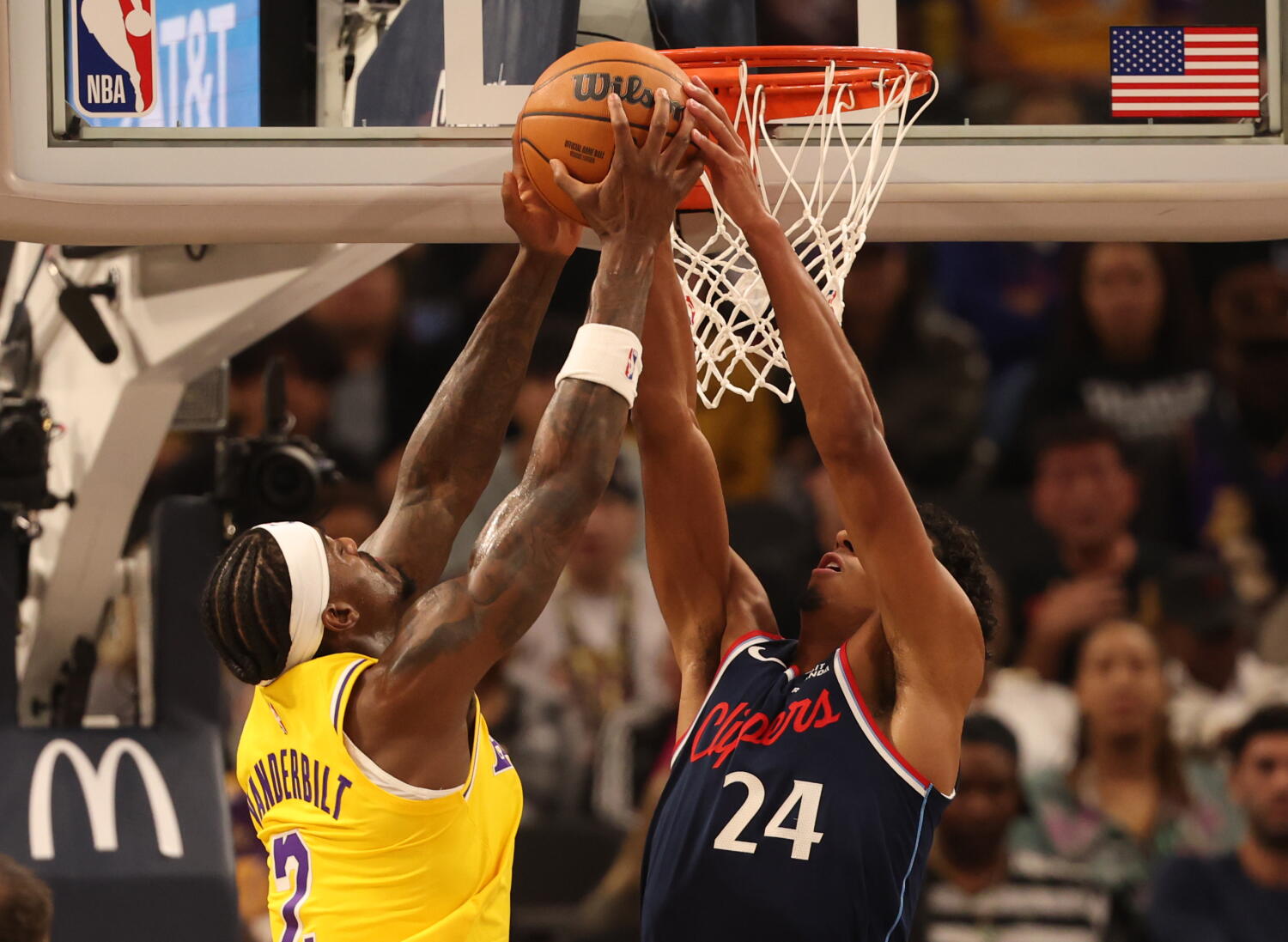
Jarred Vanderbilt does not care about your box score. When the Los Angeles Lakers squared off against the Clippers, the casual observer likely scanned the postgame stat sheet, nodded at the primary scorers, and moved on. Yet inside the locker room, the coaching staff and players pointed directly at Vanderbilt as the engine behind their second unit's dominance, labeling him a true professional whose relentless defensive energy swung the momentum of the rivalry matchup.
That praise is easy to throw around after a win. It is much harder to unpack why a player with glaring offensive limitations remains indispensable to a roster trying to survive the brutal attrition of the Western Conference. Modern NBA front offices spend millions hunting for theoretical versatility—wings who can supposedly shoot forty percent from deep while guarding three positions. Almost none of those theoretical players actually exist on a mid-level budget. What teams get instead are specialists with sharp edges. Vanderbilt is the sharpest edge on the Lakers' bench, a chaotic, high-motor disruptor whose value lives almost entirely in the margins that casual metrics fail to capture.
The Anatomy of a Bench Catalyst
Watch a single defensive possession when Vanderbilt checks into the game. His feet never stop moving. While most modern defenders rely on length and drop-coverage schemes to funnel ball handlers toward a rim protector, Vanderbilt attacks the point of attack like a free safety blitzing off the edge. Against a Clippers roster built around methodical half-court isolation and rhythmic pick-and-roll reads, that kind of physical disruption acts like sand in the gears.
He switches onto guards at the top of the key, absorbs contact through screens without dying on the pick, and still recovers in time to contest a corner three or box out a seven-footer. It is exhausting just to watch. Over a forty-eight-minute NBA game, stars settle into comfortable cadences. They know where the help is coming from, they know how much airspace they will get on a catch-and-shoot look, and they know when a defender is taking a play off to rest for the next offensive trip. Vanderbilt erases that comfort.
- Point-of-attack pressure: He forces opposing ball handlers to start their sets three feet further away from the three-point line than they want to be.
- Second-chance creation: His offensive rebounding rate consistently turns broken possessions into fresh twenty-four-second clocks, demoralizing defenses that thought they had secured a stop.
- Transition ignition: Because he crashes the glass with abandon, he frequently sparks fast-break opportunities before the opposing defense can match up.
The "true professional" label attached to him after the Clippers game isn't just locker-room cliché. In the NBA, professionalism for a role player means accepting a thankless job description without letting your ego bleed into your effort. When your number isn't called for an entire quarter—when you stand in the dunker spot or the weak-side corner while superstars orchestrate the offense—the human instinct is to disengage defensively. Vanderbilt does the exact opposite. He treats every loose ball like his next contract depends on it.
Why Modern Spacing Math Hates Players Like Vanderbilt
If Vanderbilt is so valuable, why does his playing time occasionally fluctuate? The answer lies in the cold, unforgiving geometry of modern basketball.
Offensively, Vanderbilt is a known liability from the perimeter. Opposing coaches do not respect his three-point shot, and they aren't wrong to gamble. When he shares the floor with other non-shooters, the paint turns into a crowded subway car at rush hour. Defenders sag ten feet off him, standing directly in the driving lanes that the Lakers' primary creators need to attack the rim. You can practically see the opposing center camping in the lane, daring Vanderbilt to shoot while suffocating every cut and post-up around him.
This is the central tension of building a rotation in today's league. You want Vanderbilt's defensive chaos, his switching ability, and his ferocious rebounding. To get it, you have to survive the four-on-five spacing reality on the other end of the floor.
The Lineup Puzzle
Coaching staffs spend hours staring at lineup data trying to solve this exact equation. Put Vanderbilt alongside four capable perimeter shooters, and the offense hums smoothly enough to let his defensive brilliance shine. Pair him with a traditional, non-shooting center and a ball-dominant guard who struggles from deep, and the half-court offense grinds to a halt.
Against the Clippers, the Lakers managed to thread that needle. By deploying him as the centerpiece of a high-energy bench unit surrounded by floor-spacers and decisive secondary playmakers, the staff neutralized his offensive drawbacks. Instead of standing still in the corner waiting for a reluctant catch-and-shoot three, Vanderbilt stayed in constant motion—setting bruising off-ball screens, diving hard to the rim out of short-roll actions, and living on the offensive glass. When a non-shooter moves without the ball, his defender cannot simply stand in the paint and watch the play unfold; he has to track the cutter, which naturally opens up driving lanes for everyone else.
The Hidden Economics of Effort
There is a massive blind spot in how fans and media evaluate NBA depth. We obsess over ceiling. We fall in love with twenty-two-year-old draft picks who show flashes of three-level scoring in garbage time, ignoring the fact that they miss three defensive rotations a quarter and give up more points than they score.
Veteran contenders know better. Championship rotations aren't built on theoretical upside; they are built on reliability and energy transfer. Energy in an NBA arena is contagious, and it usually flows from the bottom of the roster up, not the top down. Superstars carry the cognitive and physical burden of generating offense against loaded defenses night after night. Expecting them to also dive on the floor for loose balls in the second quarter of a regular-season game is unrealistic.
That is where a player like Vanderbilt earns every penny of his contract. When he enters the game and immediately blows up a handoff, dives into the second row to save a possession, and tips an offensive rebound out to a shooter, the entire temperature of the bench changes. Suddenly, the veteran stars lock in on their defensive assignments. The closeouts get sharper. The communication gets louder. You cannot quantify that psychological shift in a traditional box score, yet every coach in the league will tell you it is the difference between sleepwalking through a loss and stealing a division game on the road.
Surviving the Attrition of the Western Conference
The grueling eighty-two-game grind exposes shallow rosters faster than anything else in professional sports. Injuries happen. Shooting slumps are guaranteed. Over the course of six months, every team hits a stretch where the jump shots simply stop falling for two weeks straight.
Teams that rely purely on offensive talent collapse during those droughts. When the threes aren't dropping, they lose their defensive edge, surrender transition buckets, and get blown out by twenty points before the fourth quarter begins. Teams with entrenched culture setters—players whose baseline production is tied entirely to physical effort rather than shooting variance—weather the storm. You never have to wonder if Vanderbilt's motor is going to show up on a Tuesday night in February. Effort doesn't slump.
The Clippers game served as a blueprint for how Los Angeles has to survive those stretches. They cannot out-skill every opponent every night, especially when navigating minutes restrictions, back-to-backs, and inevitable roster absences. They have to out-work them. They have to win the possession battle by forcing turnovers and dominating the glass, generating ten to twelve extra shot attempts per game through sheer physical persistence.
The Blueprint for Role Player Longevity
Look around the league at the players who stick on winning rosters for a decade despite never making an All-Star team. P.J. Tucker, Alex Caruso, Gary Payton II, Dorian Finney-Smith. None of them were drafted to be franchise saviors. Most of them spent their early years fighting for guaranteed contracts, bouncing between rotations, and watching more talented scorers wash out of the league because they refused to do the dirty work.
Vanderbilt belongs firmly in that lineage. His career trajectory is a masterclass in self-awareness. Rather than demanding post touches or hijacking possessions to prove he has an offensive bag, he leaned completely into the traits that make him unique. He turned rebounding and perimeter defense into an art form. He accepted that his nights might end with six points, twelve rebounds, three steals, and a collection of floor burns—and he treated that stat line with the same pride a volume scorer treats a thirty-point outing.
For younger players watching from the end of the bench, there is no clearer lesson in how to earn trust at the highest level of basketball. Coaches do not play guys who need the ball to feel involved. They play guys who solve problems. When the Lakers' defense looked sluggish and disjointed against the Clippers, Vanderbilt walked onto the floor and solved the problem within three possessions.
The box score will always belong to the scorers, and the highlights will always belong to the dunks and deep threes, yet the games themselves are quietly decided in the trenches by the professionals willing to do everything nobody else wants to do.