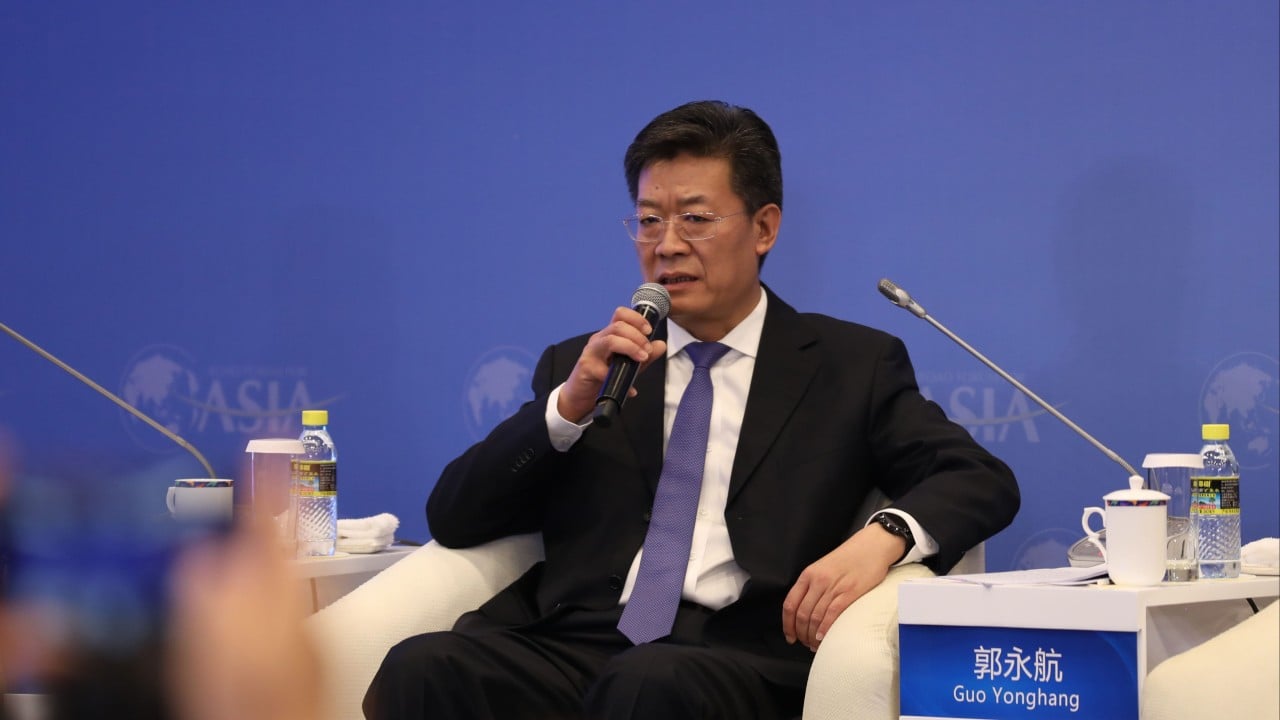
The downfall of Guo Yonghang is not just another notch on the belt of China’s Discipline Inspection Commission. When the news broke that the former Party Secretary of Guangzhou and a rising star in the Guangdong political firmament was being hauled in for "serious violations of discipline and law," the tremors were felt far beyond the provincial capital. This is a surgical strike. By removing Guo, Beijing is dismantling a specific lineage of power that connects the industrial hubs of the south to the highest echelons of the aerospace and technology sectors.
For years, Guo was seen as the protected ward of Ma Xingrui, the current Xinjiang Party Chief and a heavyweight in the "Aerospace Clique." This faction, comprised of technocrats who cut their teeth in China’s space program before moving into civil administration, has long been considered untouchable due to their role in the country’s high-tech self-reliance. Guo’s arrest shatters that illusion. It signals that even the most technically proficient "space-engineers-turned-politicians" are no longer immune to the sweeping, multi-decade anti-graft campaign that has defined the current era of Chinese governance.
The Geography of a Takedown
Guo Yonghang did not fall because of simple bribery. To understand his exit, one must look at the map of his career. He spent decades climbing the ladder in Shenzhen and Zhuhai before taking the reins in Guangzhou. These are not just cities; they are the financial lungs of the Greater Bay Area. In these zones, the line between government infrastructure projects and private capital is often a blur of state-owned enterprise (SOE) contracts and land-use rights.
Investigators are reportedly focusing on Guo’s tenure in Zhuhai and his subsequent promotion to Guangzhou. In the Chinese political ecosystem, a promotion often serves as a "cooling period" or a way to lift a target out of their local power base before the trap is sprung. While he was being praised for stabilizing Guangzhou’s economy during the post-pandemic slump, the Central Commission for Discipline Inspection (CCDI) was likely already auditing the massive infrastructure spends he authorized years prior.
The timing is calculated. With the national economy facing structural headwinds, Beijing is increasingly intolerant of "middleman" corruption—the kind where local officials skim off the top of major development projects, inflating costs and saddiling local governments with hidden debt. Guo, as a primary architect of Guangdong’s recent urban expansion, became the face of a developmental model that the central leadership now views as both risky and obsolete.
The Aerospace Connection and the Ma Xingrui Factor
The most jarring aspect of this investigation is the proximity to Ma Xingrui. Ma is a titan of the system. A former Vice Minister of Industry and Information Technology and the man who led the Chang’e 3 lunar mission, Ma is the quintessential technocrat. When Ma moved from the aerospace sector to become the Governor of Guangdong, Guo Yonghang was his reliable "boots on the ground."
In the opaque world of Chinese elite politics, Guo was widely viewed as Ma’s protégé, the man who handled the granular details of provincial management while Ma focused on the grand strategy of the Greater Bay Area. By targeting Guo, the CCDI is effectively sending a warning shot across the bow of the Aerospace Clique.
This factional tension is critical. For a decade, the aerospace technocrats were the "golden boys" of the administration. They were seen as clean, efficient, and loyal. However, as they have moved into more traditional political roles involving real estate and finance, they have become susceptible to the same "sugar-coated bullets" of corruption that downed the previous generation of officials. The investigation into Guo suggests that the "technical immunity" once enjoyed by this group has expired.
The Infrastructure Trap
Under Guo’s watch, Guangzhou and Zhuhai saw a frantic pace of construction. We are talking about billions of yuan poured into bridges, tunnels, and high-tech parks.
- The Zhuhai-Macau link: Massive investments in connectivity that provided ample opportunity for subcontracting irregularities.
- Guangzhou’s Urban Renewal: A push to "modernize" older districts that required the displacement of thousands and the reallocation of prime real estate.
- High-Tech Subsidies: Channelling state funds into "innovation hubs" that often existed more on paper than in reality.
The CCDI’s playbook in cases like this usually starts with the "small fish"—subcontractors and lower-level bureau chiefs. Over the past eighteen months, several mid-level officials in Guangdong’s transport and housing bureaus have quietly disappeared from public view. These were the foundations of the case against Guo. When an official of his stature is finally named, it means the evidence is already airtight. The "investigation" phase is often a formality; the verdict is frequently decided before the first public announcement is made.
Why the Private Sector Should Be Worried
For businesses operating in Southern China, the removal of a figure like Guo creates an immediate vacuum and a climate of fear. When a top official is purged, every contract they signed, every permit they approved, and every "friend" they had in the private sector comes under intense scrutiny.
Foreign investors often mistake these purges for simple political theater. They aren't. They are fundamental shifts in the local business environment. If your company’s growth strategy in Guangdong was built on a relationship with Guo’s office, that strategy is now a liability. We have seen this pattern before in cities like Chongqing and Dalian: a top leader falls, and the subsequent "cleanup" results in years of frozen projects and aggressive tax audits of private firms linked to the disgraced official.
There is also the "compliance" tax to consider. Local bureaucrats, terrified of being linked to the fallen leader, will now be hyper-cautious. Decision-making will slow to a crawl. Approvals that used to take weeks will now take months as every official tries to ensure their signature isn't on the wrong document.
The New Standard of Loyalty
Guo’s fall highlights a shift in what Beijing demands from its provincial leaders. It is no longer enough to deliver GDP growth. The new metric is "high-quality development," which is code for growth that doesn't involve massive debt or corruption-prone vanity projects. Guo was a master of the old school—high-speed, high-spend, and high-visibility.
His removal signals that the era of the "Growth at All Costs" provincial boss is over. The central leadership is prioritizing financial stability and central control over the entrepreneurial autonomy that once made Guangdong the "wild west" of Chinese capitalism.
The investigation is also a reminder of the "Life-Long Accountability" rule. In the current system, an official can be held responsible for a decision made twenty years ago. There is no statute of limitations on political or financial errors. Guo might be answering for things he did in the early 2010s just as much as his recent activities in Guangzhou.
The Ripple Effect Across the South
Guangdong has always been the province that tests the limits of Beijing’s patience. It is wealthy, distant, and culturally distinct. By taking down a man of Guo’s influence, the central government is reasserting the "One Chessboard" principle—the idea that the entire country must move in perfect unison with the center’s commands.
We should expect to see a series of "self-criticism" sessions across the Guangdong provincial government in the coming weeks. Subordinates will be forced to distance themselves from Guo, and his "political legacy" will be systematically scrubbed from official records. This is the standard procedure for "cleansing the poison" of a corrupt official.
However, the real story isn't about what Guo took; it's about what his removal allows the center to take back. By hollowing out the local power structures in the South, Beijing is clearing the way for a more direct form of governance, one that bypasses the powerful provincial cliques that have traditionally acted as a buffer between the capital and the country’s economic engines.
The fall of Guo Yonghang is a cold reminder that in the current landscape, technical expertise and powerful mentors are no longer a shield. The machine is hungry, and it has no qualms about consuming its own stars to ensure the survival of the system.
Track the movement of capital out of Guangzhou-based SOEs over the next quarter. That is where the true impact of this investigation will be visible. The money always knows when the party is over long before the lights are turned off.
Would you like me to analyze the specific SOEs and private firms that were most closely tied to Guo Yonghang's infrastructure projects in Zhuhai and Guangzhou?