In the village of Marjayoun, there is a particular kind of silence that residents know how to read like a barometer. It isn't the peaceful quiet of a Sunday afternoon in the countryside. It is a heavy, expectant stillness. When the birds stop chattering and the distant hum of a tractor cuts out, the elders on their balconies don’t look at their watches. They look toward the horizon, where the rolling green hills of Southern Lebanon meet the blue haze of the Galilee.
For those living along the "Blue Line," the border is not a line on a map. It is a living, breathing character in their daily lives. It determines when they plant their tobacco, where their children can kick a ball, and whether they sleep in their beds or in the reinforced concrete of a basement. To understand why this specific patch of earth has been a theater of war for over half a century, you have to look past the political speeches and into the red soil itself.
The Geography of an Incurable Friction
Southern Lebanon is a masterclass in topographical misfortune. It is beautiful, rugged, and strategically indispensable. If you stand on the heights of the Beaufort Castle, a Crusader fortress that has seen more blood than perhaps any other ruin in the Levant, you see why everyone wants this ground. From here, you can see deep into northern Israel and across the Litani River.
Control the heights, and you control the valley. Lose the heights, and you are a sitting duck.
This reality turned the region into a buffer zone before the term even existed. Following the creation of the State of Israel in 1948, the South became the final destination for thousands of Palestinian refugees. They brought with them their belongings, their keys to houses they hoped to return to, and eventually, their weapons. By the late 1960s, the "Cairo Agreement" effectively handed over control of parts of the South to the Palestine Liberation Organization (PLO).
Imagine a sovereign nation where a foreign militia runs the border. That was the reality. The Lebanese state, fragile and divided, watched from Beirut as the South became a "state within a state." The South became "Fatah-land." Every rocket fired from a Lebanese olive grove toward an Israeli town brought back a rain of fire. The farmers caught in the middle were the first to pay the price. They are still paying it.
The Year the Earth Stayed Open
1978 was the year the world realized the South would not be a localized skirmish. Operation Litani saw Israeli forces push up to the river, seeking to push Palestinian commandos away from their northern kibbutzim. This was the birth of UNIFIL—the United Nations Interim Force in Lebanon.
The word "Interim" is a cruel joke in the Levant.
Those blue helmets have been there for forty-eight years. They were meant to be a temporary fix, a dash of gauze on a deep wound. Instead, they became part of the scenery. They drink coffee in the local shops; they white-wash their bunkers every spring. Their presence is a constant reminder that the peace is not a peace at all, but a managed state of non-explosion.
Then came 1982. This wasn't a push; it was an avalanche. Israeli tanks rolled all the way to Beirut. The occupation of the South, which followed that invasion, lasted eighteen years. If you were born in a village like Nabatieh in 1982, you grew up seeing a foreign flag on the hilltops until you were nearly an adult.
Occupations have a specific chemistry. They don't just control land; they transform the people living on it. The vacuum left by the weakened PLO and the marginalized Lebanese army was filled by something more local, more religious, and far more disciplined.
A Resistance Rooted in the Orchard
Consider a young man in the early 80s. He sees his father’s orchard bulldozed for a security fence. He sees his neighbors detained. He doesn't look to Beirut for help, because Beirut is burning in its own civil war. He looks to his faith and his neighbors.
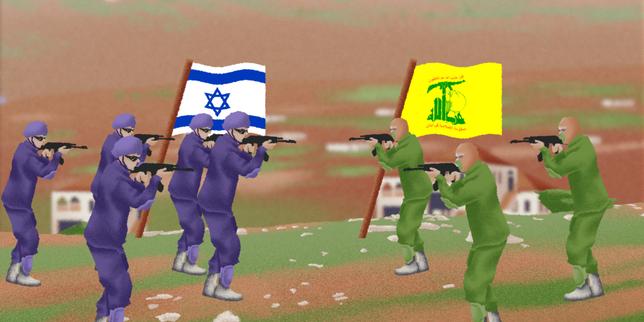
Hezbollah did not drop from the sky. It grew out of the Shiite villages of the South, fueled by the Iranian Revolution and a burning sense of dispossession. To the West, they are a proxy or a terrorist organization. To many in the South, they became the only wall between them and an eternal occupation.
This is the psychological knot that outsiders fail to untie. When the Israeli Defense Forces (IDF) finally withdrew in May 2000, it wasn't because of a treaty signed in a gilded room in Geneva. It was because of a relentless, grinding war of attrition in the hills. The images of Lebanese families rushing back to their villages, kissing the ground, and reclaiming their homes are burned into the collective memory of the region.
But the "liberation" didn't bring quiet. It changed the rules of the game. The border became a giant, high-stakes chessboard.
The Thirty-Four Day Crack in the World
In 2006, the chessboard was kicked over. What started with a cross-border raid and the kidnapping of two Israeli soldiers ended in a month of total war.
If you talk to someone who lived through the July War, they don't talk about the geopolitical shift. They talk about the sound of the bridges collapsing. Israel’s strategy was to isolate the South, cutting off every artery leading to Beirut. The South was an island.
The scars of 2006 are still visible if you know where to look. They are in the rebuilt houses that look slightly too modern for their ancient surroundings. They are in the fields where cluster munitions—small, lethal "toys"—still occasionally claim the limb of a child or a goat.
The war ended with UN Resolution 1701. It called for the area south of the Litani to be free of any armed personnel except for the Lebanese Army and UNIFIL. On paper, it was a solution. In reality, it was a polite fiction. Hezbollah moved its infrastructure underground. Israel kept its jets in the sky. Both sides spent the next two decades preparing for the sequel.
Why the Water Matters More Than the Politics
We often talk about religion and rockets, but we rarely talk about the Litani River. In a region where water is more precious than oil, the Litani is the lifeblood of Southern Lebanon.
There is a long-standing, deep-seated fear in the South that the ultimate goal of any northern push is not just security, but the diversion of the Litani’s waters. Conversely, Israel views the river as the "red line" for security. If Hezbollah has long-range precision missiles south of that water, the entire northern half of Israel is under a permanent shadow.
This isn't just about "who owns what." It’s about the fundamental ability of a state to protect its citizens. Israel cannot tolerate a non-state actor with a sophisticated arsenal on its fence. Hezbollah cannot retreat from the South without losing its entire reason for being.
It is a deadlock where the key has been thrown into the sea.
The Ghost of 1948 in 2026
The conflict is currently fueled by a cycle of "linking." When violence erupts in Gaza, the South vibrates in sympathy. This is the "Unity of Fronts" doctrine. It means that a farmer in the South, who just wants to harvest his olives in peace, is now tied to the fate of a tunnel in Khan Younis.
The border has become a high-tech wasteland. AI-driven sensors, suicide drones, and thermal imaging have replaced the simple patrols of the past. You can be targeted by someone sitting in a room five hundred miles away. The war has become invisible and constant.
But for the people of the South, there is nothing virtual about it.
They stay because the land is all they have. The soil in the South is famously red and incredibly fertile. It produces some of the best olive oil in the Mediterranean. There is a stubborn, defiant attachment to these hills. To leave is to repeat the tragedy of 1948. To stay is to live in a state of permanent "pre-war."
The Weight of the Invisible Stakes
What is the cost of living in a zone of "decades-long war"? It isn't just the casualties. It is the erosion of the future.
How do you build a business when the insurance won't cover war risks? How do you plan a wedding when the airport might close by the time the cake is delivered? The South lives in a "now" that is stretched thin.
The elders in Marjayoun still sit on their balconies. They watch the plumes of smoke from the latest exchange of fire. They can distinguish the sound of an outgoing Katyusha from an incoming Iron Dome interceptor by the pitch of the whistle. This is a terrifying level of expertise for any civilian to possess.
The South of Lebanon is not just a "conflict zone" on a news ticker. It is a place where the 20th century never ended. The ghosts of the Cold War, the scars of the 1948 Nakba, the fervor of the 1979 Revolution, and the high-tech terrors of the 2020s all collide on a single strip of road.
As the sun sets over the Mediterranean, casting long, golden shadows across the olive groves, the beauty of the landscape feels like a cruel trick. The hills are quiet again, for now. But under the red soil, the tension is humming, a low-frequency vibration that never truly stops, waiting for the next spark to turn the garden back into a graveyard.