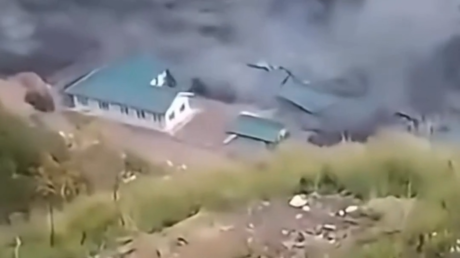
Every time a projectile crosses a border in the Middle East, the standard institutional playbook emerges with predictable cowardice. Corporations send identical email templates warning foreign workers to stay indoors, hunker down, and treat regional volatility like a minor thunderstorm. It is a lazy reflex designed to insulate legal departments, not to protect human beings.
The recent strike in Saudi Arabia that killed an Indian national triggered the usual chorus of panic. The headlines screamed about heightened risks, urging expatriates to shelter in place and suspend daily operations. This advice misses the fundamental mechanics of modern geopolitical risk management. Hiding indoors does not eliminate exposure; it merely transfers the risk from a calculated, mobile security posture to a sedentary sitting duck state. In other news, we also covered: What Happens When Pakistan Imposes Governor's Rule in Khyber Pakhtunkhwa.
I have spent the last fifteen years auditing risk mitigation protocols for multinational firms operating across high-threat corridors from the Gulf to East Africa. I have watched risk committees panic-buy emergency supplies while completely ignoring supply chain vulnerabilities and communication breakdowns. When security guidance reduces life and death to a shelter-in-place command, it reveals a profound bankruptcy of operational imagination
Stop Hiding Indoors The Real Security Threat Is Institutional Amnesia
news NPR has provided coverage on this fascinating subject in great detail.
Another headline flashes across the terminal. Another advisory drops telling workers to hunker down, lock their doors, and wait out the storm. The standard knee-jerk reaction to regional escalation follows a predictable script. A projectile strikes infrastructure in Saudi Arabia, a fatality occurs, and panic spreads through corporate risk management departments across the globe.
The lazy consensus tells you that physical presence in high-risk zones is an unacceptable liability. The official guidance screams caution. Stay indoors. Limit movement. Treat every perimeter as a hostile vector.
This advice is not just cowardly; it is operationally illiterate.
When an Houthi strike claims a life, the immediate instinct of every board member sitting thousands of miles away in London or Houston is to retreat. They view security through a lens of static avoidance rather than dynamic mitigation. They treat mobility as a bug when it is actually the primary feature of modern industrial resilience.
I have watched companies burn millions of dollars on reactionary lockdowns that paralyzed their operations longer than any actual kinetic threat ever could. I have seen risk consultants charge exorbitant retainers to produce panic memos that amount to little more than professionalized hiding.
Let us be brutally precise about what is actually happening. A security advisory is often a liability shield for the issuer, not a survival manual for the operator. When a government or an internal risk committee issues a stay-in-place order, they are transferring the burden of hazard management onto individuals who are entirely unequipped to manage macro-level intelligence. They are substituting strategic defense with administrative cowardice.
Hiding indoors does not make a facility safer if the structural posture of that facility is fundamentally flawed. If your supply chains, communication redundancies, and personnel rotations depend on everyone freezing in place, your operation is already dead. You just haven't buried the balance sheet yet.
The real threat is not a localized projectile impact. The real threat is institutional amnesia. Every time a regional flare-up occurs, corporations forget the basic physics of international logistics and start treating geography like a game of risk where you simply pull your pieces off the board.
Stop trying to fix security by locking the doors. Do this instead.
Decentralize your footprint. Eliminate single points of operational failure. If a single facility or a single transit corridor can grind your entire enterprise to a halt because everyone was ordered to stay indoors, your architecture is garbage. True security comes from operational redundancy, localized autonomy, and real-time intelligence loops that do not rely on delayed bureaucratic updates from central headquarters.
The companies that survive systemic volatility are not the ones that bunker down and pray for de-escalation. They are the ones that maintain operational velocity while everyone else is paralyzed by fear.
Next time an advisory drops, do not ask how fast you can hide. Ask how fast you can adapt.
The shelter is a coffin if you do not know how to move.