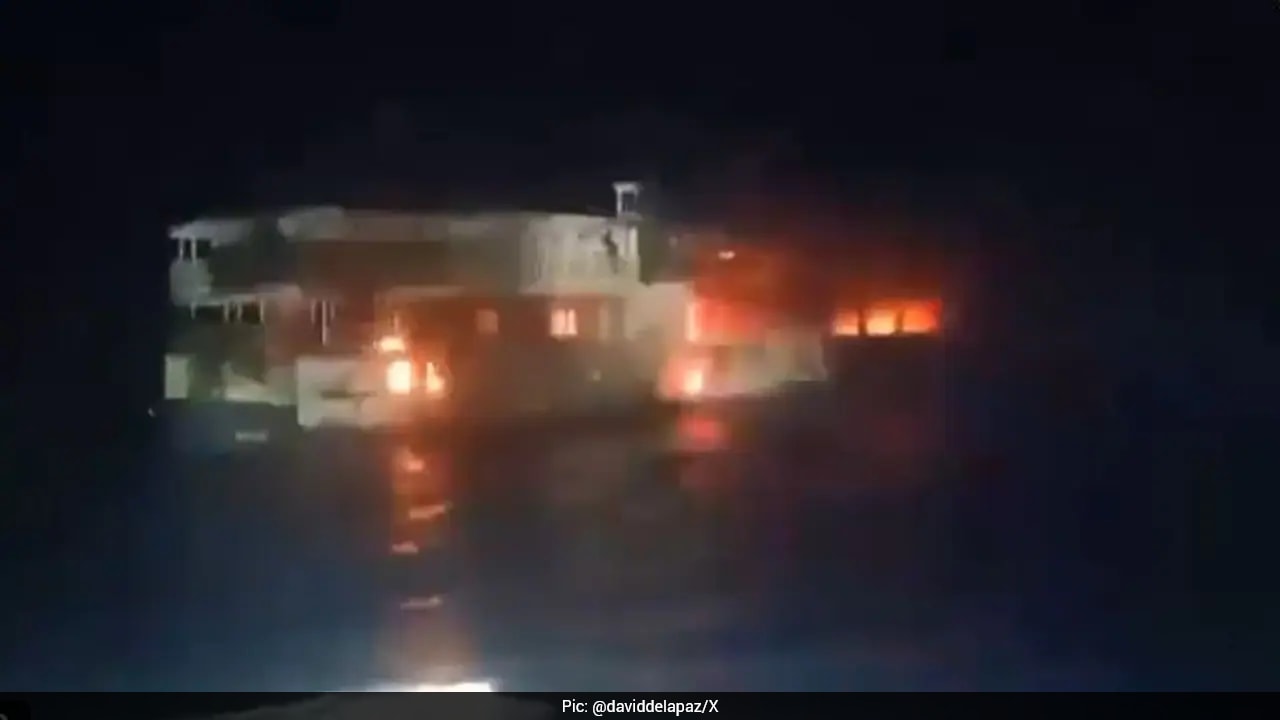
Maritime transportation safety in archipelagic states relies on systemic regulatory compliance, accurate manifest tracking, and rigorous onboard fire suppression protocols. When these variables fail simultaneously, catastrophic loss of life ensues, as demonstrated by the recent disaster involving the passenger ferry MV June Aster off the coast of Palawan. Examining the incident through an operational lens reveals how institutional drift, structural passenger reconciliation failures, and thermal propagation dynamics combine to turn standard commercial transits into disasters. Deconstructing this event requires analyzing three distinct vectors: manifest integrity vulnerabilities, onboard fire propagation mechanics, and systemic regulatory enforcement gaps.
The Manifest Integrity Deficit
Emergency response operations following an offshore fire depend entirely on immediate, high-fidelity data regarding personnel counts. In the case of the MV June Aster, official records indicated 117 passengers and 17 crew members, totaling 134 individuals on board. Initial rescue operations pulled 42 survivors from the water while confirming five fatalities, leaving an unaccounted deficit of 87 people. This statistical delta highlights a chronic vulnerability within domestic maritime logistics: the structural divergence between manifested counts and physical headcounts.
Informal ticketing practices, last-minute boarding, and cargo-deck passenger loading routinely bypass official terminal registration in inter-island transit hubs such as Manila's Baseco port. Consequently, incident commanders face an acute information vacuum during the initial hours of a search and rescue window. Without precise data on total occupants, rescue coordinators cannot calculate survival ratios, allocate search vectors using probability models, or confirm whether missing persons are trapped within submerged compartments, drifting in open water, or simply omitted from the baseline registry. This data distortion directly degrades the efficiency of maritime search architecture.
Thermal Propagation and Suppression Failure
A fire at sea constitutes a distinct engineering crisis characterized by rapid oxygen depletion, heavy smoke generation, and extreme structural heat transfer. When combustible materials ignite within enclosed or semi-enclosed passenger decks, the rate of thermal propagation quickly outpaces human response times unless automated suppression systems activate instantly. Visual evidence from the MV June Aster incident displayed total structural involvement, indicating a flashover event where radiant heat ignites all combustible surfaces simultaneously across entire compartments.
Several technical factors dictate how a localized ignition source escalates into total hull engulfment:
- Material Load: High concentrations of polymer-based furnishings, synthetic textiles, and passenger luggage create dense, toxic smoke that inhibits manual firefighting efforts long before flames reach structural bulkheads.
- Ventilation Dynamics: Open car decks or poorly compartmented passenger spaces act as wind tunnels, feeding oxygen directly into the combustion zone and accelerating fire spread across horizontal decks.
- Suppression Latency: Mechanical failure, inadequate water pressure, or delayed manual deployment of boundary cooling systems allows fires to breach primary fire-retardant barriers, neutralizing the vessel's internal compartmentalization strategy.
When these physical thresholds are breached, the ship transitions rapidly from a transport vehicle to a thermal hazard zone, forcing occupants into immediate abandon-ship scenarios under high-stress, low-visibility conditions.
Regulatory Enforcement and Economic Trade-Offs
The recurrence of major maritime incidents within the Philippine domestic ferry network points to structural misalignment between regulatory standards and economic incentives. Operating inter-island routes on thin margins creates commercial pressure to maximize passenger volume and minimize turnaround times. These operational pressures frequently manifest as deferred maintenance, compromised safety equipment inspection intervals, and lax oversight of hazardous cargo loading.
Regulatory oversight bodies face severe resource constraints when monitoring thousands of decentralized departure points spread across an expansive island chain. Enforcement mechanisms rely heavily on port-state control checks that often occur only at point of origin, leaving mid-voyage compliance unchecked. Furthermore, penalties for manifest violations or safety equipment deficiencies are frequently priced into operations as standard cost-of-business variables rather than existential deterrents.
To break this cycle of systemic failure, maritime authorities must transition from reactive post-incident investigations to preemptive algorithmic tracking. Mandating digital, biometric embarkation logging at all terminals will close the manifest integrity gap, ensuring rescue teams possess exact personnel metrics within minutes of a distress signal. Concurrently, linking route licensing directly to verified fire suppression system audits and independent structural integrity certifications will re-establish the baseline margins required for safe archipelagic transit.