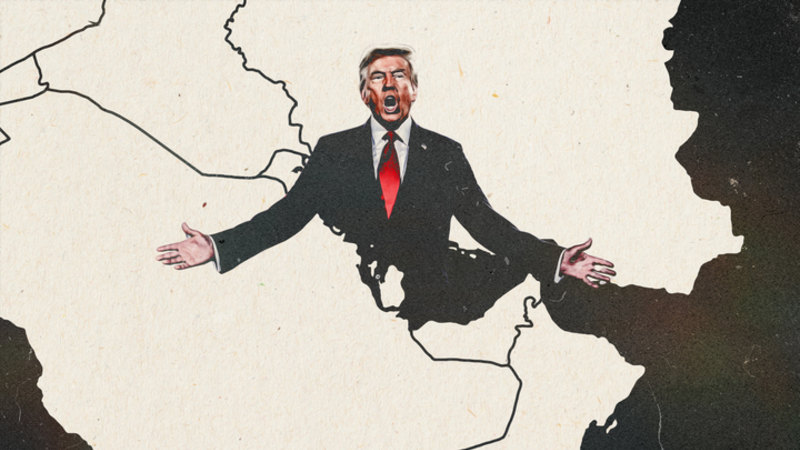
The shift in American foreign policy toward Iran is often analyzed through the lens of ideology or traditional realism, yet these frameworks fail to account for the primary driver of the current executive branch: the monetization of state influence. While conventional diplomacy assumes that states act to maximize national security or regional stability, a kleptocratic model operates on the maximization of private and factional rent-seeking. This fundamental shift in objective functions creates a paradoxical barrier to full-scale kinetic conflict. War, specifically a high-intensity conflict with Iran, introduces systemic volatility that threatens established rent-extraction networks, making "no-war" a more profitable state than "victory."
The Logic of the Extraction-Stabilization Equilibrium
In a standard geopolitical model, the threat of war is a tool used to achieve a diplomatic or territorial end. In an extraction-based administration, the threat of war is the product itself. The tension between Washington and Tehran serves as a mechanism to drive defense contracts, justify emergency procurement, and maintain a premium on regional energy security. However, the transition from the threat of war to actual war represents a catastrophic failure of this model.
Actual warfare destroys the predictability required for high-level kleptocracy. It reallocates capital from discretionary, easily skimmed projects toward "hard" military logistics where oversight—however minimal—increases due to the scale of the expenditure. Furthermore, war creates "black swan" risks for global markets, potentially devaluing the very assets the ruling elite seek to accumulate.
The Three Pillars of Kleptocratic Deterrence
The following variables dictate why a self-interested, rent-seeking executive branch avoids the "Total War" scenario:
- Asset Protection over Projection: The primary objective is the preservation of the domestic and international financial systems that facilitate the movement of private wealth. A war with Iran risks the closure of the Strait of Hormuz, through which roughly 20% of the world’s petroleum liquids pass. The resulting oil price shock would trigger a global recession, collapsing the equity markets that serve as the primary barometer of the administration’s "success."
- The Transactional Friction of Conflict: War requires a mobilization of the "Deep State"—the very bureaucracy a kleptocratic administration seeks to bypass or hollow out. To fight a war, the executive must empower the professional military and intelligence classes, thereby reducing the executive’s unilateral control over policy and patronage.
- Sanctions as a Revenue Tool: Sanctions are often viewed as a precursor to war. In a kleptocratic framework, sanctions are an end state. They create artificial scarcities and "gray markets." By controlling the exceptions, waivers, and enforcement levels of these sanctions, the administration creates a gatekeeper economy where access to the American market is sold to the highest bidder, whether that bidder is a foreign government or a multinational corporation.
The Cost Function of Kinetic Engagement
The decision to engage in war can be expressed as a calculation where the perceived benefits of regime change must outweigh the "Kleptocratic Opportunity Cost." This cost includes the loss of influence over existing trade partners and the potential for a populist backlash that could unseat the administration.
The formula for this engagement is $C_{war} > R_{p}$, where $C_{war}$ represents the systemic disruption to rent-seeking and $R_{p}$ represents the marginal gain in political or financial power from a conquered territory. In the case of Iran, a country with a sophisticated military apparatus and a population of 85 million, the value of $C_{war}$ is prohibitively high. Unlike the Iraq War, which offered the prospect of controlled oil fields, an Iran conflict offers only the prospect of a decades-long insurgency and the destruction of existing regional infrastructure.
The Mechanism of Strategic Incoherence
Observers often mistake the administration’s shifting rhetoric for a lack of strategy. On the contrary, strategic incoherence is a deliberate feature of a transactional foreign policy. By maintaining a state of "permanent brinkmanship," the administration maximizes its leverage over both allies and enemies.
- Allies are pressured to pay "protection money" in the form of increased defense spending and unfavorable trade concessions.
- Enemies are offered "deals" that are essentially payments for temporary de-escalation.
This creates a cycle of crisis and resolution, where each "resolution" is a transactional victory for the executive branch, while the underlying geopolitical tension remains unresolved. This tension is the battery that powers the entire influence-peddling machine.
Structural Bottlenecks in the Path to War
The move toward war is further constrained by the internal competition for resources within the administration. A kleptocracy is not a monolith; it is a collection of competing factions, each seeking to maximize their own extraction.
- The Mercenary Faction: Seeks localized, low-intensity conflicts that can be outsourced to private contractors. This group favors "special operations" and drone strikes over full-scale invasion.
- The Industrial Faction: Favors large-scale arms sales to regional proxies (e.g., Saudi Arabia, the UAE). This group actively lobbies against direct US involvement because a direct war would consume the inventory they intend to sell.
- The Financial Faction: Prioritizes the stability of the dollar and the global banking system. They view any disruption to the SWIFT system or Middle Eastern banking hubs as a threat to their core interests.
The friction between these factions creates a natural inertia. For a war to occur, all three factions would need to see a path to profit that exceeds the current status quo. As of 2026, no such path exists.
The Limits of Kleptocratic Peace
While the profit motive serves as a deterrent to war, it also creates a fragile and dangerous global environment. This "Kleptocratic Peace" is not based on international law or mutual respect, but on a temporary alignment of financial interests. It has three primary points of failure:
- Miscalculation through Hubris: A transactional leader may overestimate their ability to control the escalation ladder. If the administration pushes a "maximum pressure" campaign too far, Iran may feel it has nothing left to lose, triggering a conflict that the US executive never actually intended to fight.
- The Collapse of Proxy Control: Kleptocracies rely on proxies to do the "dirty work." However, proxies have their own agendas. If a regional ally decides that its own survival depends on a war between the US and Iran, it can manufacture a "false flag" or an unavoidable provocation.
- The "Going Out of Business" Sale: If the administration perceives that it will lose power in the next election cycle, the incentive structure shifts from long-term rent extraction to short-term "smash and grab." In this scenario, the long-term systemic risks of war become irrelevant to an executive looking to secure a final, massive payout or a distraction from domestic legal peril.
The Strategic Play: Navigating the Transactional Era
For institutional investors, regional governments, and corporate entities, the "Kleptocratic Peace" requires a pivot in risk assessment. Traditional metrics like "diplomatic progress" or "treaty compliance" are obsolete. Instead, one must track the flow of capital and the specific personnel changes within the executive branch.
The most reliable indicator of impending conflict is not the rhetoric of the Secretary of State, but the movement of private equity and the awarding of no-bid contracts in the logistics sector. If the administration begins to favor "long-cycle" military investments over "short-cycle" arms sales, the probability of kinetic engagement increases.
The second indicator is the "Sanction Pivot." When the administration begins to sanction the competitors of its own donors while granting waivers to its partners, it signals that the kleptocratic machine is functioning normally. War is only likely if this machine breaks down or if a competitor offers a "better deal" that requires the removal of the Iranian regime.
The optimal strategy for external actors is to become a necessary component of the administration's rent-seeking network. By ensuring that "peace" is more profitable than "war" for the individuals at the top of the US executive hierarchy, regional players can maintain a tenuous stability. This is a cynical, high-risk equilibrium, but it is the only one that aligns with the current operational reality of American power. The goal is not to solve the "Iran Problem," but to manage it as a permanent, profitable crisis.