Deep Water Secrets
Silence has a sound. Out in the middle of the Pacific Ocean, five miles above the Mariana Trench, that sound is a low, ceaseless hum. It is the noise of open air moving over thousands of miles of empty water, vast and indifference personified.
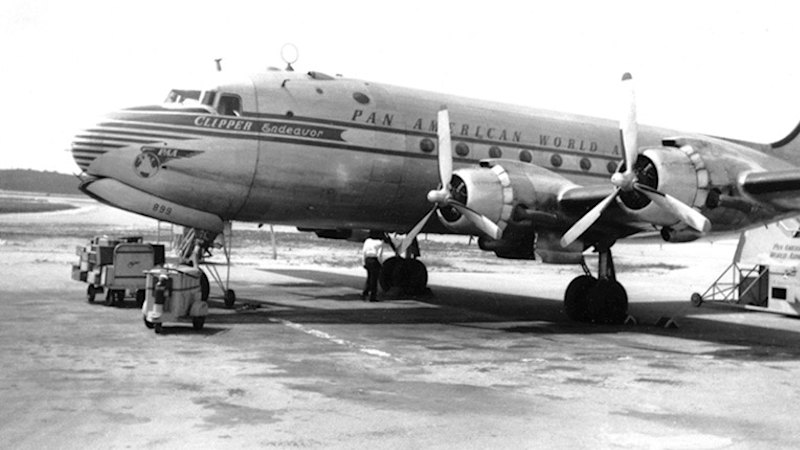
On March 16, 1962, a Military Air Transport Service flight designated as Pan Am Flight 739 moved through that silence. On board were 93 U.S. Army soldiers, three South Vietnamese military personnel, and an experienced civilian crew of eleven. They were heading to Saigon. They never arrived.
No distress call crackled through the headsets. No oil slick smoothed the choppy waves. No charred orange life rafts bobbed in the Pacific swell.
One moment, a radar screen in Guam held a steady green blip. The next, the screen was empty.
Decades passed. Entire wars ended, borders shifted, and the families of those ninety-seven men aged in quiet rooms filled with framed black-and-white photographs. For over sixty years, Pan Am 739 remained one of the most maddening mysteries in aviation history.
Until the mud finally gave up its secrets.
The Night the Sky Sparkled
To understand the weight of what was lost, you have to picture the cabin of that Lockheed L-1049 Super Constellation.
It was not a modern jetliner with sleek composite wings and whisper-quiet turbofans. The Super Constellation was a mechanical beast—four giant Wright R-3350 duplex-cyclone engines churning the air, vibrating through the floorboards, filling the cabin with a rhythmic, hypnotic roar.
Inside sat young men. Most were barely out of their teens, carrying canvas duffel bags, letter paper, and nervous energy. They were elite commando units, specialists in guerrilla tactics, sent on a secret mission before the American public fully understood what Vietnam would become.
They were brothers, husbands, and sons.
Late that night, a Liberian tanker named the T.L. Lenzen was cruising off the coast of Guam. The watch officer on deck looked up at the star-dusted sky and saw something that stopped him cold.
A flash. Bright, intense, and white.
Then, two distinct glowing vapor trails fell toward the ocean, drifting apart before disappearing into the black horizon. The tanker's crew logged the observation immediately. They turned their ship toward the area and searched for hours, staring into the dark with searchlights that swallowed themselves in the mist.
They found nothing.
When the military launched one of the largest search-and-rescue operations in Pacific history—scanning over 200,000 square miles of water—they found no debris. No floating cushions. No wreckage.
The ocean had closed its hand.
The Long Wait in the Dark
For sixty-four years, the story of Flight 739 was buried beneath administrative technicalities and forgotten casualty lists.
Because the aircraft was operated by a private airline under a military charter, and because the mission was classified, the names of the ninety-three American soldiers were not etched into the black granite of the Vietnam Veterans Memorial in Washington, D.C.
Think about that.
For the families left behind, the grief was doubled. There was no body to bury, no grave to visit, and no recognition on the wall that honored their fallen comrades.
Consider a hypothetical mother in Indiana, sitting on her porch in 1970. She watches the evening news, listening to the casualty counts from Da Nang and the Mekong Delta. She knows her son died in that same air space, yet his name exists in a kind of bureaucratic vault, marked neither as killed in action nor as a traditional peacetime accident.
That silence is heavy. It weighs on generations.
"You just live with a ghost," one relative recounted decades later. "You wonder if the plane broke apart, if they knew, or if it was over in a second."
A Voice from the Abyss
Technology eventually caught up with the mystery.
In recent years, deep-sea research vessels equipped with high-definition side-scan sonar and autonomous underwater vehicles began mapping the dark, abyssal plains of the Western Pacific. These are machines capable of withstanding crushing pressures—pressures that would flatten a steel pipe like a soda can—to photograph objects the size of a wrist watch thousands of feet down.
When expedition teams returned to the target grid identified by those long-ago coordinates from the T.L. Lenzen, the sonar sweeps began returning anomalies.
Not natural rock formations. Not volcanic basalt.
Linear edges. Right angles. Highly reflective metallic surfaces buried under decades of marine sediment.
"Oh God! That’s a plane!"
The exclamation broke through the quiet chatter of a research vessel's control room. On the monitors, rendered in stark neon-yellow sonar returns, lay the shattered spine of a large aircraft.
The engine nacelles, distinctive to the Wright Cyclone engines, rested in the silt. The triple-tail fin layout of the Super Constellation—an icon of mid-century aviation design—was clearly visible, half-drowned in gray sand.
It was Flight 739.
The Anatomy of a Disappearance
Finding the metal does more than satisfy curiosity; it reconstructs the final seconds of a forgotten tragedy.
Aviation forensic experts analyzing deep-water wrecks do not look for simple answers. They look for patterns of destruction. The dispersion field of the debris—how far the pieces fell from one another—tells a story.
When an aircraft suffers a structural failure or an mid-air explosion at high altitude, the light pieces drift far away, while the heavy engines plunge straight down. The sonar mapping of the Pan Am wreckage confirmed what the crew of the T.L. Lenzen saw in 1962.
The aircraft had suffered a sudden, catastrophic breakup at 18,000 feet.
There was no time to send a Mayday. No time to buckle life vests. In less time than it takes to read this sentence, the cabin lost pressure, the night air rushed in, and ninety-seven souls were swallowed by the Pacific.
Was it a mechanical failure? Engine fires on the Super Constellation were notorious, sometimes burning through wing spars if unextinguished. Was it a bomb? Sabotage was quietly investigated by the FBI at the time, given the covert nature of the mission, though no conclusive evidence was ever published.
The physical wreckage, resting in the deep, holds those answers. Modern oceanography and underwater forensics are now working to piece together the mechanical autopsy.
Beyond the Metal
It is easy to get lost in the engineering of a recovery. We talk about dynamic positioning systems, remotely operated vehicles, and titanium pressure hulls. We discuss engine displacement and radar vectors.
But the discovery of Pan Am Flight 739 is not a victory of technology. It is a debt paid to memory.
For six decades, ninety-seven families carried a secret weight. They were told their loved ones were gone, but the absence of a physical crash site left a permanent, unclosed loop. The discovery of the wreck brings an end to the speculation, the wild theories, and the quiet doubt that haunts those who lose someone without a trace.
Efforts are now underway to ensure that the names of the men aboard Flight 739 are finally recognized where they belong. Petitions have reached Congress. The data from the ocean floor provides the undeniable proof required by military archivists to update the historical record.
The Pacific is vast, cold, and unforgiving. It holds thousands of stories in its depths, wrapped in corrosion and silt. But every now and then, a light shines down into the dark, and a forgotten flight finally comes home.